Buoyancy, Flotation & Metacentric Height Stability
In this chapter (4 topics)
On this page
- 1. Topic Metadata & Syllabus Mapping
- 2. Executive Summary & Core Engineering Concepts
- 3. Archimedes' Principle & Center of Buoyancy
- 3.1 Mathematical Derivation of Archimedes' Principle
- 3.2 Flotation & Immersion Draft of Prismatic Bodies
- 4. Equilibrium and Stability of Submerged Bodies
- Stability Conditions for Submerged Bodies
- 5. Equilibrium and Stability of Floating Bodies & Metacentric Height (GM)
- 5.1 Definition of the Metacenter (M)
- 5.2 Analytical Derivation of BM = fracIforalldisp
- 5.3 Formulation of Metacentric Height (GM)
- 5.4 Stability Criteria for Floating Bodies
- 6. Dynamic Roll Oscillations & The Inclining Experiment
- 6.1 Derivation of Rolling Period (T)
- 6.2 The Naval Architecture Trade-Off: "Stiff" vs "Tender" Ships
- 6.3 The Inclining Experiment (Full-Scale Sea Trials)
- 7. Complete Mathematical Formulations & Derivations Summary
- 8. Visual Architectural Diagrams
- Diagram 1: Buoyancy, Flotation & Submerged vs Floating Stability
- Diagram 2: Metacentric Height Derivation & Dynamic Ship Stability
- 9. Worked Numerical Problems
- Problem 1: Rectangular Pontoon Metacentric Height & Restoring Couple (GATE / ESE Standard)
- Problem 2: Vertical Flotation Stability Limit for a Solid Cylinder (ESE Standard)
- Problem 3: Ship Rolling Period and Cargo Transverse Shift (GATE Standard)
- 10. Common Traps, Fallacies & Edge Cases
- Trap 1: Applying the Submerged Body Stability Rule to Floating Vessels
- Trap 2: Using the Wrong Axis for Waterline Moment of Inertia
- Trap 3: Neglecting Free Surface Effect of Liquid Cargo
- Trap 4: Assuming a Larger Metacentric Height is Always Desirable
- 11. Multi-Exam Multi-Choice & Conventional Practice Set
- Q1. GATE CE (1 Mark) — Floating Body Stability Criterion
- Q2. UPSC ESE (Paper-II) — Analytical Metacentric Radius
- Q3. SSC JE — Submerged Body Equilibrium
- Q4. State AE — Rolling Period Relationship
- Q5. RRB JE — Inclining Experiment Formula
- 12. Cross-Subject Synthesis & Practical Field Applications
- 1. Structural & Geotechnical Engineering: Bridge Pier Open Caissons
- 2. Offshore Engineering: Semi-Submersible Oil Drilling Rigs
- 3. Transportation & Harbor Engineering: Floating Dry Docks
- 13. Comprehensive Summary & Formula Cheatsheet
- Quick Revision Cards
- References & Standard Codes
1. Topic Metadata & Syllabus Mapping
| Field | Description / Value |
|---|---|
| Topic ID | FM-02-03 |
| Module Title | Buoyancy, Flotation & Metacentric Height Stability |
| Primary Subject | Fluid Mechanics & Hydraulic Machinery |
| Parent Chapter | Chapter 02: Fluid Statics & Manometry |
| GATE CE Mapping | Buoyancy and Flotation: Archimedes' principle, center of buoyancy, metacentric height, stability of floating and submerged bodies. |
| UPSC ESE Mapping | Paper-II Fluid Mechanics: Buoyant force, center of buoyancy, metacenter and metacentric height, analytical derivation of , stability criteria, dynamic roll oscillation period, inclining experiment. |
| SSC JE / RRB JE | Archimedes' principle, conditions of equilibrium of floating and submerged bodies, definition of metacentric height, calculation of draft. |
| Core Competencies | 1. Calculate draft and immersion depth using Archimedes' principle. 2. Differentiate between stability criteria of submerged vs floating bodies. 3. Rigorously derive and from first principles. 4. Determine the natural time period of rolling oscillations and analyze the stiff vs tender ship design trade-off. 5. Compute experimental from full-scale inclining tests. |
2. Executive Summary & Core Engineering Concepts
When a body is wholly or partially immersed in a static fluid, it experiences a net vertically upward hydrostatic force termed the buoyant force (). Discovered by Archimedes of Syracuse (c. 287–212 BCE), this upward force arises because fluid pressure increases with depth; the upward pressure forces acting against the underside of the body exceed the downward pressure forces acting against the top. Archimedes' Principle states:
Any body completely or partially submerged in a fluid is buoyed up by a force equal to the weight of the fluid displaced by the body (), and this force acts vertically upward through the centroid of the displaced fluid volume, termed the Center of Buoyancy ().
The fundamental engineering challenge lies in equilibrium stability—the capacity of a submerged or floating vessel (such as a submarine, ship, bridge caisson, offshore oil platform, or weather balloon) to generate a self-restoring righting couple when disturbed by wind, waves, or cargo shifts.
Crucially, submerged bodies and floating bodies obey entirely distinct stability mechanisms:
- Submerged Bodies: The shape of the displaced fluid volume remains invariant regardless of tilt. Consequently, the center of buoyancy is fixed relative to the body. Stability requires the Center of Gravity () to lie strictly below the Center of Buoyancy (). If is above , any tilt produces an overturning couple that capsizes the body.
- Floating Bodies: As the body tilts, its submerged geometry changes dynamically: a triangular wedge of fluid emerges on the raised side, while an identical wedge is submerged on the depressed side. This lateral redistribution of displaced fluid shifts the center of buoyancy from to a new position . The vertical line of action of the buoyant force through intersects the original vertical axis of symmetry at a point termed the Metacenter ().
- A floating body is in stable equilibrium if lies strictly above (), even if the center of gravity is located far above the center of buoyancy !
- The distance is termed the Metacentric Height. The analytical expression for metacentric radius is: Where is the second moment of area of the waterline plane about the longitudinal rolling axis.
3. Archimedes' Principle & Center of Buoyancy
3.1 Mathematical Derivation of Archimedes' Principle
Consider an arbitrary solid body of total volume submerged in a static fluid of uniform density . Let an infinitesimal vertical cylinder of horizontal cross-sectional area extend through the body from its upper surface at depth to its lower surface at depth .
                 Free Surface (p = 0 gauge)
       +--------------------------------------------+
       |                  |                         |
    h1 |                  v p1 = ρf g h1            |
       |               +-----+                      |
       |               |     |                      |
       |            dz | d∀  | Solid Body           |
       |               |     |                      |
    h2 |               +-----+                      |
       |                  ^ p2 = ρf g h2            |
       +--------------------------------------------+
- Downward normal force on upper surface:
- Upward normal force on lower surface:
- Net vertical buoyant force on the cylinder:
Since , the volume of the infinitesimal vertical fluid column displaced by the solid:
Integrating over the entire displaced volume :
- Point of Application: The line of action of passes through the centroid of the displaced volume , denoted as the Center of Buoyancy ():
3.2 Flotation & Immersion Draft of Prismatic Bodies
For a body floating freely in static equilibrium, vertical force balance requires:
For a prismatic rectangular pontoon of length , width , and total height , floating with draft :
- Center of Buoyancy location above base :
- Center of Gravity location for homogeneous body:
- Distance between and :
4. Equilibrium and Stability of Submerged Bodies
For a completely submerged body (such as a submarine, submersible, or hot-air balloon), the volume and shape of displaced fluid never change when the body rotates. Consequently, the center of buoyancy remains fixed relative to the body's geometric frame.
       STABLE                    NEUTRAL                  UNSTABLE
    (B above G)                (B ≡ G)                  (G above B)
        ^ F_B                      ^ F_B                     ^ F_B
        |                          |                         |
       [B]                       [B ≡ G]                    [G]
        |                          |                         |
       [G]                         v W                      [B]
        v W                                                  v W
  Restoring Couple          Zero Restoring Couple      Overturning Couple
Stability Conditions for Submerged Bodies
- Stable Equilibrium ( strictly above ): When tilted by an angle , the upward buoyant force at and downward weight at form a restoring couple: This couple rotates the body in the direction opposite to , restoring it to its upright equilibrium.
- Neutral Equilibrium ( coincides with , ): and remain collinear for any angle of tilt. No couple is generated (). The body remains at rest in whatever orientation it is placed.
- Unstable Equilibrium ( strictly above ): When tilted by an angle , and produce an overturning couple in the same direction as : This couple amplifies the disturbance, causing the body to capsize until swings beneath .
Practical Design Rule for Submarines & Aerostats: Submerged vehicles must always maintain below . In submarines, heavy components (lead keel ballast, battery banks, drive motors) are concentrated in the bottom bilge, while buoyant air tanks and light fairings are positioned at the top. In airships and hot air balloons, the heavy gondola and passengers hang beneath the buoyant gas envelope.
5. Equilibrium and Stability of Floating Bodies & Metacentric Height ()
In floating bodies, is almost always located above () because the upper superstructure extends well above the waterline. Despite being above , ships and boats float stably without capsizing. This is made possible by the concept of the Metacenter ().
5.1 Definition of the Metacenter ()
The Metacenter () is defined as the point of intersection between the vertical line of action of the buoyant force through the shifted center of buoyancy (in the tilted state) and the original vertical axis of symmetry passing through and (in the upright state).
The distance between the center of gravity and the metacenter is defined as the Metacentric Height ():
               Original Axis of Symmetry
                        |
                        v
                       (M)  <--- Metacenter
                        |
                        | GM (Metacentric Height)
                        |
                       (G)  <--- Center of Gravity (W acts down)
                        |
                        | BG
                        |
                 (B)----+-----> (B') <--- Shifted Center of Buoyancy
                 Original        |        (F_B acts vertically up)
                                 ^
5.2 Analytical Derivation of
Consider a floating ship of displacement volume tilted through an infinitesimal angle about its longitudinal centerline axis:
-
As the vessel tilts through angle , the waterline plane tilts relative to the hull.
-
On the depressed side, an additional wedge of fluid of volume is submerged.
-
On the raised side, an identical wedge of volume emerges from the water.
-
For an elemental strip of the waterline plane of width , length , located at transverse distance from the centerline axis:
- Height of the wedge: (for small angles).
- Elemental volume of the wedge:
-
Moment of this transferred volume of fluid about the longitudinal tilting axis:
Where:
is the second moment of area (moment of inertia) of the waterline plane (plan view at water surface) about the longitudinal axis of tilting.
-
By the principle of moments, the shift in the center of buoyancy from to multiplied by the total displaced volume must equal the moment of the transferred wedges:
-
From the right-angled triangle :
-
Equating the two expressions for :
Dividing throughout by :
Where:
- is termed the Metacentric Radius ().
- is the second moment of area of the waterline plane about the longitudinal rolling axis (). For a rectangular waterline of length and beam :
- is the total submerged volume of liquid displaced ().
5.3 Formulation of Metacentric Height ()
From the vertical geometry along the centerline axis of the hull:
Where:
- is the vertical height of the center of gravity above the keel/base ().
- is the vertical height of the center of buoyancy above the keel/base ().
- is the vertical distance between and .
5.4 Stability Criteria for Floating Bodies
| Condition | Metacenter Position | Restoring Couple () | Equilibrium State | Physical Behavior |
|---|---|---|---|---|
| lies strictly ABOVE | Positive (Restoring) | STABLE | Vessel rights itself automatically when disturbed. | |
| COINCIDES with | Zero () | NEUTRAL | Vessel remains at rest in newly tilted position. | |
| lies strictly BELOW | Negative (Overturning) | UNSTABLE | Overturning moment amplifies roll until vessel capsizes. |
6. Dynamic Roll Oscillations & The Inclining Experiment
6.1 Derivation of Rolling Period ()
When a stable floating vessel () is deflected by angle and released, the restoring couple acts to restore equilibrium:
For small angles of roll (, ):
By D'Alembert's principle / Newton's second law for rotation about the rolling axis:
Where is the mass moment of inertia of the vessel including entrained water, expressed in terms of the radius of gyration :
Substituting into the differential equation of motion:
Dividing throughout by :
This is the canonical equation of Simple Harmonic Motion (), with natural angular frequency:
The natural Time Period of Rolling () is:
6.2 The Naval Architecture Trade-Off: "Stiff" vs "Tender" Ships
The rolling period equation reveals a fundamental conflict in naval architecture:
- Large ("Stiff Ship", ):
- Advantage: Enormous righting moment, highly resistant to capsizing under extreme gale winds or damage flooding.
- Disadvantage: Very short rolling period (). The ship snaps back violently to upright, causing extreme racking stresses on hull frames, cargo shifting, and severe seasickness among crew and passengers.
- Applications: Warships, aircraft carriers, tugboats, open ocean barges.
- Small ("Tender Ship", ):
- Advantage: Long, gentle rolling period (). Smooth, comfortable motions with low structural accelerations.
- Disadvantage: Small margin of safety against dynamic capsizing in heavy beam seas or when cargo shifts.
- Applications: Luxury passenger cruise liners, ocean passenger ferries.
6.3 The Inclining Experiment (Full-Scale Sea Trials)
The actual metacentric height of a completed ship is measured empirically through the Inclining Experiment:
- A movable test weight is shifted transversely across the deck through a measured distance .
- This creates an applied heeling moment:
- The ship tilts through a small angle , measured using a long plumb line of length suspended inside a hold, deflecting by a horizontal distance :
- In the tilted static equilibrium, the heeling moment equals the restoring moment:
- Solving for :
Where is the total displacement weight of the ship determined from measured draft marks and hydrostatic tables.
7. Complete Mathematical Formulations & Derivations Summary
| Parameter | Governing Formula | Key Physical Variables |
|---|---|---|
| Buoyant Force | : Liquid density, : Submerged volume | |
| Flotation Equilibrium | : Specific gravities of body and fluid | |
| Prismatic Pontoon Draft | : Total pontoon height, : Submerged depth | |
| Metacentric Radius | : Waterline area moment of inertia about roll axis | |
| Metacentric Height | : Height of , : Height of () | |
| Restoring Couple | : Heel angle in radians | |
| Rolling Oscillation Period | : Radius of gyration of ship about roll axis | |
| Inclining Test | : Test weight, : Shift distance, : Plumb length | |
| Cylinder Vertical Stability | : Cylinder length, : Diameter, : Specific gravity |
8. Visual Architectural Diagrams
Diagram 1: Buoyancy, Flotation & Submerged vs Floating Stability
The following diagram illustrates Archimedes' principle, draft calculation, stability states of submerged bodies ( vs ), and stability states of floating bodies ( vs ):
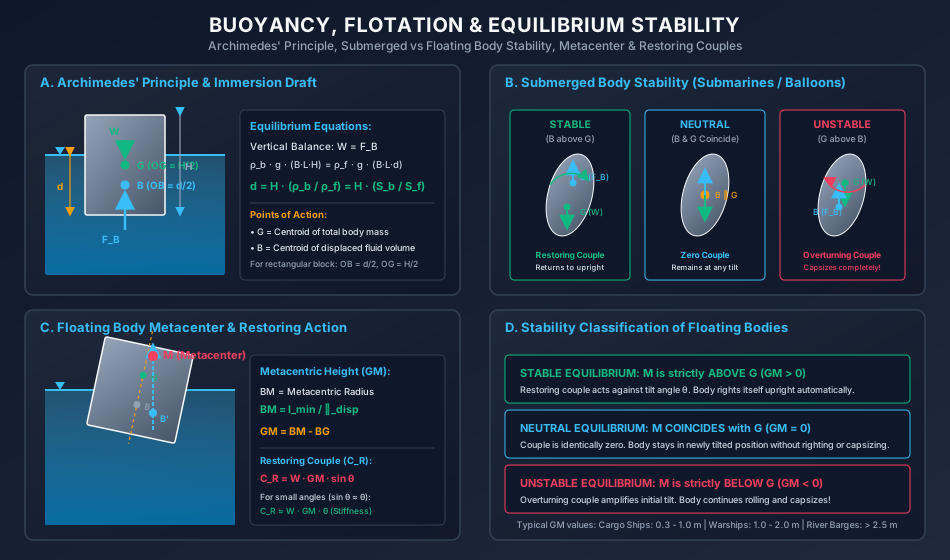
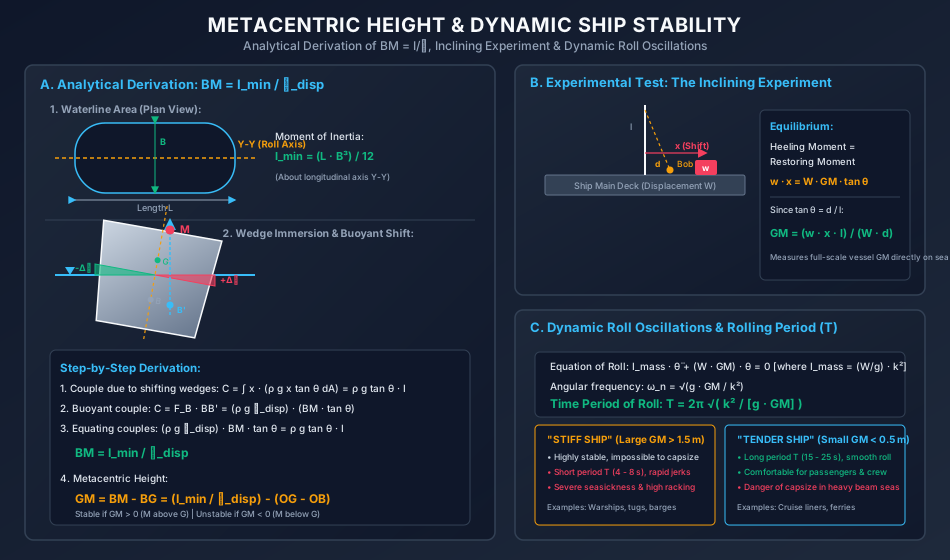
Diagram 2: Metacentric Height Derivation & Dynamic Ship Stability
The following diagram demonstrates the analytical derivation of via shifting fluid wedges, the naval inclining experiment, and harmonic roll oscillations:
9. Worked Numerical Problems
Problem 1: Rectangular Pontoon Metacentric Height & Restoring Couple (GATE / ESE Standard)
Statement: A rectangular pontoon of length , width , and depth floats in seawater of density . The total weight of the pontoon including deck equipment is . The center of gravity of the loaded pontoon is located at above the base. Take .
- Compute the depth of immersion (draft ) and the location of the center of buoyancy .
- Compute the metacentric radius and the metacentric height .
- State whether the pontoon is in stable equilibrium for rolling motions.
- Calculate the restoring couple developed when the pontoon is heeled through an angle of .
Solution:
Part 1: Draft and Center of Buoyancy :
- Weight of pontoon:
- By Archimedes' principle:
- Submerged draft :
- Height of center of buoyancy above the bottom base :
- Distance between center of buoyancy and center of gravity: (Note: is above )
Part 2: Metacentric Radius and Metacentric Height :
- The critical rolling axis is the longitudinal axis (tilting about width ).
- Second moment of area of the waterline plane about the longitudinal rolling axis:
- Metacentric radius:
- Metacentric height:
Part 3: Stability Assessment: Since , the metacenter lies above the center of gravity .
Part 4: Restoring Couple at :
Problem 2: Vertical Flotation Stability Limit for a Solid Cylinder (ESE Standard)
Statement: A solid circular cylinder of diameter , length , and specific gravity floats in water ().
- Derive the general algebraic condition for the cylinder to float vertically in stable equilibrium in terms of and .
- For the given specific gravity , find the maximum allowable value of for which the cylinder will float vertically upright without tilting over.
Solution:
Part 1: General Stability Derivation:
- Let the cylinder float vertically with immersion draft .
- By Archimedes' principle:
- Height of center of buoyancy from base:
- Height of center of gravity from base:
- Distance between and :
- Second moment of area of the circular waterline plane:
- Displaced volume of water:
- Metacentric radius:
- Condition for stable vertical flotation (): Dividing by :
Part 2: Evaluation for :
Physical Conclusion: A solid wooden log with can float vertically upright only if its length is less than of its diameter (). Any longer cylinder (such as a standard tree trunk where ) is unstable upright and will inevitably capsize and float horizontally on its side!
Problem 3: Ship Rolling Period and Cargo Transverse Shift (GATE Standard)
Statement: A container cargo ship of displacement () has a metacentric height of . The radius of gyration of the ship about its longitudinal rolling axis is . Take .
- Compute the natural time period of rolling oscillations and the rolling frequency in cycles per minute.
- During cargo loading, heavy containers are relocated higher on the upper deck such that the overall center of gravity rises by . Calculate the new metacentric height and the new rolling period .
Solution:
Part 1: Initial Rolling Period:
- Formula for rolling period:
- Substituting values:
- Rolling frequency:
Part 2: Cargo Shift & New Rolling Period:
-
When cargo is shifted upward, the center of gravity rises:
-
Because the total displacement weight and hull geometry are unchanged, and remain in their exact original locations.
-
New metacentric height:
-
New rolling period:
-
Observation: Raising the center of gravity reduced the metacentric height from to (a reduction in stiffness), lengthening the rolling period from to (). The ship becomes more "tender," providing a gentler roll but operating with a reduced margin of capsize stability.
10. Common Traps, Fallacies & Edge Cases
Trap 1: Applying the Submerged Body Stability Rule to Floating Vessels
- The Fallacy: Assuming that a ship with its center of gravity above the center of buoyancy () must be unstable and will capsize.
- The Physical Reality: Submerged bodies require above . However, floating bodies do not require above . A floating body is stable as long as the metacenter is above (). In nearly all merchant ships, is well above .
Trap 2: Using the Wrong Axis for Waterline Moment of Inertia
- The Fallacy: Using the transverse pitch axis inertia () instead of the longitudinal roll axis inertia () in .
- The Physical Reality: Stability must be verified against the minimum moment of inertia (). Since for ships, . Rolling about the longitudinal axis represents the weakest stability mode and the primary mode of capsizing.
Trap 3: Neglecting Free Surface Effect of Liquid Cargo
- The Fallacy: Calculating metacentric height assuming liquid fuel or water ballast tanks inside a ship act as solid weights.
- The Physical Reality: Liquids in partially filled tanks slosh to the low side as the ship heels, shifting their center of gravity in the direction of tilt. This causes a virtual rise in the ship's center of gravity: This "Free Surface Correction" severely degrades and has caused numerous historical capsizes. Modern ships install longitudinal swash bulkheads to subdivide tanks.
Trap 4: Assuming a Larger Metacentric Height is Always Desirable
- The Fallacy: Believing that maximizing () creates an ideal ship.
- The Physical Reality: Excessive creates an overly "stiff" ship with an uncomfortably short rolling period (). Violent accelerations rip cargo lashings, fracture mast stays, and cause debilitating seasickness.
11. Multi-Exam Multi-Choice & Conventional Practice Set
Q1. GATE CE (1 Mark) — Floating Body Stability Criterion
Question: A floating body is in stable equilibrium when:
- (A) The center of buoyancy is above the center of gravity .
- (B) The center of gravity is above the metacenter .
- (C) The metacenter is above the center of gravity .
- (D) The metacenter coincides with the center of buoyancy .
Solution: For a floating body, the restoring couple is . A positive restoring couple that returns the body to upright requires to lie strictly above (). Correct Answer: (C)
Q2. UPSC ESE (Paper-II) — Analytical Metacentric Radius
Question: The distance between the center of buoyancy and the metacenter of a floating body is given by:
- (A)
- (B)
- (C)
- (D)
Solution: From the moment of shifting fluid wedges: , where is the second moment of area of the waterline plane about the axis of rotation, and is the displaced fluid volume. Correct Answer: (B)
Q3. SSC JE — Submerged Body Equilibrium
Question: A completely submerged submarine is in neutral equilibrium when:
- (A) The metacenter is at the water surface.
- (B) The center of buoyancy is above the center of gravity.
- (C) The center of buoyancy and center of gravity coincide.
- (D) The buoyant force is greater than the total weight.
Solution: For a fully submerged body, neutral equilibrium occurs when any angular displacement produces zero couple, which requires the center of gravity and center of buoyancy to coincide exactly (). Correct Answer: (C)
Q4. State AE — Rolling Period Relationship
Question: The time period of rolling oscillation of a ship is:
- (A) Directly proportional to
- (B) Inversely proportional to
- (C) Directly proportional to
- (D) Inversely proportional to
Solution: The natural rolling period is . Correct Answer: (B)
Q5. RRB JE — Inclining Experiment Formula
Question: In an inclining experiment conducted on a ship of total displacement , a weight is moved across the deck by a distance , producing a heel angle . The metacentric height is:
- (A)
- (B)
- (C)
- (D)
Solution: Equating the applied heeling moment to the restoring moment:
Correct Answer: (B)
12. Cross-Subject Synthesis & Practical Field Applications
1. Structural & Geotechnical Engineering: Bridge Pier Open Caissons
In major river bridge construction, massive reinforced concrete open well caissons are cast on land or barges, floated into position, and sunk to bedrock. During the floating towing phase, the caisson acts as a floating body. Engineers must verify that across all draft stages to prevent catastrophic capsize during river transit.
2. Offshore Engineering: Semi-Submersible Oil Drilling Rigs
Semi-submersible drilling platforms utilize large underwater buoyant pontoons connected to the operating deck via slender vertical columns. This configuration minimizes the waterline area , significantly lengthening the natural heave and roll period () to avoid resonance with typical ocean wave periods ().
3. Transportation & Harbor Engineering: Floating Dry Docks
Floating dry docks raise massive commercial ships out of water by pumping out ballast water from internal wing wall tanks. During lifting, as the ship's keel leaves the water, the combined center of gravity rises sharply, demanding precise ballasting control to maintain positive metacentric height ().
13. Comprehensive Summary & Formula Cheatsheet
Quick Revision Cards
================================================================================
               BUOYANCY, FLOTATION & METACENTRIC HEIGHT CHEATSHEET
================================================================================

1. ARCHIMEDES' PRINCIPLE & DRAFT:
   - Buoyant force: F_B = ρ_f g ∀_disp  (Acts upward through centroid B)
   - Flotation:     W = F_B  -->  ∀_disp = ∀_total (S_body / S_fluid)
   - Prismatic:     Draft d = H (S_body / S_fluid),  OB = d / 2,  OG = H / 2

2. SUBMERGED BODY STABILITY:
   - STABLE:   B strictly ABOVE G  (Restoring couple C_R = W · BG sin θ)
   - NEUTRAL:  B coincides with G (BG = 0)
   - UNSTABLE: G strictly ABOVE B  (Overturning couple capsizes body)

3. FLOATING BODY STABILITY (METACENTER M):
   - Metacentric radius: BM = I_min / ∀_disp
   - For rectangular:    I_min = (L · B³) / 12  (About longitudinal roll axis)
   - Metacentric height: GM = BM - BG = (I_min / ∀_disp) - (OG - OB)
   - STABLE:   M strictly ABOVE G  (GM > 0)
   - NEUTRAL:  M coincides with G (GM = 0)
   - UNSTABLE: M strictly BELOW G  (GM < 0)

4. DYNAMIC ROLLING OSCILLATIONS:
   - Equation of motion: (W/g k²) θ̈ + (W · GM) θ = 0
   - Rolling Period:     T = 2π √( k² / [g · GM] )   -->  T ∝ 1 / √(GM)
   - Stiff Ship:   Large GM, small T (Rapid, jerky, seasickness, high fatigue)
   - Tender Ship:  Small GM, long T  (Slow, gentle, passenger comfort, capsize risk)

5. INCLINING EXPERIMENT (SEA TRIALS):
   - GM = (w · x · l) / (W · d_plumb)
================================================================================
References & Standard Codes
- Streeter, V. L., Wylie, E. B., and Bedford, K. W., Fluid Mechanics, 9th Edition, McGraw-Hill, New York.
- White, F. M., Fluid Mechanics, 8th Edition, McGraw-Hill Education, 2016.
- Modi, P. N., and Seth, S. M., Hydraulics and Fluid Mechanics Including Hydraulics Machines, Standard Book House, New Delhi.
- Lewis, E. V., Principles of Naval Architecture (Volume I: Stability and Strength), Society of Naval Architects and Marine Engineers (SNAME).
- IS 4410 (Part 15/Sec 1):1973, Glossary of Terms Relating to River Valley Projects, Bureau of Indian Standards.