Soil Structure, Clay Mineralogy, Activity, Sensitivity & Thixotropy
In this chapter (8 topics)
On this page
- 1. Topic Metadata & Syllabus Anchors
- 2. Executive Summary & Micro-Structural Physics of Soils
- 2.1 Gravitational vs. Electrochemical Surface Forces
- 3. Soil Fabric & Structural Types
- 3.1 Single-Grained Structure (Coarse Sand & Gravel)
- 3.2 Honeycomb Structure (Fine Sands & Coarse Silts, 0.002 - 0.02 mm)
- 3.3 Flocculated Structure (Marine & Saline Clays)
- 3.4 Dispersed Structure (Freshwater & Remolded Clays)
- 4. Clay Mineralogy & Crystal Lattice Architecture
- 4.1 The Fundamental Structural Building Sheets
- 4.2 The Three Primary Clay Mineral Groups
- 4.3 Isomorphous Substitution & Electrical Surface Charge
- 4.4 The Gouy-Chapman Diffuse Double Layer (DDL)
- 5. Diagnostic Engineering Indices & Special Soil Phenomena
- 5.1 Skempton's Activity of Clay (A)
- 5.2 Sensitivity of Clays (St)
- 5.3 Thixotropy
- 5.4 Expansive Soils & Indian Black Cotton Soils
- 6. Rigorous Analytical Derivations & Mathematical Proofs
- 6.1 Derivation 1: Void Ratios and Porosities for Ideal Spherical Soil Packings
- 7. Visual Vector Graphics & Engineering Schematics
- 7.1 Clay Mineralogy Crystal Lattices & Diffuse Double Layer
- 7.2 Soil Fabric Structures, Activity Chart & Sensitivity Mechanics
- 8. Laboratory Testing Protocols & Standards
- 8.1 Sensitivity Determination Test (IS 2720 Part 10)
- 8.2 Free Swell Index Test (IS 2720 Part 40)
- 9. Step-by-Step Pre-Calculated Numerical Examples
- Problem 1: Ideal Uniform Sand Packing & Densification Limits
- Problem 2: Skempton's Activity, Mineral Identification & Black Cotton Soil
- Problem 3: Sensitivity, Remolding & Thixotropic Strength Regain
- 10. Common Exam Traps, Failure Modes & Field Gotchas
- The 5 Critical Traps in Clay Mineralogy & Fabric Mechanics
- 11. Multi-Exam Targeted Practice Questions
- Question 1 (GATE CE Computational)
- Question 2 (UPSC ESE Conventional - 10 Marks)
- Question 3 (SSC JE Rapid Recall)
- Question 4 (State AE Objective)
- Question 5 (RRB JE Technical)
- 12. Reference Standards & Authoritative Handbooks
1. Topic Metadata & Syllabus Anchors
| Attribute | Specification |
|---|---|
| Topic ID | GEOTECH-01-03 |
| Subject Module | Subject 09: Geotechnical Engineering & Foundation Engineering |
| Chapter | Chapter 01: Soil Nature, Three-Phase Relationships & Volumetric-Gravimetric Properties |
| GATE CE Syllabus | Soil structure and fabric; clay mineralogy (Kaolinite, Illite, Montmorillonite), diffuse double layer; Activity, Sensitivity, Thixotropy |
| UPSC ESE Syllabus | Paper-II Section D (Geo-technical Engineering): Soil structure, clay minerals and their crystal lattices, diffuse double layer, cation exchange capacity, activity of clays, sensitivity and thixotropy of cohesive soils |
| SSC JE / RRB JE / State AE | Soil structure types (single-grained, honeycomb, flocculated, dispersed), clay minerals, Kaolinite vs Montmorillonite, Black Cotton soil behavior, definition of sensitivity and activity |
| Primary Codes & Standards | IS 2720 (Part 10): 1991 – Determination of Unconfined Compressive Strength and Sensitivity; IS 2720 (Part 40): 1977 – Determination of Free Swell Index of Soils; IS 1498: 1970 – Classification of Soils |
| Master Note Path | notes/geotechnical_engineering/01_soil_mechanics/03_soil_structure_clay_mineralogy.md |
2. Executive Summary & Micro-Structural Physics of Soils
2.1 Gravitational vs. Electrochemical Surface Forces
The macroscopic engineering behavior of any soil deposit (its compressibility under building foundations, shear strength against slope failure, and permeability under seepage) is governed directly by its microscopic fabric and mineral crystal chemistry:
- Coarse-Grained Soils (Gravels & Sands, ):
- The ratio of surface area to body mass is exceptionally low (Specific Surface Area ).
- Gravitational and inertial body forces completely dominate over electrical surface charges.
- Particles settle independently into bulky contact packings governed purely by friction and gravity (Single-Grained Fabric).
- Fine-Grained Cohesive Soils (Silts & Clays, ):
- As particle size decreases below , the specific surface area escalates by four orders of magnitude ( for Kaolinite up to for Montmorillonite).
- Electrical surface forces (electrostatic attraction, repulsion, and hydration forces) vastly overpower gravity.
- Clay particles behave as colloidal suspensions, forming complex edge-to-face or face-to-face networks (Flocculated vs. Dispersed Fabrics).
                            SOIL FABRIC ARCHITECTURE
                                       │
                 ┌─────────────────────┴─────────────────────┐
                 ▼                                           ▼
      [ GRAVITATIONAL REGIME ]                    [ ELECTROCHEMICAL REGIME ]
      (Coarse Soils: Gravel, Sand)                (Fine Soils: Silt, Clay)
      • Low Specific Surface (< 0.1 m²/g)         • Enormous Specific Surface (10 - 800 m²/g)
      • Body weight governs equilibrium           • Surface electric charges govern equilibrium
      • Single-Grained & Honeycomb Fabrics        • Flocculated & Dispersed Clay Fabrics
3. Soil Fabric & Structural Types
Soil fabric refers to the geometric arrangement, orientation, and inter-particle contact pattern of soil grains.
3.1 Single-Grained Structure (Coarse Sand & Gravel)
- Genesis: Found in clean sands and gravels settling through water or deposited by wind and gravity.
- Mechanics: Every particle rests in direct mechanical contact with adjacent grains. No inter-particle cohesion exists.
- Limiting Ideal Packings of Uniform Spheres:
- Loosest Packing (Simple Cubic Packing): Spheres stacked directly on top of each other. Void ratio , Porosity .
- Densest Packing (Face-Centered Rhombohedral Packing): Spheres nestle into the hollows of the layer below. Void ratio , Porosity .
- Engineering Trait: High shear strength (), virtually zero compressibility, and extremely high hydraulic permeability.
3.2 Honeycomb Structure (Fine Sands & Coarse Silts, )
- Genesis: Occurs when very fine sand or non-plastic silt settles quietly through water.
- Mechanics: As particles settle, minute inter-particle attractions (van der Waals forces and surface tension) cause grains to adhere upon initial contact, forming arches and bridges that bridge across large void cavities.
- Engineering Trait: Possesses an abnormally high void ratio (). Stable under static gravitational loads, but exceptionally sensitive to dynamic vibration, shock, or pile driving, which breaks the delicate particle arches and causes spontaneous liquefaction or structural collapse.
3.3 Flocculated Structure (Marine & Saline Clays)
- Genesis: Formed when clay platelets settle in saline water (marine environment) or suspensions with high electrolyte concentration and low pH.
- Mechanics: High electrolyte concentration suppresses the repulsive diffuse double layer. The positively charged edges of clay platelets are drawn electrostatically to the negatively charged faces of adjacent platelets, forming an Edge-to-Face () contact pattern (an open "card-house" structure).
- Engineering Properties:
- High natural void ratio ().
- High undisturbed shear strength due to rigid edge-to-face interlocking bonds.
- High permeability due to large, interconnected void channels between flocs.
- Low compressibility under moderate loads until the fragile card-house skeleton is crushed.
3.4 Dispersed Structure (Freshwater & Remolded Clays)
- Genesis: Formed when clay settles in freshwater lakes (lacustrine) with low electrolyte concentration, or when a flocculated clay is mechanically sheared, remolded, or roller-compacted.
- Mechanics: The repulsive diffuse double layer expands. Repulsive forces overpower attraction, causing platy clay sheets to slide into a parallel Face-to-Face () alignment.
- Engineering Properties:
- Low void ratio ().
- Lower shear strength because parallel platelets slide easily past each other.
- Extremely low hydraulic permeability because parallel platelets block seepage flowpaths.
- High compressibility under structural loads.
| Fabric Attribute | Flocculated Fabric (Edge-to-Face) | Dispersed Fabric (Face-to-Face) |
|---|---|---|
| Sedimentation Environment | Saline / Marine water, high electrolyte concentration | Fresh water, low salinity, or mechanically remolded |
| Inter-Particle Contact | Edge-to-Face () dominant | Face-to-Face () parallel |
| Net Inter-Particle Force | Net Attraction | Net Repulsion |
| Undisturbed Shear Strength | Significantly Higher | Lower |
| Hydraulic Permeability () | Higher (by 1 to 2 orders of magnitude) | Much Lower (ideal for clay liners & dam cores) |
| Compressibility at Low Stresses | Lower (rigid card-house resists compression) | Higher |
| Swelling Potential | Lower | Higher |
4. Clay Mineralogy & Crystal Lattice Architecture
Clay minerals are hydrous aluminum (or magnesium) silicates exhibiting sheet-like, platy crystalline structures known as phyllosilicates.
4.1 The Fundamental Structural Building Sheets
All clay minerals are constructed from two basic crystallographic sheets:
- Silica Tetrahedral Sheet ():
- A central Silicon cation () coordinated tetrahedrally with 4 Oxygen anions ().
- Tetrahedra link together at their 3 basal oxygen atoms to form an infinite hexagonal network. The tip oxygens all point in the same direction, ready to bond with the adjacent octahedral sheet.
- Alumina Octahedral Sheet (Gibbsite / Brucite Sheet):
- A central Aluminum () or Magnesium () cation coordinated octahedrally with 6 Hydroxyls () or Oxygens.
- When occupies two-thirds of the available octahedral positions, it is called a Gibbsite sheet (, dioctahedral).
- When occupies all available octahedral positions, it is called a Brucite sheet (, trioctahedral).
       SILICA TETRAHEDRAL SHEET                 ALUMINA OCTAHEDRAL SHEET (GIBBSITE)
             (Trapezoid Symbol)                           (Rectangle Symbol)
             ┌──────────────┐                             ┌──────────────────┐
            /      Si⁴⁺      \                            │     Al³⁺ / Mg²⁺  │
           /   O²⁻   O²⁻   O²⁻\                           │   OH⁻      OH⁻   │
          └────────────────────┘                          └──────────────────┘
4.2 The Three Primary Clay Mineral Groups
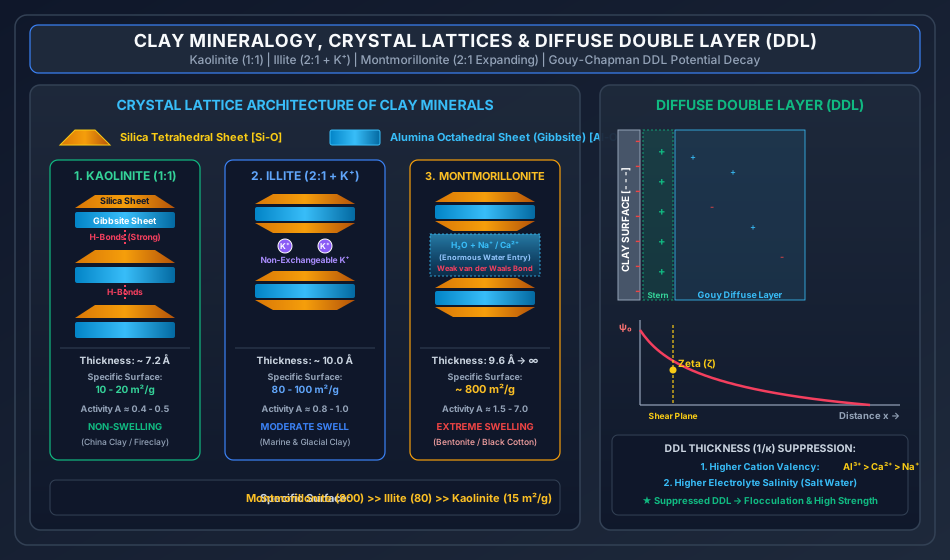
1. Kaolinite Group ( Mineral Lattice)
- Lattice Stacking: One silica tetrahedral sheet permanently bonded to one gibbsite octahedral sheet by shared oxygens. The thickness of a single unit layer is ().
- Interlayer Bonding: Successive layers are held together by strong Hydrogen Bonds formed between the hydroxyls () of the gibbsite sheet and the basal oxygens () of the adjacent silica sheet.
- Physical Characteristics:
- Because hydrogen bonds are exceptionally strong, water molecules cannot force their way between adjacent unit layers.
- Completely non-expanding and stable.
- Specific surface area: .
- Plasticity index: Low ().
- Skempton Activity: Inactive ().
- Industrial Use: High-grade porcelain, ceramics, paper coating (China clay / Kaolin).
2. Illite Group ( Non-Expanding Lattice)
- Lattice Stacking: An alumina octahedral sheet sandwiched symmetrically between two silica tetrahedral sheets pointing inward. The basic unit layer thickness is ().
- Interlayer Bonding: Isomorphous substitution of for in the tetrahedral sheets generates net negative charges on the outer faces. These charges are balanced by unhydrated Potassium ions () that fit snugly into the hexagonal cavities of adjacent silica sheets.
- Physical Characteristics:
- The ionic bonds are significantly stronger than van der Waals forces, preventing free water entry.
- Moderate swelling and shrinkage.
- Specific surface area: .
- Plasticity index: Intermediate ().
- Skempton Activity: Normal ().
- Occurrence: The most common clay mineral in sedimentary shales, weathered mudstones, and marine clays.
3. Montmorillonite / Smectite Group ( Expanding Lattice)
- Lattice Stacking: A sandwich of one gibbsite sheet between two silica sheets. The dry unit layer thickness is ().
- Interlayer Bonding: Extensive isomorphous substitution of or for occurs in the central octahedral sheet. The interlayer bonding consists only of extremely weak van der Waals forces and loosely held, highly exchangeable hydrated cations ().
- Physical Characteristics:
- Because interlayer van der Waals bonds are exceptionally weak, dipolar water molecules rush into the interlayer spaces, pushing the unit sheets apart from to over or complete separation.
- Exhibits extreme volumetric swelling upon wetting and massive shrinkage cracking upon drying.
- Enormous specific surface area: (both external and internal interlayer surfaces).
- High cation exchange capacity (CEC ).
- Skempton Activity: Highly Active ().
- Geological Occurrence: Formed from the chemical weathering of volcanic ash under alkaline conditions (Bentonite) and basaltic rocks (Indian Black Cotton soils).
         KAOLINITE (1:1)                  ILLITE (2:1 + K⁺)              MONTMORILLONITE (2:1)
     ┌──────────────────────┐        ┌──────────────────────┐        ┌──────────────────────┐
     │  Silica Sheet (Si)   │        │  Silica Sheet (Si)   │        │  Silica Sheet (Si)   │
     ├──────────────────────┤        ├──────────────────────┤        ├──────────────────────┤
     │  Gibbsite Sheet (Al) │        │  Gibbsite Sheet (Al) │        │  Gibbsite Sheet (Al) │
     └──────────────────────┘        ├──────────────────────┤        ├──────────────────────┤
       H-Bonds (Very Strong)         │  Silica Sheet (Si)   │        │  Silica Sheet (Si)   │
     ┌──────────────────────┐        └──────────────────────┘        └──────────────────────┘
     │  Silica Sheet (Si)   │          ●  K⁺ Ions (Strong)           ~~~~~~~~~~~~~~~~~~~~~~~~
     ├──────────────────────┤        ┌──────────────────────┐         H₂O + Na⁺ (Weak van der
     │  Gibbsite Sheet (Al) │        │  Silica Sheet (Si)   │          Waals, Massive Swell)
     └──────────────────────┘        ├──────────────────────┤        ~~~~~~~~~~~~~~~~~~~~~~~~
       Thickness: ~ 7.2 Å            │  Gibbsite Sheet (Al) │        ┌──────────────────────┐
       Non-Swelling                  └──────────────────────┘        │  Silica Sheet (Si)   │
       10 - 20 m²/g                    Thickness: ~ 10.0 Å           └──────────────────────┘
                                       Moderate Swelling               Thickness: 9.6 Å to ∞
                                       80 - 100 m²/g                   Colossal Swelling: 800 m²/g
4.3 Isomorphous Substitution & Electrical Surface Charge
Clay particles carry a permanent, net negative electrical surface charge created during crystallization through isomorphous substitution:
- Replacement of tetravalent Silicon () by trivalent Aluminum () in the tetrahedral sheet creates a net deficit of charge per substitution.
- Replacement of trivalent Aluminum () by divalent Magnesium () or Iron () in the octahedral sheet creates another deficit. Because the crystalline geometry is preserved without change in lattice form, the particle surface becomes a permanent negative charge sheet.
4.4 The Gouy-Chapman Diffuse Double Layer (DDL)
To neutralize the permanent negative surface charge, the clay particle in water attracts:
- Polar water molecules (which align their positive hydrogen poles toward the negative clay face).
- Dissolved cations from the pore fluid ().
The system of negative surface charges and the neutralizing cloud of attracted cations is called the Diffuse Double Layer (DDL):
- Stern Layer (Fixed Layer): A mono-molecular layer of cations held firmly against the clay surface by powerful electrostatic attraction.
- Gouy Diffuse Layer: A mobile ionic cloud extending outward into the bulk pore fluid, where cation concentration decreases exponentially to the background fluid concentration.
- Zeta Potential (): The electrical potential at the hydrodynamic slipping plane separating the fixed fluid layer from the mobile diffuse layer.
Factors Controlling DDL Thickness ():
According to the Gouy-Chapman theory, the Debye screening length (thickness of DDL) is given by:
where is dielectric constant, is absolute temperature, is electrolyte concentration, is cation valency, and is elementary charge.
| Environmental Factor | Change in Variable | Effect on DDL Thickness | Effect on Soil Fabric & Shear Strength |
|---|---|---|---|
| Cation Valency () | Monovalent Divalent Trivalent () | Drastically Suppressed (Thinner DDL) | Cations neutralize surface charges quickly. Repulsion drops Flocculation promoted Higher strength, lower swell. |
| Pore Water Salinity () | Increased electrolyte concentration (e.g., seawater) | Suppressed (Thinner DDL) | Compresses diffuse layer Flocculated card-house structure. |
| Leaching of Marine Clay | Saltwater washed out by freshwater percolation | Expanded (Thicker DDL) | Repulsive forces spike Spontaneous liquefaction (Quick Clay). |
| pH of Pore Fluid | Lower pH (Acidic) | Suppressed DDL | Positive edge charges increase Enhanced Edge-to-Face attraction. |
5. Diagnostic Engineering Indices & Special Soil Phenomena
5.1 Skempton's Activity of Clay ()
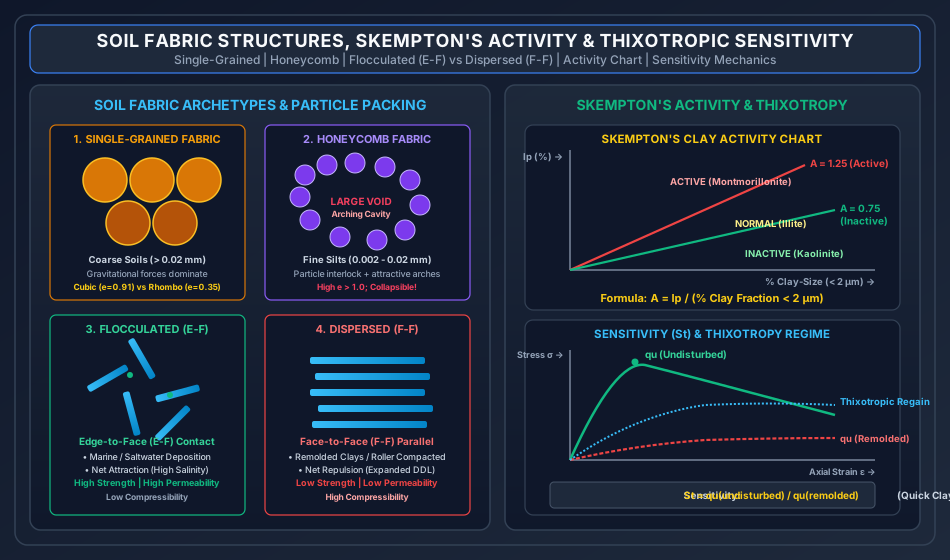
In 1953, A. W. Skempton defined the Activity of Clay () as the ratio of the plasticity index to the percentage of clay-size particles by weight:
Activity reflects the water-holding capacity and electrochemical reactivity of the clay minerals present:
| Activity Range () | Classification (Skempton) | Dominant Clay Mineral | Swelling & Shrinkage Potential |
|---|---|---|---|
| Inactive Clay | Kaolinite, Quartz/Calcite flour | Very Low / Negligible | |
| Normal Clay | Illite | Moderate | |
| Active Clay | Montmorillonite (Smectite) | High to Colossal (Bentonite, Black Cotton) |
[!NOTE] Typical activities:
- Kaolinite:
- Illite:
- Black Cotton Soil:
- Sodium Bentonite:
5.2 Sensitivity of Clays ()
Natural clay deposits develop an undisturbed shear strength over geological time through inter-particle bonding, thixotropic aging, and flocculated skeleton formation. When mechanically remolded (churned) at identical water content and density, the fragile fabric collapses, causing a drastic loss of strength:
where is unconfined compressive strength and is undrained shear strength.
| Sensitivity () | Descriptive Classification (IS 2720 Part 10 / Terzaghi) | Typical Geological Deposit |
|---|---|---|
| Insensitive | Heavily overconsolidated clays, compacted fills | |
| Moderately Sensitive | Normally consolidated continental clays | |
| Sensitive | Flocculated estuarine and marine clays | |
| Extra-Sensitive | Young post-glacial marine clays | |
| up to | Quick Clays (Leda Clays) | Canadian and Scandinavian marine clays subjected to freshwater leaching |
The Quick Clay Phenomenon:
Quick clays were deposited in ancient post-glacial salt seas with an open, highly flocculated card-house fabric (). Following post-glacial isostatic rebound, freshwater rain leached out the pore saltwater (). The DDL expanded dramatically, generating immense inter-particle repulsion. The clay remains stable only as long as it is undisturbed; upon a minor shock or vibration, the fabric collapses instantaneously, transforming the solid clay bluff into a liquid slurry that flows like water, triggering catastrophic retrogressive landslides.
5.3 Thixotropy
Thixotropy is defined as the property of certain cohesive soils by virtue of which they undergo an isothermal, reversible loss of shear strength upon remolding, followed by a progressive, time-dependent regain of shear strength when left undisturbed at constant water content and constant volume.
    UNCONFINED COMPRESSIVE STRENGTH (qu)
      ▲
      │    Undisturbed Strength (qu,undisturbed)
      ├────────────────────────────
      │                             ╲
      │                              ╲ Remolding (Fabric Destroyed)
      │                               ▼
      │                             Remolded Strength (qu,remolded)
      │                             ────────────────────────────────
      │                                ▲
      │                                 ╲   Thixotropic Strength Regain
      │                                  ╲  (Re-orientation of water dipoles &
      │                                   ╲  reformation of electrostatic bonds)
      │                                    ▼
      │                             Aged Strength (qu,thixotropic)
      └─────────────────────────────────────────────────────────────► TIME (t)
Microscopic Mechanism of Thixotropy:
- Upon remolding, external shear destroys edge-to-face flocculated bonds, breaking the soil into parallel dispersed sheets. Adsorbed water dipoles are disorganized.
- When left at rest, the attractive van der Waals forces and edge-to-face electrostatic charges slowly pull particles back into partial flocculation.
- Adsorbed water molecules re-orient into structured crystalline configurations.
- Key Exam Point: Thixotropic strength regain is only partial. It never reaches of the original undisturbed strength because irreversible structural cementation cannot be restored without geological pressure and time.
5.4 Expansive Soils & Indian Black Cotton Soils
- Origin: Deep residual weathering of volcanic basalt lava flows (Deccan Trap) covering Maharashtra, Gujarat, Madhya Pradesh, and Andhra Pradesh.
- Dominant Mineral: Montmorillonite ( expanding lattice).
- Behavior:
- High liquid limit () and high plasticity index ().
- Swells dramatically during the monsoon season, exerting upward swelling pressures exceeding (lifting building footings and cracking masonry).
- Shrinks severely during summer dry seasons, forming deep polygonal ground fissures up to wide and deep.
- Differential Free Swell Test (, IS 2720 Part 40):
where is the sediment volume of dry soil in distilled water, and is the sediment volume in kerosene (kerosene is non-polar, causing zero swelling).
- : Low degree of expansion.
- : Moderate degree of expansion.
- : High degree of expansion.
- : Very High degree of expansion (Black Cotton Soil).
- Foundation Remediation: Under-reamed piles anchored into stable, non-swelling strata below the active seasonal moisture zone ( depth), or lime stabilization ( exchange compressing the DDL).
6. Rigorous Analytical Derivations & Mathematical Proofs
6.1 Derivation 1: Void Ratios and Porosities for Ideal Spherical Soil Packings
Proof for Simple Cubic (Loosest) Packing:
- Consider identical rigid spheres of radius and diameter .
- In simple cubic arrangement, each sphere is centered at the corner of a unit cube of edge length .
- Total volume of the unit cell:
- Number of spheres per unit cube: 8 corners, each sharing -th of a sphere:
- Volume of solid sphere:
- Volume of voids:
- Void ratio ():
- Porosity ():
Proof for Dense Rhombohedral Packing:
- In face-centered close packing, spheres nestle into the hollows of adjacent layers with contact angle of .
- The unit rhombohedron has edge length and face angles of and .
- Total volume of the rhombohedral cell containing 1 net sphere:
- Volume of solid sphere: .
- Void ratio ():
- Porosity ():
7. Visual Vector Graphics & Engineering Schematics
7.1 Clay Mineralogy Crystal Lattices & Diffuse Double Layer
The detailed schematic below presents the crystallographic lattice architecture of Kaolinite (), Illite (), and Montmorillonite (), alongside the Gouy-Chapman DDL potential decay profile:
7.2 Soil Fabric Structures, Activity Chart & Sensitivity Mechanics
The engineering diagram below illustrates the four fabric archetypes, Skempton's activity classification lines, and sensitivity stress-strain curves with thixotropic aging:
8. Laboratory Testing Protocols & Standards
8.1 Sensitivity Determination Test (IS 2720 Part 10)
- An undisturbed cylindrical specimen of cohesive soil ( dia, height) is trimmed from an undisturbed thin-walled Shelby tube sample.
- The specimen is placed in an Unconfined Compression Testing machine and sheared to failure at an axial strain rate of . The peak compressive stress is recorded as .
- All sheared pieces are collected, thoroughly remolded by hand or in a plastic bag without changing water content or mass, and compacted back into the identical split mold.
- The remolded specimen is sheared to failure, and the peak compressive stress is recorded as .
- Sensitivity is computed as:
8.2 Free Swell Index Test (IS 2720 Part 40)
- Two oven-dried soil samples of each, passing a sieve, are placed into two separate graduated glass cylinders.
- One cylinder is filled with distilled water to the mark; the other cylinder is filled with kerosene.
- Entrapped air is removed by gentle shaking. Both cylinders are left undisturbed for .
- The settled sediment volumes are read as (in water) and (in kerosene).
- The Free Swell Index is:
9. Step-by-Step Pre-Calculated Numerical Examples
Problem 1: Ideal Uniform Sand Packing & Densification Limits
Statement: A clean deposit of uniform rounded dune sand is modeled as identical rigid spheres of diameter .
- Compute the theoretical maximum void ratio () and minimum dry unit weight () corresponding to simple cubic packing, assuming solid specific gravity and .
- Compute the theoretical minimum void ratio () and maximum dry unit weight () corresponding to dense rhombohedral packing.
- If an initial deposit of this sand in its loosest cubic state is densified by vibratory roller compaction into its densest rhombohedral packing, compute the new compacted volume () and the percentage volumetric reduction ().
Detailed Step-by-Step Solution:
Step 1: Simple Cubic (Loosest) Packing From Section 6.1:
Minimum dry unit weight:
Step 2: Dense Rhombohedral Packing From Section 6.1:
Maximum dry unit weight:
Step 3: Volumetric Reduction on Densification During roller vibration, the volume of solid mineral spheres remains strictly constant:
The new compacted volume in the densest state:
Total volumetric shrinkage:
Percentage volume reduction:
Problem 2: Skempton's Activity, Mineral Identification & Black Cotton Soil
Statement: A soil sample collected from a proposed canal embankment in the Deccan Trap region of central India was subjected to laboratory testing:
- Liquid Limit:
- Plastic Limit:
- Sieve analysis: passing IS Sieve.
- Hydrometer analysis: Clay fraction finer than () of the total soil sample.
- Free Swell Index: .
- Calculate the Plasticity Index () of the soil.
- Determine Skempton's Activity () and classify the activity state.
- Identify the dominant clay mineral governing this soil deposit.
- Evaluate the geotechnical hazards expected for structural foundations constructed on this soil stratum.
Detailed Step-by-Step Solution:
Step 1: Plasticity Index
Step 2: Skempton's Activity ()
Referring to Skempton's classification:
- Inactive
- Normal
- Active Clay
Since , the soil is classified as Active Clay.
Step 3: Clay Mineral Identification The soil exhibits:
- Very high Liquid Limit ().
- High Plasticity Index ().
- High Activity ().
- Extremely high Free Swell Index ().
- Origin: Basaltic Deccan Trap region. These parameters confirm that the dominant clay mineral is Montmorillonite (Smectite group) with a expanding crystal lattice. The deposit is an expansive Indian Black Cotton Soil.
Step 4: Geotechnical Hazards & Engineering Countermeasures
- Hazards: High volumetric swelling during wet periods causing foundation heave; severe shrinkage and polygonal ground cracking during dry summers; high compressibility; loss of shear strength upon saturation.
- Countermeasures: Shallow strip footings are unsafe. Design must employ bored under-reamed cast-in-situ piles (IS 2911 Part 3) anchored deep into stable non-expansive strata, provision of a CNS (Cohesive Non-Swelling) soil cushion, or lime slurry pressure injection to replace monovalent cations with divalent , suppressing the diffuse double layer.
Problem 3: Sensitivity, Remolding & Thixotropic Strength Regain
Statement: An undisturbed cylindrical specimen of soft marine clay ( dia, height) retrieved from an offshore borehole was tested in an unconfined compression machine. The peak compressive strength was . The failed specimen was thoroughly remolded at unchanged moisture content and retested, giving a remolded strength . A second identical remolded specimen was sealed in an airtight paraffin wax container and stored undisturbed at constant moisture content () for . Upon testing after , the unconfined compressive strength was found to be .
- Calculate the sensitivity () of the clay and classify its degree of sensitivity.
- Determine the undrained shear strength () in both undisturbed and remolded states.
- Compute the magnitude of shear strength regained through thixotropic hardening after .
- Calculate the percentage of lost strength regained and the Thixotropic Ratio.
Detailed Step-by-Step Solution:
Step 1: Sensitivity () and Classification
Referring to standard classification:
- Sensitive Clay
- Extra-Sensitive Clay
With , the clay is classified as Sensitive to Extra-Sensitive Marine Clay. Remolding causes an immediate drop in load-carrying capacity.
Step 2: Undrained Shear Strengths () Undisturbed undrained shear strength:
Remolded undrained shear strength:
Step 3: Thixotropic Strength Regained After 60 Days Total strength lost upon initial remolding:
Strength regained after 60 days of storage:
Undrained shear strength after 60 days:
Step 4: Percentage Regain & Thixotropic Ratio Percentage of lost strength regained through thixotropy:
Thixotropic Ratio:
10. Common Exam Traps, Failure Modes & Field Gotchas
[!WARNING]
The 5 Critical Traps in Clay Mineralogy & Fabric Mechanics
- The Clay Fraction Denominator Trap in Skempton's Activity:
- Activity is defined as , where is the percentage of particles finer than ().
- Exam Trap: Questions often give "Fines passing , and clay fraction finer than ." Students frequently divide by or .
- Golden Rule: In standard Skempton formula, the denominator is the percentage of clay-size particles () expressed as a percentage of the total soil sample. Always use .
- Hydrogen Bonding vs. Potassium Ions vs. Van der Waals Forces:
- Questions frequently swap interlayer bond types among minerals:
- Kaolinite (): Strong Hydrogen Bonds (stable, non-swelling).
- Illite (): Non-exchangeable Potassium () Ionic Bonds (moderate swell).
- Montmorillonite (): Weak van der Waals Bonds (extreme water uptake, colossal swell).
- Never confuse the Potassium ions of Illite with the weak van der Waals forces of Montmorillonite!
- Flocculated vs. Dispersed Permeability Paradox:
- Both flocculated and dispersed fabrics can have the exact same void ratio.
- However, the flocculated fabric has a permeability 10 to 100 times higher than the dispersed fabric because the edge-to-face card-house creates large, open, continuous macro-pores, whereas the parallel face-to-face dispersed sheets create tortuous, microscopic slits.
- Field Application: Clay liners for landfills and earth dam impervious cores are compacted on the wet side of optimum moisture to deliberately force a dispersed, low-permeability fabric.
- Quick Clay Sensitivity Threshold:
- Sensitivity designates a Quick Clay.
- Quick clays do NOT possess zero undisturbed strength; their undisturbed strength can be quite high (). Their defining feature is that remolding turns them into a viscous fluid with near-zero shear strength ().
- Thixotropy vs. Consolidation:
- Thixotropy is strength gain without any change in water content or volume.
- Consolidation is strength gain accompanied by the expulsion of pore water and volumetric settlement.
- Never confuse thixotropic hardening with primary consolidation!
11. Multi-Exam Targeted Practice Questions
Question 1 (GATE CE Computational)
A clay deposit has a liquid limit of and a plastic limit of . The hydrometer test indicates that of the particles are finer than . The activity of the clay is:
- (A)
- (B)
- (C)
- (D)
Correct Answer: (B)
Step-by-Step Derivation:
- Plasticity Index: .
- Clay-size fraction (): .
- Activity: The soil lies exactly on the boundary between a normal clay and an active clay.
Question 2 (UPSC ESE Conventional - 10 Marks)
Describe the crystal structure of Kaolinite, Illite, and Montmorillonite. Explain why Montmorillonite undergoes enormous swelling and shrinkage, whereas Kaolinite remains dimensionally stable.
Model Answer Outline:
- Kaolinite: lattice composed of one silica tetrahedral sheet and one gibbsite octahedral sheet (). Successive unit layers are held together by exceptionally strong Hydrogen bonds formed between the basal oxygens of the silica sheet and the hydroxyls of the adjacent gibbsite sheet. Because hydrogen bonds are strong and rigid, dipolar water molecules cannot penetrate the interlayer space, making Kaolinite dimensionally stable, non-expanding, with low specific surface ().
- Illite: sandwich of one gibbsite sheet between two silica sheets (). Isomorphous substitution of for in tetrahedral sheets creates negative charges balanced by non-exchangeable Potassium ions () that lock into the hexagonal cavities of adjacent silica sheets, providing moderate stability against swelling.
- Montmorillonite: lattice (). Isomorphous substitution of for in the octahedral sheet creates net negative charges. The interlayer bonding consists only of extremely weak van der Waals forces and loosely held exchangeable hydrated cations (). Water molecules readily force their way into the interlayer spaces, causing unit layers to expand from to over or complete delamination. This exposes an enormous specific surface area of , generating colossal swelling when wet and severe desiccation cracking when dried.
Question 3 (SSC JE Rapid Recall)
The clay mineral predominantly responsible for the swelling and shrinkage behavior of Indian Black Cotton soils is:
- (A) Kaolinite
- (B) Illite
- (C) Montmorillonite
- (D) Halloysite
Correct Answer: (C) Montmorillonite
Explanation: Montmorillonite is an expanding phyllosilicate with weak interlayer van der Waals bonding, leading to the massive volume change characteristics of Black Cotton soils.
Question 4 (State AE Objective)
A clay with a sensitivity is classified as:
- (A) Insensitive
- (B) Normal
- (C) Extra-sensitive / Quick
- (D) Thixotropic
Correct Answer: (C) Extra-sensitive / Quick
Explanation: Soils with are classified as Quick clays. Upon disturbance, their flocculated skeleton collapses completely, transforming the solid clay into a fluid slurry.
Question 5 (RRB JE Technical)
The structure of soil formed when clay platelets settle in saltwater with edge-to-face contacts is called:
- (A) Honeycomb structure
- (B) Dispersed structure
- (C) Flocculated structure
- (D) Single-grained structure
Correct Answer: (C) Flocculated structure
Explanation: High salinity in seawater compresses the repulsive diffuse double layer, allowing net electrostatic attraction between positively charged platelet edges and negatively charged faces, forming a flocculated "card-house" fabric.
12. Reference Standards & Authoritative Handbooks
- Bureau of Indian Standards:
- IS 2720 (Part 10): 1991 – Determination of Unconfined Compressive Strength and Sensitivity of Soils.
- IS 2720 (Part 40): 1977 – Determination of Free Swell Index of Soils.
- IS 2911 (Part 3): 1980 – Code of Practice for Design and Construction of Pile Foundations: Under-Reamed Piles.
- IS 1498: 1970 – Classification and Identification of Soils for General Engineering Purposes.
- Authoritative Geotechnical Treatises:
- Karl Terzaghi, Ralph B. Peck, and Gholamreza Mesri, Soil Mechanics in Engineering Practice, 3rd ed., John Wiley & Sons.
- T. William Lambe and Robert V. Whitman, Soil Mechanics, SI Version, John Wiley & Sons.
- Gopal Ranjan and A. S. R. Rao, Basic and Applied Soil Mechanics, New Age International.
- B. C. Punmia, Ashok Kumar Jain, and Arun Kumar Jain, Soil Mechanics and Foundations, Laxmi Publications.
- R. E. Grim, Clay Mineralogy, 2nd ed., McGraw-Hill, New York.