Virtual Work & Energy Methods (Degrees of Freedom, Ideal Constraints, Equilibrium Stability)
In this chapter (1 topics)
On this page
- 1. Executive Summary & Core Definitions
- Core Definitions
- 2. Foundational Principles & Governing Axioms
- 2.1 The Concept of Virtual Displacement vs Real Displacement
- 2.2 Workless Nature of Ideal Constraints
- 3. Step-by-Step Analytical Derivations
- 3.1 Derivation of the Principle of Virtual Work from Statics
- 3.2 Equivalence of Virtual Work and Stationary Potential Energy
- 3.3 Mathematical Proof of Equilibrium Stability (Taylor Series Expansion)
- 3.4 Derivation of the Scissor / Toggle Mechanism Effort
- 3.5 Derivation of Castigliano's Second Theorem
- 4. Key Formulas & Summary Tables
- Table 4.1: Master Formulas in Virtual Work & Energy Methods
- 5. Visual Architectural Diagrams
- Diagram 1: Principle of Virtual Work, Ideal Constraints & Linkages
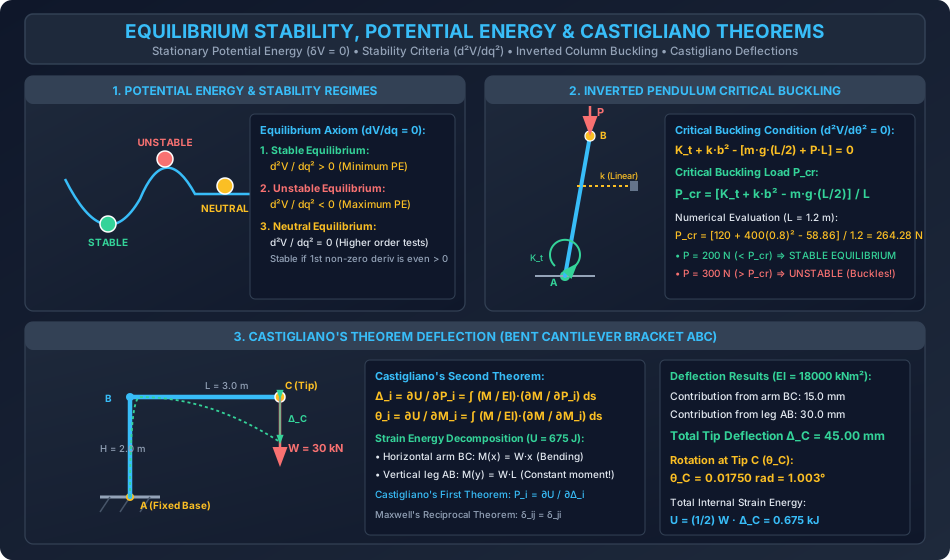
- Diagram 2: Equilibrium Stability, Potential Energy & Castigliano Theorems
- 6. Standard Practice Guidelines & Boundary Conditions
- 6.1 Civil Engineering Energy Method Practice
- 7. Critical Failure Modes & Edge Cases
- 7.1 Confusing Castigliano's First and Second Theorems
- 7.2 Fictitious Dummy Loads for Rotations or Unloaded Nodes
- 7.3 Snap-Through Buckling in Shallow Arches
- 8. Worked Numerical Problems
- Problem 1: Scissor Lift / Toggle Mechanism Analysis via Virtual Work
- Problem 2: Equilibrium Stability & Critical Buckling Load of an Inverted Column
- Problem 3: Castigliano's Theorem Deflection of a Bent Cantilever Frame
- 9. Comparative Exam Analysis
- 10. Common Pitfalls & Traps
- 11. Real-World Civil & Structural Applications
- 12. Comprehensive Summary & Quick Revision Guide
- 13. Practice Problems for Self-Assessment
- 14. References & Standard Texts
1. Executive Summary & Core Definitions
Energy methods represent one of the most powerful, elegant, and unifying analytical paradigms in engineering mechanics and structural engineering. Rather than resolving complex networks of vector equilibrium equations and internal reactive forces at every pin and joint, energy principles formulate equilibrium, kinematics, and stability through scalar work and potential functions. The Principle of Virtual Work allows the direct determination of equilibrium configurations and mechanical efforts in multi-body linkages without solving for constraint forces, while the Principle of Minimum Potential Energy provides the mathematical framework for structural stability and buckling. In structural mechanics, Castigliano's Theorems provide exact closed-form solutions for deflections and rotations in indeterminate trusses, arches, and frames.
                  +-------------------------------------------------+
                  |             ENERGY & VIRTUAL METHODS            |
                  +-----------------------+-------------------------+
                                          |
                 +------------------------+------------------------+
                 |                                                 |
                 v                                                 v
   +---------------------------+                     +---------------------------+
   | PRINCIPLE OF VIRTUAL WORK |                     |  POTENTIAL ENERGY METHODS |
   |        (δU = 0)           |                     |       (V(q), δV = 0)      |
   +-------------+-------------+                     +-------------+-------------+
                 |                                                 |
         +-------+-------+                         +---------------+---------------+
         |               |                         |               |               |
         v               v                         v               v               v
     Linkages &      Degrees of                 Stationary        Stability of    Castigliano's
     Mechanisms       Freedom                   Equilibrium        Equilibrium      Theorems
   (P = W·cot θ)    (q_1, ..., q_n)             (dV/dq = 0)       (d²V/dq² ≷ 0)   (Δ = ∂U/∂P)
Core Definitions
- Virtual Displacement ( or ): An imagined, infinitesimal, arbitrary change in the position or orientation of a mechanical system, consistent with all kinematic constraints, assumed to occur without the passage of time ().
- Virtual Work (): The scalar work done by all active external forces and couples acting through their respective virtual displacements:
- Ideal (Workless) Constraints: Mechanical constraints (such as frictionless pins, smooth rigid guides, inextensible cables, and rolling without slipping) that perform identically zero net virtual work during any kinematically admissible virtual displacement:
- Principle of Virtual Work: A mechanical system with ideal constraints is in static equilibrium if and only if the total virtual work done by all active forces is zero for every virtual displacement consistent with constraints:
- Degrees of Freedom (DOF): The minimum number of independent scalar generalized coordinates () necessary to uniquely specify the configuration of all parts of a mechanical system at any instant.
- Generalized Force (): The coefficient of the virtual displacement of a generalized coordinate in the total virtual work expression (). For equilibrium:
- Potential Energy Function (): The total energy stored in a conservative mechanical system, comprising gravitational potential energy (), elastic strain energy of springs ( or ), and strain energy of deformed structural members.
- Equilibrium Stability: The behavior of a system when slightly perturbed from an equilibrium configuration:
- Stable Equilibrium: The system spontaneously returns to its equilibrium position (, local minimum of ).
- Unstable Equilibrium: The system diverges further from its equilibrium position (, local maximum of ).
- Neutral Equilibrium: The system remains in equilibrium in the adjacent perturbed state (, flat plateau of ).
- Castigliano's Second Theorem: In any linearly elastic structure subjected to external loads, the first partial derivative of the total internal strain energy () with respect to any applied force () equals the deflection () at the point of application and in the direction of that force:
2. Foundational Principles & Governing Axioms
2.1 The Concept of Virtual Displacement vs Real Displacement
+------------------------------------+------------------------------------+
| REAL DISPLACEMENT (dr)             | VIRTUAL DISPLACEMENT (δr)          |
+------------------------------------+------------------------------------+
| • Occurs over real time interval dt| • Imagined instant at fixed time   |
| • Governed by real kinematics,     | • Purely geometric, arbitrary, and |
|   velocities, and accelerations    |   infinitesimal                    |
| • dr = v · dt                      | • δt ≡ 0                           |
| • Constraints may vary with time   | • Strictly consistent with frozen  |
|   (rheonomic systems)              |   geometric boundary constraints   |
+------------------------------------+------------------------------------+
2.2 Workless Nature of Ideal Constraints
In any multi-body structural assembly, forces can be classified into:
- Active Forces (): External applied loads, gravity weights, spring forces, and driving torques that can perform work.
- Reactive Constraint Forces (): Internal joint forces, normal reactions, and link tensions that enforce kinematic connectivity.
For all ideal constraints, the constraint forces do no virtual work:
- Frictionless Pin Joint: The action and reaction forces between connected members are equal and opposite (), and both members share the identical virtual displacement at the pin (). Therefore:
- Smooth Surface / Guide: The reaction is normal to the guide, while virtual displacement is tangential:
- Inextensible Cable / Rigid Link: Tension acts equally and oppositely at both ends; since the link length is fixed (), the net work is zero.
- Pure Rolling Without Slip: The instantaneous point of contact has zero virtual displacement (); hence static friction does zero virtual work.
3. Step-by-Step Analytical Derivations
3.1 Derivation of the Principle of Virtual Work from Statics
Consider a particle in static equilibrium under resultant external force and constraint force :
Take the dot product of this equilibrium equation with an arbitrary virtual displacement :
Sum over all particles comprising the system:
For ideal constraints, . Therefore, the necessary and sufficient condition for static equilibrium reduces strictly to:
3.2 Equivalence of Virtual Work and Stationary Potential Energy
For a conservative mechanical system, all active forces are derivable from a potential energy function :
Substituting into the Virtual Work equation:
Using the chain rule of multivariable calculus for generalized coordinates :
Because the virtual variations are mutually independent and arbitrary:
A conservative system is in static equilibrium at every configuration where its potential energy function is stationary.
3.3 Mathematical Proof of Equilibrium Stability (Taylor Series Expansion)
Let be an equilibrium position (). Expand in a Taylor series about for a small perturbation :
Setting the datum and noting :
Potential Energy V(q)
    ^
    |          Unstable (d²V/dq² < 0)
    |             /\
    |            /  \        Neutral (d²V/dq² = 0)
    |           /    \      ___________
    |          /      \    /
    |  \      /        \__/
    |   \____/
    |   Stable (d²V/dq² > 0)
    +------------------------------------> Coordinate q
- Stable Equilibrium ():
- For any perturbation , .
- The potential energy increases in all neighboring states ( is a local minimum).
- Any displacement creates a restoring force directed toward , returning the system to equilibrium.
- Unstable Equilibrium ():
- . The potential energy decreases in neighboring states ( is a local maximum).
- Any perturbation creates a driving force directed away from , causing dynamic divergence or collapse.
- Neutral Equilibrium ():
- Higher-order derivatives must be inspected. The equilibrium is stable if and only if the first non-vanishing derivative is of even order and strictly positive (). If it is of odd order, the equilibrium is unstable.
3.4 Derivation of the Scissor / Toggle Mechanism Effort
Consider a rhombus toggle linkage formed by 4 rigid links of length , pinned together:
- Base pins: at origin , sliding horizontally on the -axis.
- Symmetrical lateral pins: and , separated by width .
- Top apex: , located at height .
- Active forces: Vertical downward load at , horizontal inward compressive effort at and .
- Express active force coordinates in terms of generalized coordinate :
- Formulate total virtual work ():
- Divide through by :
- As (fully extended), (huge mechanical advantage).
- As (flattened toggle), enormous horizontal force is required.
3.5 Derivation of Castigliano's Second Theorem
In a linearly elastic structural system obeying Hooke's law, the internal strain energy is equal to the external work done by applied loads :
By the principle of superposition, the deflection at point is a linear function of all applied forces:
where are flexibility influence coefficients. Substitute into the strain energy expression:
Differentiating partially with respect to force :
By Maxwell's Reciprocal Theorem, the flexibility matrix is symmetric ():
4. Key Formulas & Summary Tables
Table 4.1: Master Formulas in Virtual Work & Energy Methods
| Method / Theorem | Mathematical Formulation | Physical Application & Notes |
|---|---|---|
| Virtual Work Equilibrium | Eliminates all ideal constraint forces | |
| Generalized Force | One equation per degree of freedom | |
| Stationary Potential Energy | Conservative systems in equilibrium | |
| Equilibrium Stability | (Stable), (Unstable), (Neutral) | Evaluated strictly at equilibrium point |
| Critical Buckling Load | Boundary between stable & unstable states | |
| Axial Strain Energy | Tension or compression member | |
| Bending Strain Energy | Primary flexural strain energy in beams/frames | |
| Torsional Strain Energy | Circular shafts and torsion members | |
| Shear Strain Energy | for rectangle, for circle | |
| Castigliano's 1st Theorem | Yields force from known displacement | |
| Castigliano's 2nd Theorem | Yields deflection from applied load | |
| Dummy Unit Load Method | = moment due to virtual unit load | |
| Maxwell-Betti Reciprocal | Linear elastic structural reciprocity |
5. Visual Architectural Diagrams
Diagram 1: Principle of Virtual Work, Ideal Constraints & Linkages
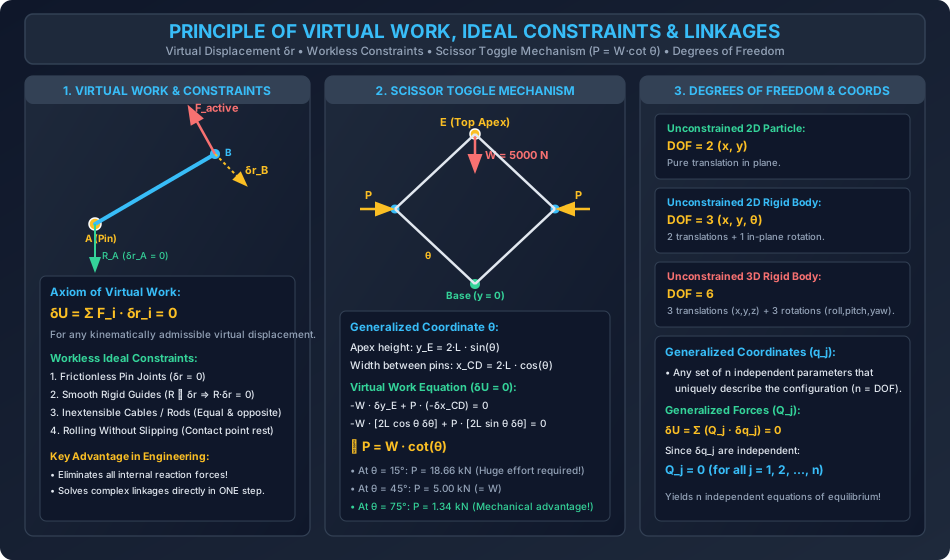
Diagram 2: Equilibrium Stability, Potential Energy & Castigliano Theorems
6. Standard Practice Guidelines & Boundary Conditions
6.1 Civil Engineering Energy Method Practice
- Deflection Calculations in Bridge Trusses (Dummy Unit Load Method):
- Under IRS and IRC specifications, truss deflections under moving train live loads are calculated using the virtual unit load method: where is the real axial force in member , and is the internal force produced in member by a fictitious virtual unit load () applied at the deflection point.
- Column Buckling Analysis by Energy Methods (Rayleigh-Ritz Method):
- For non-prismatic, tapered, or stepped columns where Euler's differential equation cannot be integrated in closed form, the critical buckling load is computed by equating internal flexural strain energy to external work of the axial load:
7. Critical Failure Modes & Edge Cases
7.1 Confusing Castigliano's First and Second Theorems
- Castigliano's First Theorem (): Differentiates strain energy with respect to displacement, yielding the corresponding force. Valid for both linear and non-linear elastic systems.
- Castigliano's Second Theorem (): Differentiates strain energy with respect to force, yielding displacement. Valid STRICTLY for LINEARLY ELASTIC materials obeying Hooke's law! (For non-linear elastic materials, complementary strain energy must be used).
7.2 Fictitious Dummy Loads for Rotations or Unloaded Nodes
- If the deflection or rotation is required at a point where no real load or moment exists, a fictitious dummy load or fictitious dummy moment must be introduced.
- Differentiate before integrating, and set the dummy variable to zero ( or ) after differentiation:
7.3 Snap-Through Buckling in Shallow Arches
- In shallow curved arches or dome trusses, the potential energy curve exhibits two local minima separated by an unstable maximum.
- When the external load reaches a critical threshold, the stable well disappears, causing the structure to "snap through" dynamically to an inverted position with violent kinetic energy release.
8. Worked Numerical Problems
Problem 1: Scissor Lift / Toggle Mechanism Analysis via Virtual Work
Statement: A hydraulic toggle mechanism consists of 4 identical rigid links, each of length , interconnected in a rhombus configuration.
- The base pin is anchored at the origin .
- The lateral pins and are compressed horizontally inward by a hydraulic ram exerting effort .
- The top apex carries a vertical downward payload of . Using the Principle of Virtual Work:
- Derive the symbolic closed-form relation for the required effort as a function of link angle with the horizontal.
- Calculate the required driving effort for angles , and .
- State the mechanical advantage at each configuration and explain the physical significance as and .
Solution & Calculations:
                  E (Top Apex) <--- W = 5000 N (Down)
                 / \
                /   \   Link length L = 1.0 m
               /     \
   P --->   C +-------+ D   <--- P (Effort)
               \     /
                \   /   Angle θ with horizontal
                 \ /
                  A (Base Pin)
Step 1: Kinematic Coordinates & Virtual Variations
Let be the generalized coordinate measuring link inclination with the horizontal:
- Height of top apex :
- Lateral distance between pins and :
Step 2: Formulation of Virtual Work Equation ()
- Virtual work done by downward load :
- Virtual work done by compressive effort (which pushes inward, opposing the separation ):
Equating total virtual work to zero for static equilibrium:
Divide through by :
Step 3: Numerical Evaluation ()
| Angle () | Apex Height () | Lateral Width () | Required Effort () | Mechanical Advantage () |
|---|---|---|---|---|
| (Low) | ||||
| () | ||||
| (High) |
Physical Insight:
- At , the mechanism is near its flattened state; an enormous force of is needed to lift a load.
- As , the required effort drops towards zero ( at ), producing massive mechanical advantage in industrial scissor lifts.
Problem 2: Equilibrium Stability & Critical Buckling Load of an Inverted Column
Statement: An inverted rigid vertical pendulum rod of mass and length () is pinned at base . The rod is restrained against rotation by:
- A torsional spring of stiffness at base .
- A horizontal linear spring of stiffness attached to the rod at distance above base . Both springs are completely unstrained when the rod is in the vertical upright position (). A vertical downward compressive load is applied at the top tip .
- Formulate the total potential energy function of the system.
- Prove that the vertical upright position () is an equilibrium configuration for any value of .
- Derive the closed-form expression for the critical buckling load and calculate its numerical value.
- Determine whether the equilibrium at is stable, critical, or unstable for , , and .
Solution & Calculations:
               P (Downward Load)
               v
             B + (Top tip, height y_B = L cos θ)
               |
               |
               |---/\/\/\/\---+ (Horizontal spring k at b = 0.8 m)
               |              |
               | G (CG at L/2 = 0.6 m)
               |
               | ) K_t (Torsional spring at base)
             A + (Pin)
            ======= GROUND
Step 1: Total Potential Energy Formulation
Choose base as the potential energy datum ():
- Elastic Strain Energy of Torsional Spring:
- Elastic Strain Energy of Linear Spring: Horizontal displacement at height : .
- Gravitational Potential Energy of Rod Mass : Height of center of gravity : .
- Potential Energy of Top Load : Height of tip : .
Total Potential Energy Function:
Step 2: First Derivative & Equilibrium Proof ()
Evaluate at the upright vertical position ():
Since regardless of the value of , the vertical upright position is ALWAYS an equilibrium configuration.
Step 3: Second Derivative & Critical Buckling Load ()
Evaluate at ():
For stability:
Critical buckling occurs when the second derivative vanishes ():
Step 4: Numerical Calculation of
- Restoring spring term:
- Destabilizing gravity term:
- Net restoring capacity:
- Critical Buckling Load:
Step 5: Stability Classification Under Test Loads
- At :
- At :
- At :
Problem 3: Castigliano's Theorem Deflection of a Bent Cantilever Frame
Statement: A bent cantilever bracket consists of:
- A vertical leg of height rigidly fixed to the foundation at .
- A horizontal arm of length rigidly connected to at at . The entire bracket has uniform flexural rigidity . A vertical downward concentrated load of is applied at the free end . Neglecting axial and shear deformations, use Castigliano's Second Theorem to:
- Determine the vertical downward deflection at tip .
- Determine the rotational angle at tip by introducing a fictitious dummy moment .
- Compute the total internal flexural strain energy stored in the structure.
Solution & Calculations:
      A (Fixed Base)
      +
      |
      | Vertical leg AB (H = 2.0 m)
      |
      +----------------------------+ C (Tip)
      B  Horizontal arm BC (L = 3.0 m)  v W = 30 kN
Step 1: Bending Moment Formulations
- Member (Horizontal arm, coordinate measured from free end , ):
- Bending moment:
- Partial derivative with respect to load :
- Member (Vertical leg, coordinate measured from corner , ):
- The end load produces a constant bending moment throughout the vertical leg:
- Partial derivative with respect to load :
Step 2: Vertical Deflection by Castigliano's Second Theorem
-
Contribution from Horizontal Arm :
-
Contribution from Vertical Leg :
-
Total Vertical Deflection at Tip :
(Notice that the vertical leg AB contributes 66.7% of the total tip deflection due to rigid-body rotation of joint B!)
Step 3: Tip Rotation via Fictitious Dummy Moment
Apply a fictitious clockwise moment at tip :
- In member : .
- In member : . Apply Castigliano's theorem and set :
- Numerical evaluation:
Step 4: Total Stored Flexural Strain Energy ()
Using the Clapeyron work equation for linear elastic structures:
Alternatively, integrating :
9. Comparative Exam Analysis
| Parameter / Feature | GATE CE | UPSC ESE | SSC JE | RRB JE | State AE |
|---|---|---|---|---|---|
| Weightage | 2 - 4 Marks (NAT / MCQ) | 12 - 20 Marks (Obj + Conv) | 3 - 5 Marks (Direct CBT) | 2 - 4 Marks (Direct CBT) | 4 - 8 Marks (Obj + Conv) |
| Primary Question Type | Stability of equilibrium (), Scissor toggle linkage , Castigliano frame deflection | Full derivation of Virtual Work principle, Critical buckling of spring columns, Maxwell reciprocal proof | Definition of virtual work, Stability criteria ( stable), Castigliano 2nd theorem | Formula recall: Bending strain energy , Axial | Scissor lift effort, Frame deflection with dummy load, Betti's law |
| Tricky Traps | Confusing stable () with unstable (); Missing rigid body rotation of corner joints | Neglecting gravity PE of member mass in inverted columns | Confusing Castigliano 1st and 2nd theorems | Forgetting factor in strain energy | Applying Castigliano 2nd theorem to non-linear materials |
| Speed vs Depth | Analytical elegance, coordinate calculus, exact derivatives | Comprehensive multi-page proofs with full Free-Body diagrams | Rapid 20-second formula matching | Direct 15-second identification | Standard textbook energy problems & frame deflections |
10. Common Pitfalls & Traps
- Incorrect Sign in Potential Energy Stability:
- In calculus, a minimum occurs when . Because humans associate "positive" with growth and "minimum" with smallness, students mistakenly think means stable.
- Mnemonic: Valley floor holds water safely CURVATURE UPWARD STABLE!
- Forgetting That Constraints Do ZERO Virtual Work:
- Wastefully writing reactions into virtual work equations. Ideal constraint forces cancel out identically and must NEVER appear in .
- Omitting Rigid Body Rotation in Bent Cantilever Frames:
- In Problem 3, calculating only for member and forgetting that the rotation at corner () tilts the entire arm by , which accounts for two-thirds of the total tip deflection!
- Confusing Castigliano's 1st vs 2nd Theorem:
- First Theorem: Differentiate with respect to Displacement Force ().
- Second Theorem: Differentiate with respect to Force Displacement ().
11. Real-World Civil & Structural Applications
- Hydraulic Scissor Lifts & Aerial Work Platforms:
- Designed using the virtual work relation . Hydraulic cylinder diameter and stroke are sized to deliver peak thrust at the fully folded configuration () where required effort is maximum.
- Toggle Clamps & Mechanical Stone Crushers (Blake Jaw Crusher):
- Heavy rock crushers employ dual toggle linkages near dead-center (), generating massive compressive crushing forces exceeding from modest flywheel inputs.
- Bridge & Building Deflections under Serviceability (IS 456 / IS 800):
- Span-to-depth deflection limits ( or ) are checked using Castigliano's Second Theorem and the Dummy Unit Load Method for complex non-prismatic structural frames.
- Energy-Based Seismic Design (IS 1893:2016):
- Modern earthquake engineering assesses structural collapse prevention through hysteretic energy dissipation capacity () rather than purely elastic force limits.
12. Comprehensive Summary & Quick Revision Guide
- Virtual Work Axiom: . Eliminates all ideal constraint forces.
- Ideal Constraints: Frictionless pins, smooth surfaces, inextensible cables, and pure rolling do ZERO net virtual work.
- Generalized Coordinates & Forces: ; for all .
- Stationary Potential Energy: Conservative equilibrium .
- Stability Criteria:
- STABLE (Local minimum).
- UNSTABLE (Local maximum).
- NEUTRAL (Check higher derivatives).
- Critical Buckling: Occurs when .
- Scissor Toggle Mechanism: .
- Strain Energies:
- Axial: .
- Bending: .
- Torsion: .
- Castigliano's Theorems:
- 1st: .
- 2nd: (Linear elastic only).
- Maxwell-Betti: .
13. Practice Problems for Self-Assessment
-
Problem 1 (Virtual Work on Stepladder): A symmetrical stepladder consists of two legs and , each of length , hinged at top apex and connected at their midpoints by a horizontal tie cable of length . A painter of weight stands on top apex . Neglecting self-weight and floor friction, use the Principle of Virtual Work to calculate the tension in the horizontal tie cable. (Answer: . Top height . Cable length . Virtual work gives )
-
Problem 2 (Stability of Rocking Cylinder): A solid homogeneous cylinder of radius rests on top of a fixed rough cylindrical surface of radius . Show that the upright equilibrium position is stable against small rolling perturbations if and only if . (Answer: Potential energy expansion yields . For stability, )
-
Problem 3 (Castigliano Deflection of Semicircular Ring): A thin semicircular circular arch rib of radius and uniform flexural rigidity is fixed at base and free at tip . A vertical load is applied at free tip . Use Castigliano's theorem to calculate the vertical deflection . (Answer: . )
14. References & Standard Texts
- Beer, F. P., Johnston, E. R., Mazurek, D. F. — Vector Mechanics for Engineers: Statics, 12th Edition, McGraw-Hill.
- Hibbeler, R. C. — Structural Analysis, 10th Edition, Pearson Education.
- Timoshenko, S. P., Gere, J. M. — Theory of Elastic Stability, 2nd Edition, McGraw-Hill.
- Langhaar, H. L. — Energy Methods in Applied Mechanics, John Wiley & Sons.
- Reddy, C. S. — Basic Structural Analysis, 3rd Edition, Tata McGraw-Hill.
- Bureau of Indian Standards (BIS):
- IS 456:2000 — Plain and Reinforced Concrete - Code of Practice (Deflection Criteria).
- IS 800:2007 — General Construction in Steel - Code of Practice (Energy Methods & Stability).
- IS 1893 (Part 1):2016 — Criteria for Earthquake Resistant Design of Structures.