System of Forces, Free Body Diagrams, Lami's Theorem, Varignon's Theorem & Static Equilibrium
In this chapter (1 topics)
On this page
- 1. Module Overview & Pedagogical Scope
- 2. Learning Objectives & Exam Weightage Analysis
- Learning Objectives
- Exam Weightage Analysis
- 3. Taxonomy of Force Systems & Principle of Transmissibility
- 3.1 Classification of Force Systems
- 3.2 Principle of Transmissibility
- 4. Resultant of Force Systems: Parallelogram, Triangle & Polygon Laws
- 4.1 Parallelogram Law of Forces
- 4.2 Triangle Law & Polygon Law
- 5. Moment of a Force, Couples & Force-Couple Equivalence
- 5.1 Moment of a Force (MO)
- 5.2 Mechanics of Couples
- 6. Varignon's Theorem of Moments: Analytical Proof & Line of Action
- 6.1 Vector Proof
- 6.2 Locating the Resultant Line of Action
- 7. Free Body Diagrams (FBD): Idealized Support Reactions & Boundary Conditions
- 7.1 Standard Support Reactions in Civil Engineering
- 8. Static Equilibrium Axioms in 2D Space & Alternative Formulations
- 8.1 Standard Three Scalar Equations
- 8.2 Alternative Two-Moment Formulation
- 8.3 Alternative Three-Moment Formulation
- 9. Lami's Theorem for Three Concurrent Coplanar Forces
- 9.1 Theorem Statement
- 9.2 Derivation via Triangle Law and Sine Rule
- 10. 3D Spatial Concurrent & Non-Concurrent Equilibrium
- 10.1 Vector Formulation along a Line
- 10.2 Spatial Concurrent Equilibrium Equations
- 11. Step-by-Step Rigorous Worked Numerical Examples
- Problem 1: Contact Mechanics of Two Smooth Cylinders in a Trench (Lami's Theorem)
- Problem 2: Non-Concurrent Coplanar Force System & Varignon's Theorem
- Problem 3: 3D Spatial Concurrent Force Equilibrium (Symmetrical Tripod Cable Rig)
- 12. Comprehensive Exam Question Bank
- Section A: GATE CE Previous Years & Anticipated Styles
- Section B: UPSC ESE Conventional Practice
- Section C: SSC JE & State AE/JE Quick Fire
- 13. Common Conceptual Pitfalls & Field Traps
- 14. Quick Reference Formulas & Multi-Code Summary Table
1. Module Overview & Pedagogical Scope
Engineering Mechanics is the foundational physical science upon which the entirety of structural engineering, geotechnical analysis, and fluid dynamics is erected. While subsequent disciplines (such as Strength of Materials and Structural Analysis) analyze internal stress distributions and material deformability, classical statics investigates the external behavioral equilibrium of idealized rigid bodies—bodies whose relative spatial dimensions remain invariant under external force interactions.
The study of statics rests upon Sir Isaac Newton's First and Third Laws of Motion and Stevinus' Principle of the Parallelogram of Forces. When a system of forces acts upon a rigid body, two fundamental questions must be resolved:
- System Reduction: What is the single simplest equivalent mechanical system—the Resultant Force () and Resultant Couple ()—that produces identical kinematic and dynamic effects upon the body?
- Equilibrium State: What external constraints, reactions, and geometric orientations must be enforced to ensure that the body maintains a state of complete static rest ( and )?
This master module presents an exhaustive analytical and vector treatment of static mechanics:
- Taxonomy of Force Systems: Coplanar and spatial configurations; concurrent, parallel, and general non-concurrent arrangements.
- Vector Mechanics of Resultants: Derivation of the Parallelogram Law, Triangle Law, Polygon Law, and Cartesian component resolution.
- Moment Mechanics & Varignon's Theorem: Mathematical proof that the moment of a resultant about any origin equals the algebraic summation of individual force moments ().
- Free Body Diagram (FBD) Architecture: Rigorous isolation of mechanical systems, mapping idealized support reactions (rollers, frictionless hinges, fixed encastre supports, flexible tension-only cables, and smooth normal contact surfaces).
- Lami's Theorem & Contact Mechanics: Trigonometric sine-rule derivation for three concurrent coplanar equilibrium vectors, resolving classic engineering problems of stacked rollers, spheres, and cylinders.
- 3D Spatial Equilibrium: Vector dot and cross product formulations for spatial concurrent cable networks, tripods, and space frames.
2. Learning Objectives & Exam Weightage Analysis
Learning Objectives
- Classify coplanar and non-coplanar force systems (concurrent, parallel, collinear, general non-concurrent) and apply the principle of transmissibility.
- Formulate and derive the Parallelogram Law of Forces for resultant magnitude () and orientation ().
- Define moments and couples, proving that a couple is a Free Vector invariant of the moment center.
- State and prove Varignon's Theorem of Moments, establishing the perpendicular moment arm () and cartesian line-of-action equations ().
- Construct accurate, unambiguous Free Body Diagrams (FBDs) replacing physical supports with kinematically correct reaction vectors.
- State the three necessary and sufficient conditions for 2D static equilibrium () and apply alternative two-moment and three-moment equilibrium forms.
- Apply Lami's Theorem () to resolve concurrent contact force mechanics without solving simultaneous linear systems.
- Resolve 3D concurrent force equilibrium using Cartesian unit vectors () across spatial cables, boom derricks, and ball-and-socket joints.
Exam Weightage Analysis
| Exam Stream | Typical Question Type | Average Weightage | Recurring Focus Concepts |
|---|---|---|---|
| GATE CE | Numerical Answer Type (NAT) & MCQ | 1 – 3 Marks | Lami's theorem on sphere/cylinder contact; resultants of non-concurrent systems; cable tensions in 2D/3D concurrent systems; friction-free roller contact reactions. |
| UPSC ESE (Prelims & Mains) | Objective + Multi-step Conventional | 10 – 18 Marks | Varignon's theorem proofs; equilibrium of bodies with multiple contact points; line-of-action intercepts; 3D equilibrium of spatial masts and tripods. |
| SSC JE / RRB JE | Core Objective Section | 4 – 8 Questions | Lami's theorem conditions (3 coplanar concurrent forces in equilibrium); Parallelogram law special cases (); Varignon's theorem definition; Support degrees of freedom (Roller = 1, Hinge = 2, Fixed = 3). |
| State PSC AE/JE | Mixed Objective & Short Problem | 4 – 10 Marks | Resultant angle formula; Lami's theorem calculations; reaction forces on beams and trusses; couple characteristics. |
3. Taxonomy of Force Systems & Principle of Transmissibility
A Force is a vector quantity representing the mechanical interaction between two bodies that tends to alter their state of rest or uniform motion. It is fully specified by four characteristics: Magnitude, Direction, Sense, and Point of Application.
3.1 Classification of Force Systems
+---------------------------------------------------------------------------------------------------+
| FORCE SYSTEM TYPE   | GEOMETRIC CRITERIA                                    | NUMBER OF EQUIL. EQNS |
+---------------------+-------------------------------------------------------+---------------------+
| Collinear           | Lines of action of all forces lie on a single line    | 1: Σ F_x = 0        |
| Coplanar Concurrent | All forces lie in one plane and intersect at 1 point  | 2: Σ F_x = 0, Σ F_y = 0|
| Coplanar Parallel   | All forces lie in one plane with parallel action lines| 2: Σ F_y = 0, Σ M_O = 0|
| Coplanar General    | All forces lie in one plane (non-concurrent, non-par.)| 3: Σ F_x = 0, Σ F_y = 0, Σ M = 0 |
| Spatial Concurrent  | 3D space, lines of action intersect at 1 point        | 3: Σ F_x = 0, Σ F_y = 0, Σ F_z = 0 |
| Spatial Parallel    | 3D space, lines of action are parallel                | 3: Σ F_z = 0, Σ M_x = 0, Σ M_y = 0 |
| Spatial General     | 3D space, random orientations and points of action    | 6: Σ F = 0 and Σ M = 0 (3F + 3M) |
+---------------------+-------------------------------------------------------+---------------------+
3.2 Principle of Transmissibility
The external mechanical effect of a force on a rigid body is unchanged if the point of application of the force is moved to any other point along its line of action.
- Mathematical Implication: A force is a Sliding Vector.
- Physical Limitation: The principle of transmissibility applies strictly to external rigid-body equilibrium; it does not apply to internal stresses or material deformations! (e.g., Pulling a bar in tension produces tensile stress, while pushing it along the same line produces compressive stress).
4. Resultant of Force Systems: Parallelogram, Triangle & Polygon Laws
When multiple forces act simultaneously on a body, their combined external effect is represented by a single vector—the Resultant ():
4.1 Parallelogram Law of Forces
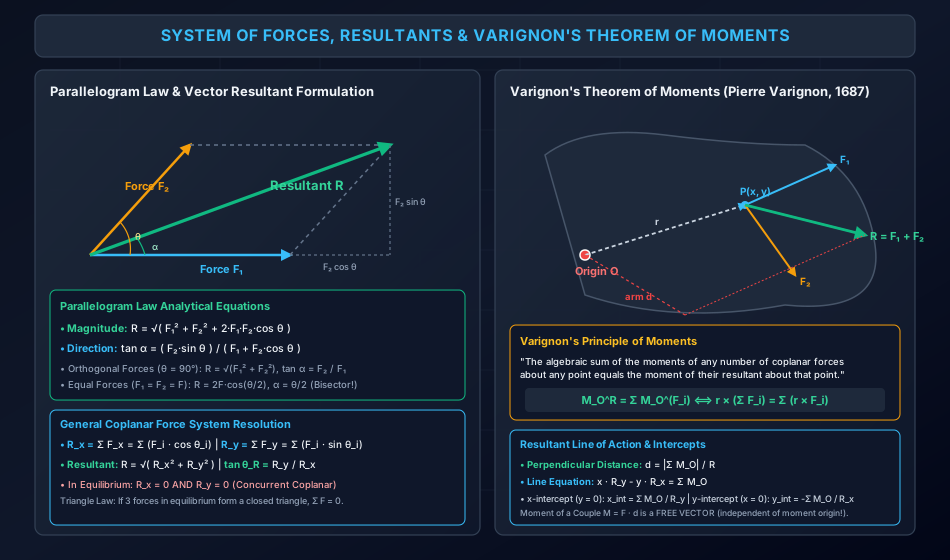
If two concurrent forces acting simultaneously on a body are represented in magnitude and direction by the adjacent sides of a parallelogram drawn from a point, their resultant is represented completely by the diagonal of the parallelogram passing through that point.
Let two forces and act at an angle to each other:
Analytical Derivation of Resultant Magnitude ():
From the right-angled triangle formed by dropping a perpendicular from the opposite vertex (see SVG 1):
Since :
Direction of Resultant ( with Force ):
Special Geometric Cases:
- Forces in Same Direction ():
- Forces in Opposite Direction ():
- Forces at Right Angles ():
- Two Equal Forces (): (The resultant of two equal forces strictly bisects the angle between them!).
4.2 Triangle Law & Polygon Law
- Triangle Law of Forces: If two forces acting at a point are represented in magnitude and direction by the two sides of a triangle taken in order, their resultant is represented in magnitude and direction by the third closing side taken in reverse order.
- Polygon Law of Forces: If a number of coplanar forces acting at a point are represented in magnitude and direction by the sides of an open polygon taken in order, their resultant is represented by the closing side taken in reverse order.
- Equilibrium Corollary: If the polygon of forces forms a completely closed perimeter taken in order, the resultant is zero (), and the concurrent force system is in Static Equilibrium.
5. Moment of a Force, Couples & Force-Couple Equivalence
5.1 Moment of a Force ()
The Moment of a force measures its rotational tendency about a specific pivot point (moment center ).
- Scalar Formulation: where is the perpendicular distance (moment arm) from point to the action line of force . (Sign convention: Counter-Clockwise [CCW] is positive; Clockwise [CW] is negative).
- Vector Cross Product Formulation: where is the position vector drawn from origin to any arbitrary point along the line of action of .
In 2D Cartesian coordinates ():
5.2 Mechanics of Couples
A Couple consists of two parallel forces of equal magnitude (), opposite senses, and non-collinear action lines separated by perpendicular distance .
Fundamental Invariant Properties of Couples:
- Translational Resultant is Zero: . A couple causes pure rotation with zero linear acceleration!
- Moment of a Couple is a Free Vector:
The moment of a couple is independent of the choice of origin! Proof: Let two opposite forces and act at points and with position vectors and from origin : Because depends only on the relative displacement between the two action lines, the moment is completely independent of origin ! - A couple can be shifted anywhere in its plane or to any parallel plane without changing its mechanical effect on a rigid body.
6. Varignon's Theorem of Moments: Analytical Proof & Line of Action
Varignon's Theorem (Theorem of Moments, 1687):
The algebraic sum of the moments of any number of coplanar forces about any point in their plane is identically equal to the moment of their resultant about the same point.
6.1 Vector Proof
Consider a system of concurrent forces acting at a common point with position vector relative to origin . The resultant force is .
The total moment about is:
By the distributive property of the vector cross product:
6.2 Locating the Resultant Line of Action
For a general non-concurrent coplanar force system, once resultant components () and total moment about origin () are computed:
- Perpendicular Distance () from Origin to Action Line:
- Equation of the Line of Action: Using the scalar moment expansion :
- Axis Intercepts:
- Setting
- Setting
7. Free Body Diagrams (FBD): Idealized Support Reactions & Boundary Conditions
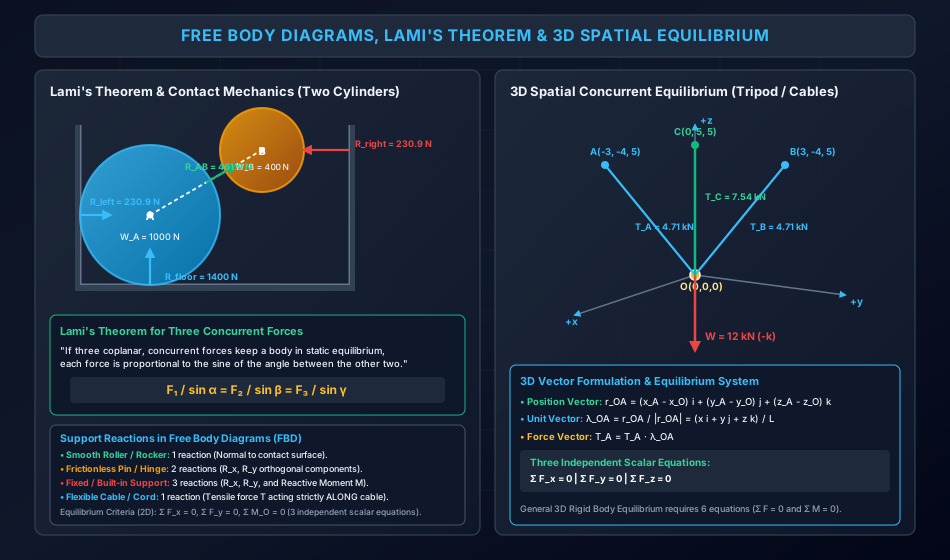
The Free Body Diagram (FBD) is the fundamental analytical tool of engineering statics. It consists of a completely isolated sketch of the physical body stripped of all mechanical supports, with every support replaced by its equivalent reactive force and moment vectors.
7.1 Standard Support Reactions in Civil Engineering
+---------------------------------------------------------------------------------------------------+
| PHYSICAL SUPPORT TYPE       | RESTRAINED MOTIONS                    | UNKNOWNS ON FBD             |
+---------------------+-----------------------------------------------+-----------------------------+
| Smooth Surface Contact| Translation normal to surface prevented       | 1 Reaction: R normal to surf|
| Flexible Cable / Cord | Separation along cable axis prevented         | 1 Tension: T pulling ALONG  |
| Roller / Rocker Bear. | Translation normal to guide track prevented   | 1 Reaction: R normal to base|
| Frictionless Pin/Hinge| Translation in X and Y planes prevented       | 2 Reactions: R_x and R_y    |
| Fixed / Built-in End  | Translation in X, Y and Rotation prevented    | 3 Reactions: R_x, R_y and M |
+---------------------+-----------------------------------------------+-----------------------------+
8. Static Equilibrium Axioms in 2D Space & Alternative Formulations
A rigid body is in Static Equilibrium when it possesses zero linear acceleration and zero angular acceleration.
8.1 Standard Three Scalar Equations
For any 2D coplanar system:
8.2 Alternative Two-Moment Formulation
A system is in equilibrium if:
Condition for Determinacy: The line joining points and must NOT be perpendicular to the -axis.
8.3 Alternative Three-Moment Formulation
A system is in equilibrium if:
Condition for Determinacy: The three moment centers must NOT lie on a straight line (non-collinear).
9. Lami's Theorem for Three Concurrent Coplanar Forces
9.1 Theorem Statement
If three coplanar, concurrent, and non-collinear forces acting on a particle keep it in static equilibrium, each force is directly proportional to the sine of the angle included between the other two forces.
Let forces be in equilibrium at a point. Let:
- Angle between and (opposite to ).
- Angle between and (opposite to ).
- Angle between and (opposite to ).
9.2 Derivation via Triangle Law and Sine Rule
Because are in static equilibrium, their vectors form a closed triangle of forces taken in order:
In the triangle of forces, the interior angles opposite to sides are , , and . Applying the Trigonometric Sine Rule to the closed force triangle:
Since :
[!CAUTION] Lami's Theorem Strict Prerequisites:
- Exactly three forces.
- Forces must be strictly coplanar.
- Forces must be strictly concurrent (intersect at a single point).
- The system must be in static equilibrium.
If any force is added, or if forces do not meet at a common point, Lami's theorem cannot be applied!
10. 3D Spatial Concurrent & Non-Concurrent Equilibrium
In three dimensions, forces and positions must be formulated in vector notation using Cartesian unit vectors :
10.1 Vector Formulation along a Line
For a force of magnitude acting along a cable running from point to anchor :
- Position Vector:
- Length of Cable:
- Unit Vector ():
- Force Vector ():
10.2 Spatial Concurrent Equilibrium Equations
At a common concurrency point :
Separating into three scalar equations:
This produces a system of three linear equations in three unknown cable tensions:
11. Step-by-Step Rigorous Worked Numerical Examples
Problem 1: Contact Mechanics of Two Smooth Cylinders in a Trench (Lami's Theorem)
Problem Statement:
Two smooth, rigid cylinders and rest in a horizontal rectangular trench of width with vertical smooth side walls:
- Cylinder : Weight , Radius (rests on floor and left vertical wall).
- Cylinder : Weight , Radius (rests on cylinder and right vertical wall).
Calculate:
- The angle that the line of centers makes with the horizontal.
- The mutual compressive contact force () between cylinders and .
- The horizontal reactions from the left wall () and right wall ().
- The vertical reaction from the trench floor ().
Step 1: Geometry of the System
- Center-to-center distance:
- Horizontal coordinates from left wall:
- Center of Cylinder : .
- Center of Cylinder : .
- Horizontal distance between centers:
- Angle with horizontal:
Step 2: Free Body Diagram & Equilibrium of Cylinder
Cylinder is subjected to three concurrent forces meeting at its center:
- Gravity weight (vertically downward).
- Right wall reaction (horizontal, pointing left normal to wall).
- Contact force from cylinder (directed along line of centers at above horizontal, pointing upward and right).
Method A: Cartesian Component Equilibrium:
-
Vertical Equilibrium:
-
Horizontal Equilibrium:
Method B: Verification via Lami's Theorem:
- Angle between (down) and (left) .
- Angle between (left) and ( up-right) .
- Angle between (down) and ( up-right) .
Step 3: Free Body Diagram & Equilibrium of Cylinder
Forces acting on Cylinder :
- Weight downward.
- Floor reaction upward.
- Left wall reaction horizontally right.
- Newton's 3rd Law reaction from cylinder : downward and left at .
-
Horizontal Equilibrium:
-
Vertical Equilibrium:
(System Check: Total vertical reaction ; Horizontal wall reactions balance exactly: ).
Problem 2: Non-Concurrent Coplanar Force System & Varignon's Theorem
Problem Statement:
A rigid rectangular structural gusset plate of dimension is subjected to four coplanar forces:
- Force at : .
- Force at : .
- Force at : .
- Force at : .
Calculate:
- The Resultant force vector (), its magnitude, and its angle with the positive -axis.
- The total algebraic moment about origin ().
- The perpendicular distance () from origin to the resultant's line of action.
- The -intercept and -intercept of the resultant line of action.
Step 1: Resultant Force Vector Components
- Magnitude of Resultant:
- Direction ():
Step 2: Total Moment About Origin
Using scalar 2D moment expansion (Counter-Clockwise positive):
- Force at : Passes through origin .
- Force at :
- Force at :
- Force at :
Step 3: Perpendicular Distance () via Varignon's Theorem
Step 4: Line of Action & Axis Intercepts
Using the Cartesian line-of-action formulation:
- -Intercept ():
- -Intercept ():
Problem 3: 3D Spatial Concurrent Force Equilibrium (Symmetrical Tripod Cable Rig)
Problem Statement:
A heavy precast concrete element of weight is suspended at origin by three spatial steel cables anchored to overhead attachment points , and :
- Cable is anchored at .
- Cable is anchored at .
- Cable is anchored at .
- The suspended weight acts vertically downward along the -axis: .
Calculate the tensile force in each of the three cables ().
Step 1: Position Vectors and Cable Lengths
- Cable :
- Cable :
- Cable :
All three cables possess identical lengths: .
Step 2: Formulate Cartesian Force Vectors
Step 3: Equilibrium Equations at Concurrency Node
Multiplying through by :
-
-Direction Equilibrium:
(By lateral symmetry, Cable A and Cable B carry identical tension!)
-
-Direction Equilibrium:
Substituting :
-
-Direction (Vertical) Equilibrium:
Step 4: Solve for Cable Tensions
Substituting and :
Therefore:
12. Comprehensive Exam Question Bank
Section A: GATE CE Previous Years & Anticipated Styles
-
[GATE CE NAT] Two identical smooth cylinders, each of radius and weight , rest in a horizontal rectangular channel of width with vertical smooth side walls. The contact force (in N) between the two cylinders is:
- (A) 500.00
- (B) 577.35
- (C) 707.11
- (D) 1000.00
Answer: (B) .
Solution: Horizontal distance between centers . Center-to-center distance . . For top cylinder, .
-
[GATE CE MCQ] Three coplanar concurrent forces act at a point in equilibrium. The angles opposite to are , respectively. The ratio is:
- (A)
- (B)
- (C)
- (D)
Answer: (A). By Lami's theorem: .
Section B: UPSC ESE Conventional Practice
- [ESE Mains] (a) State and prove Varignon's Theorem of Moments for a system of coplanar concurrent forces.
(b) A uniform ladder of length and weight rests against a smooth vertical wall with its lower end on a rough horizontal floor (). If the ladder makes an angle of with the floor, determine the maximum distance along the ladder a person weighing can climb before the ladder slips.
Section C: SSC JE & State AE/JE Quick Fire
-
Lami's theorem is applicable only when the number of forces in equilibrium is:
- (A) 2
- (B) 3
- (C) 4
- (D) Any number
Answer: (B) Exactly 3.
-
If two equal forces act at an angle of to each other, their resultant is:
- (A)
- (B)
- (C)
- (D)
Answer: (B) .
-
A couple produces:
- (A) Pure translation
- (B) Pure rotation
- (C) Combined translation and rotation
- (D) Zero mechanical motion
Answer: (B) Pure rotation (resultant force is zero).
-
The number of independent scalar equations of equilibrium for a general 3D spatial force system is:
- (A) 2
- (B) 3
- (C) 6
- (D) 9
Answer: (C) 6 ().
13. Common Conceptual Pitfalls & Field Traps
- Applying Lami's Theorem to Non-Concurrent Forces:
Applying Lami's theorem to three forces acting on a rigid body when their lines of action do not meet at a common concurrency point. Lami's theorem is strictly valid only for concurrent vectors! - Angle Misidentification in Lami's Theorem:
Taking the angle between force vectors when they point towards each other rather than diverging away from the concurrency node. Always draw vectors pointing away from the concurrency point before measuring angles! - Internal vs External Transmissibility:
Assuming force transmissibility applies to internal stress calculations. Moving a point load along its action line alters bending moments and shear forces internally, even though external support reactions remain unchanged. - Sign Convention Trap in Varignon Intercepts:
Writing . The correct expansion of gives when . - Fixed Support Reaction Count:
Treating a fixed encastre support as having only two reactions (). A 2D fixed support resists rotation and therefore provides three reactions (, and Reactive Moment ).
14. Quick Reference Formulas & Multi-Code Summary Table
| Category | Parameter | Exact Analytical Formulation |
|---|---|---|
| Parallelogram Law | Resultant Magnitude () | |
| Direction ( with ) | ||
| Equal Forces () | ||
| Moment & Couple | 2D Scalar Moment () | |
| Couple Moment | (Free vector, independent of origin) | |
| Varignon's Theorem | Resultant Moment Law | |
| Moment Arm to Resultant () | ||
| Action Line Equation | ||
| Lami's Theorem | 3-Force Equilibrium | |
| 2D Equilibrium | Three Scalar Conditions | |
| 3D Equilibrium | Six Scalar Conditions | |
| Unit Vector along Cable |