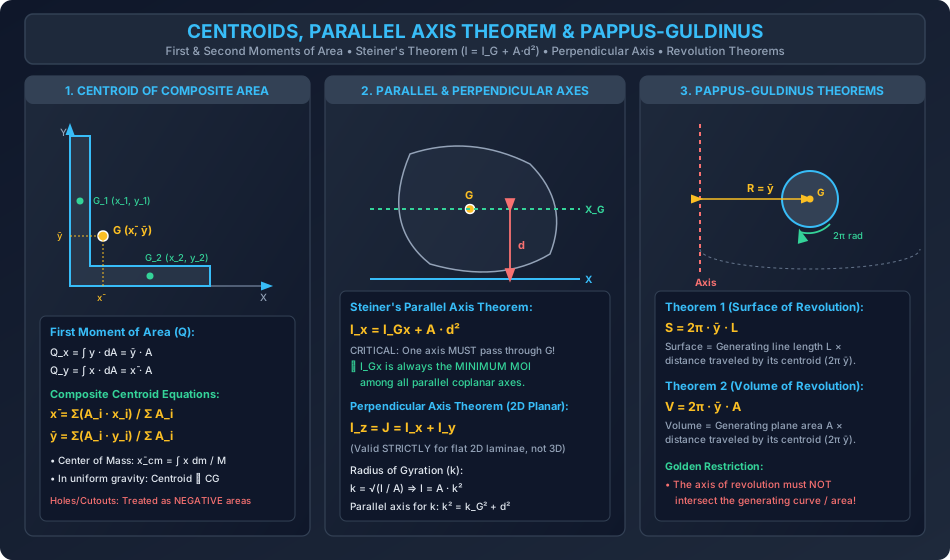
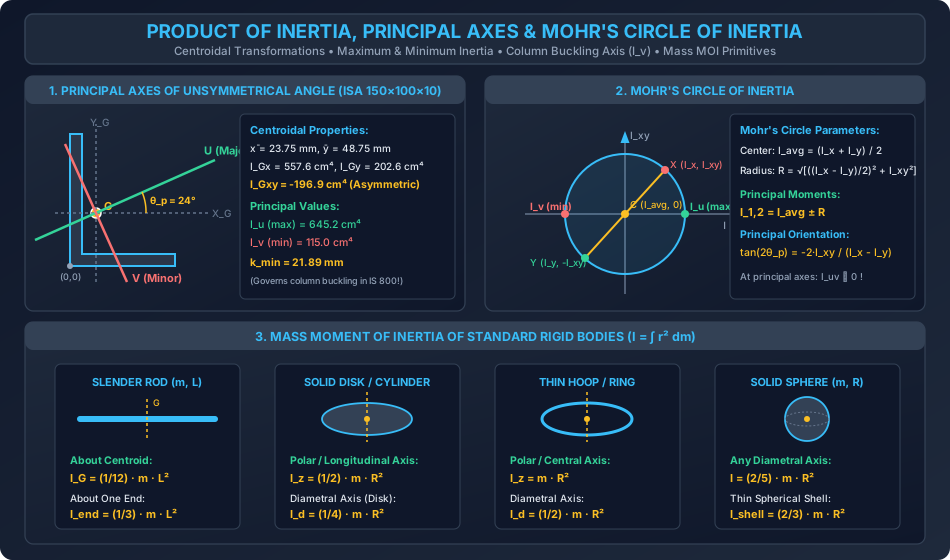
The geometrical and inertial properties of plane areas and three-dimensional rigid bodies represent fundamental pillars of structural mechanics, fluid statics, and structural dynamics. The first moment of area determines the centroid (xˉ,yˉ) and governs shear stress distributions (τ=IbVQ), while the second moment of area (moment of inertia, I) measures the resistance of a cross-section to flexural bending (σ=IMy) and compressive column buckling (Pcr=(KL)2π2EI). In unsymmetrical civil engineering sections—such as cold-formed roof purlins, girt angles, and crane runway channels—the product of inertia (Ixy) produces biaxial coupling, requiring principal axis transformation (u−v) and Mohr's Circle analysis to identify the critical minimum radius of gyration (kmin).
GEOMETRIC AXES vs PRINCIPAL AXES (ISA 150x100x10):
        Y
        ^           V (Minor Principal Axis: k_min = 21.89 mm)
        |          /
    +---+         /
    |   |        /
    |   |       /   U (Major Principal Axis: I_u = 645.2 cm^4)
    |   |      /   /
    |   |     /   /
    |   |    /   /   θ_p = 23.98°
    |   +---+---/---------> X
    |       G  /
    +---------+
Core Definitions
Centroid (G): The geometric center of a plane area, curve, or volume; mathematically, the unique point at which the first moment of area or volume about any passing axis is identically zero.
Center of Mass / Center of Gravity (CG): The point at which the entire mass or weight of a body may be considered concentrated. In a uniform gravitational field, the Center of Gravity coincides identically with the Center of Mass and Centroid.
First Moment of Area (Q): The integral of area elements multiplied by their distance from a reference axis:
Qx=∫ydA=yˉA,Qy=∫xdA=xˉA
Second Moment of Area (Moment of Inertia, I): The integral of area elements multiplied by the square of their distance from a reference axis:
Ix=∫y2dA,Iy=∫x2dA
Polar Moment of Inertia (J or Ip): The moment of inertia of a plane area about an axis perpendicular to its plane:
J=∫r2dA=∫(x2+y2)dA=Ix+Iy
Radius of Gyration (k): The fictitious distance from the reference axis at which the entire area could be concentrated into a thin strip without altering its moment of inertia:
k=AI⟺I=Ak2
Product of Inertia (Ixy): The integral of area elements multiplied by both their x and y coordinate distances:
Ixy=∫xydA
Principal Axes (u−v): A pair of mutually orthogonal axes passing through the centroid about which the product of inertia is identically zero (Iuv=0). One principal axis corresponds to the absolute maximum moment of inertia (Iu), and the other corresponds to the absolute minimum moment of inertia (Iv).
Mohr's Circle of Inertia: A graphical construct in the (I,Ixy) coordinate plane that visually represents the transformation of moments and products of inertia under arbitrary coordinate rotation.
Mass Moment of Inertia (Im): A measure of the rotational inertia of a rigid body about a specified axis:
Im=∫r2dm
2. Foundational Principles & Governing Axioms
2.1 The Two Fundamental Theorems of Area Inertia
Parallel Axis Theorem (Steiner's Theorem):
The moment of inertia of an area about any arbitrary axis is equal to the moment of inertia about a parallel centroidal axis plus the product of the total area and the square of the perpendicular distance separating the two axes:
Ix=IGx+Ady2,Iy=IGy+Adx2
Crucial Governing Axiom: One of the two parallel axes MUST pass through the centroid G. The parallel axis theorem cannot be applied directly between two non-centroidal axes without first transforming through G.
Corollary: Because Ad2≥0, the moment of inertia about a centroidal axis is the absolute minimum among all parallel axes in the plane.
Perpendicular Axis Theorem:
For any plane lamina lying in the x−y plane, the polar moment of inertia about the perpendicular z-axis passing through the origin is equal to the sum of the moments of inertia about the coplanar x and y axes:
Iz=J=Ix+Iy
Crucial Governing Axiom: Valid STRICTLY for two-dimensional planar flat laminae. It cannot be applied to three-dimensional solid bodies.
2.2 Product of Inertia Axioms & Symmetry
Sign of Product of Inertia: Unlike moments of inertia (Ix,Iy>0), the product of inertia Ixy can be positive, negative, or zero depending on the distribution of area in the four Cartesian quadrants.
Symmetry Theorem: If a plane area possesses at least one axis of geometric symmetry, the product of inertia with respect to that axis and any perpendicular axis is identically zero:
Symmetry about X or Y⟹Ixy=0
Consequently, for symmetric sections (I-beams, T-sections, rectangular channels, circular pipes), the geometric centroidal axes are already the principal axes!
Parallel Axis Theorem for Product of Inertia:Ixy=IGxy+Axˉyˉ
3. Step-by-Step Analytical Derivations
3.1 Derivation of the Parallel Axis Theorem
Consider a plane area A in the x−y plane. Let G(xˉ,yˉ) be the centroid.
Define centroidal coordinates x′,y′ such that:
x=xˉ+x′,y=yˉ+y′
By definition of centroid:
∫x′dA=0,∫y′dA=0
Reference Y
    ^       Centroidal Y'
    |          ^
    |          |
    |          +--- Area dA (x', y')
    |          |
    |     d_x  |
    +--------->G (Centroid)
    |          |
    +------------------------> Reference X
              d_y
Now evaluate the moment of inertia about the reference x-axis:
Let a plane curve of length L lying in a plane be rotated by an angle θ (or a full 2π radians) about an axis in its plane that does not intersect the curve.
Consider an infinitesimal arc length dL located at perpendicular distance y from the axis.
Upon rotation through 2π radians, dL sweeps out a ring surface area:
dAs=2πydL
Integrating over the entire length L:
As=∫2πydL=2π∫ydL
By definition of the centroid of a line, ∫ydL=yˉL. Therefore:
As=2πyˉL
The surface area generated equals the length of the generating curve multiplied by the distance traveled by its centroid.
Theorem 2 (Volume of Revolution):
Let a plane area A be rotated by 2π radians about a non-intersecting coplanar axis.
An area element dA located at distance y sweeps out a circular ring of volume:
dV=2πydA
Integrating over the entire area A:
V=∫2πydA=2π∫ydA=2π(yˉA)V=2πyˉA
The volume generated equals the generating plane area multiplied by the distance traveled by its centroid.
3.3 Principal Axes & Mohr's Circle Transformation Equations
Let centroidal coordinates (x,y) be rotated counter-clockwise through an angle θ to new axes (x1,y1):
Diagram 2: Product of Inertia, Principal Axes & Mohr's Circle of Inertia
6. Standard Practice Guidelines & Boundary Conditions
6.1 Codal Provisions for Structural Steel Sections (IS 800:2007)
Compressive Buckling Governed by kmin (Cl. 7.1.2):
In structural steel design, compressive strength (fcd) depends on the maximum slenderness ratio λ=rKL.
For single-angle struts (e.g., roof truss web members, transmission tower diagonals), buckling always occurs about the minor principal axis v−v, where the radius of gyration is minimum (rmin=rv):
λmax=rvL
Attempting to design the strut using rx or ry leads to catastrophic underestimation of slenderness and premature elastic buckling failure!
Purlins Subject to Biaxial Bending:
Cold-formed Z-purlins and angle purlins resting on sloping roof trusses experience loads perpendicular to both geometric axes.
Design requires transforming moments into principal axes:
σ=IuMuv+IvMvu
7. Critical Failure Modes & Edge Cases
7.1 Applying Parallel Axis Theorem Between Two Non-Centroidal Axes
Fatal Error: A student calculates I about an axis A−A, and then tries to find I about parallel axis B−B using:
IBB=IAA+AdAB2[COMPLETELY WRONG!]
Correct Formulation: The parallel axis theorem holds ONLY when one axis passes through the centroid G:
IGx=IAA−AdGA2⟹IBB=IGx+AdGB2=IAA−AdGA2+AdGB2
7.2 Cutouts and Negative Area Rules
When determining the centroid and moment of inertia of plates with holes or cutouts, holes are incorporated as negative areas (Ah<0):
xˉ=Asolid−AholeAsolidxˉs−Aholexˉh,Ix=(Ixs+Asds2)−(Ixh+Ahdh2)
7.3 Applying Perpendicular Axis Theorem to 3D Solids
The identity Iz=Ix+Iy is strictly valid only for plane laminae where z=0. For a 3D solid (such as a cylinder or box), Iz=Ix+Iy because all three Cartesian moments contain z2:
Ix=∫(y2+z2)dm,Iy=∫(x2+z2)dm,Iz=∫(x2+y2)dm⟹Ix+Iy=∫(x2+y2+2z2)dm=Iz+2∫z2dm=Iz
8. Worked Numerical Problems
Problem 1: Centroid & Moment of Inertia of an Unsymmetrical Angle Section (ISA 150×100×10 mm)
Statement:
An unsymmetrical rolled steel angle section has the following nominal dimensions:
Vertical leg: 150.0 mm height, 10.0 mm thickness
Horizontal leg: 100.0 mm width, 10.0 mm thickness
Place the Cartesian origin (0,0) at the outer heel corner of the angle.
Determine:
The total cross-sectional area A and the coordinates of the centroid (xˉ,yˉ).
The moments of inertia Ix,Iy and product of inertia Ixy about the heel axes.
The centroidal moments of inertia IGx,IGy and product of inertia IGxy.
The radii of gyration kGx and kGy.
Solution & Calculations:
    Y
    ^
    |  Vertical leg: 140 mm x 10 mm (Segment 1)
    +---+
    |   |  A1 = 1400 mm^2, x1 = 5 mm, y1 = 80 mm
    |   |
    |   |
    |   |
    |   |
    |   |
    |   +-----------------------+
    |   |                       | Horizontal leg: 100 mm x 10 mm (Segment 2)
    +---+-----------------------+------> X
  (0,0)   A2 = 1000 mm^2, x2 = 50 mm, y2 = 5 mm
Step 1: Decomposition & Centroid Coordinates
Divide the angle into two non-overlapping rectangles:
Segment 1 (Vertical leg above base):b1=10.0 mm,h1=140.0 mmA1=10.0×140.0=1400.0 mm2x1=210.0=5.0 mm,y1=10.0+2140.0=80.0 mm
Segment 2 (Horizontal leg):b2=100.0 mm,h2=10.0 mmA2=100.0×10.0=1000.0 mm2x2=2100.0=50.0 mm,y2=210.0=5.0 mm
Total Area:
A=A1+A2=1400.0+1000.0=2400.0 mm2
Centroid Coordinates:
xˉ=AA1x1+A2x2=2400.0(1400.0×5.0)+(1000.0×50.0)=2400.07000.0+50000.0=2400.057000.0=23.750 mmyˉ=AA1y1+A2y2=2400.0(1400.0×80.0)+(1000.0×5.0)=2400.0112000.0+5000.0=2400.0117000.0=48.750 mm
Radius of Mohr's Circle (R):
R=(2IGx−IGy)2+IGxy2=(1,775,000.0)2+(−1,968,750.0)2R=3.150625×10¹²+3.87597656×1012=7.02660156×1012=2,650,773.77 mm4=265.077 cm4
Step 2: Principal Moments of Inertia
Major Principal Moment of Inertia (Iu):Iu=Iavg+R=3,801,250.0+2,650,773.77=6,452,023.77 mm4=645.202 cm4
Minor Principal Moment of Inertia (Iv):Iv=Iavg−R=3,801,250.0−2,650,773.77=1,150,476.23 mm4=115.048 cm4
The major principal axis U−U is inclined counter-clockwise at 23.981∘ to the centroidal XG axis.
The minor principal axis V−V is perpendicular to U−U, inclined at θp+90∘=113.981∘.
Step 4: Minimum Radius of Gyration (kmin)
kmin=kv=AIv=2400.01,150,476.23=479.365=21.894 mm
Structural Engineering Impact:
While kGx=48.20 mm and kGy=29.06 mm, the actual weakest axis of the section has kmin=21.89 mm—which is 24.6% lower than kGy!
Because Euler buckling capacity varies with k2 (Pcr∝k2), the actual buckling load about the minor principal axis is:
Pcr(y)Pcr(v)=(29.05621.894)2=(0.7535)2=0.5678⟹43.2% REDUCTION IN CAPACITY!
Ignoring product of inertia and principal axis rotation would overestimate the column load capacity by nearly two-fold, causing catastrophic structural collapse.
Problem 3: Pappus-Guldinus Theorems & Rigid Body Mass Moment of Inertia
Statement:
Pappus-Guldinus: A circular steel ring (torus) of circular cross-section with radius r=30.0 mm is formed by revolving the circle about a vertical coplanar axis located at distance R=100.0 mm from its center.
Calculate the total external surface area S and enclosed volume V of the torus.
Mass Moment of Inertia of Composite Flywheel:
A cast-iron industrial flywheel consists of:
A heavy outer rim of mass Mrim=250.0 kg and mean radius Rm=0.60 m.
A central solid disk/web of mass Mdisk=150.0 kg and outer radius Rd=0.50 m.
Calculate the total mass moment of inertia I of the flywheel about its rotational axis and its effective radius of gyration k.
Solution & Calculations:
Part A: Pappus-Guldinus Analysis of Torus
Generating Curve: Circle perimeter L=2πr=2π(0.030)=0.1884956 m.
Generating Area: Circle area A=πr2=π(0.030)2=0.00282743 m2.
Distance traveled by centroid: yˉ=R=0.100 m.
Path length: 2πyˉ=2π(0.100)=0.6283185 m.
Outer Rim (Treated as thin cylindrical hoop):Irim=MrimRm2=250.0×(0.60)2=250.0×0.36=90.00 kg⋅m2
Central Solid Disk:Idisk=21MdiskRd2=21×150.0×(0.50)2=75.0×0.25=18.75 kg⋅m2
Total Mass Moment of Inertia:Itotal=Irim+Idisk=90.00+18.75=108.75 kg⋅m2
Total Mass & Effective Radius of Gyration:Mtotal=Mrim+Mdisk=250.0+150.0=400.0 kgk=MtotalItotal=400.0108.75=0.271875=0.5214 m=521.4 mm
9. Comparative Exam Analysis
Parameter / Feature
GATE CE
UPSC ESE
SSC JE
RRB JE
State AE
Weightage
2 - 3 Marks (NAT / MCQ)
10 - 16 Marks (Obj + Conv)
3 - 5 Marks (Direct CBT)
2 - 4 Marks (Direct CBT)
4 - 8 Marks (Obj + Conv)
Primary Question Type
Principal axes rotation, Minor radius of gyration kmin, Pappus-Guldinus
Full derivation of Steiner's theorem, Mohr circle of inertia, composite T/L sections
Centroid of triangle (h/3), semicircle (4R/3π), rectangle bh3/12
Formula recall: Circle πD4/64, polar MOI J=Ix+Iy
Built-up I-section MOI, Slenderness calculation with rmin
Tricky Traps
Forgetting product of inertia IGxy in angle struts; Confusing Ibase and IG
Direct application of parallel axis between two non-centroidal axes
Using h/2 for triangle centroid instead of h/3 from base
Applying perpendicular axis theorem to 3D cylinders
Semicircle centroid 4R/(3π) vs 3R/8 (hemisphere CG)
Speed vs Depth
Analytical precision, exact matrix invariants
Comprehensive mathematical derivations with full drawings
Pure speed: 20-30 seconds per question
Rapid 15-second formula matching
Standard composite sections & IS 800 codal tables
10. Common Pitfalls & Traps
The Non-Centroidal Parallel Axis Trap:
Attempting I2=I1+Ad2 where axis 1 is NOT the centroidal axis. Steiner's theorem requires going to G first: IG=I1−Ad12, then I2=IG+Ad22.
Confusing Semicircle Centroid with Solid Hemisphere Center of Gravity:
Planar Semicircle (Area): yˉ=3π4R≈0.4244R.
Solid Hemisphere (Volume/Mass): yˉ=83R=0.375R.
Hemispherical Thin Shell: yˉ=2R=0.50R.
Triangle Moment of Inertia Confusion:
About centroidal axis parallel to base: IG=36bh3.
About the base itself: Ibase=36bh3+(2bh)(3h)2=12bh3.
About an axis passing through the apex: Iapex=36bh3+(2bh)(32h)2=4bh3.
Incorrect Sign of Product of Inertia (Ixy):
In angle sections with legs in the first quadrant, x>0 and y>0, so heel Ixy>0. However, after subtracting Axˉyˉ, the centroidal product of inertia IGxy is frequently negative!
Applying Perpendicular Axis Theorem to 3D Bodies:
Iz=Ix+Iy is strictly valid only when z≡0 (flat 2D laminae). For solid disks or spheres, Iz=Ix+Iy.
11. Real-World Civil & Structural Applications
Steel Strut Buckling (IS 800:2007):
Single and double angle struts in roof trusses and transmission towers are designed against buckling about the minor principal axis v−v with radius of gyration kmin=kv.
Unsymmetrical Bending in Bridge Deck Girders:
Trapezoidal box girders, channel facias, and skewed bridge cross-girders experience unsymmetrical bending where the neutral axis is tilted relative to the bending moment vector.
Hydrostatic Pressure Centers on Submerged Gates (Fluid Mechanics):
The center of pressure on submerged dam gates and sluice valves is located at hcp=hˉ+AhˉIGsin2θ, directly governed by the second moment of area IG.
Earthquake Base Shear & Torsional Irregularity (IS 1893:2016):
When the center of mass (CM) of a building does not coincide with its center of stiffness / rigidity (CR), lateral seismic forces induce dangerous torsional moments governed by the polar mass moment of inertia (Jm=∫r2dm).
12. Comprehensive Summary & Quick Revision Guide
First Moment of Area:Qx=yˉA,Qy=xˉA⟹xˉ=∑Ai∑Aixi,yˉ=∑Ai∑Aiyi.
Parallel Axis Theorem:I=IG+Ad2 (IG is strictly the minimum among parallel axes).
Problem 1 (Built-Up T-Section MOI):
A symmetrical T-section consists of a flange 200 mm×20 mm and a web 150 mm×20 mm. Calculate the distance of the centroid from the top face of the flange and the centroidal moment of inertia IGx.
(Answer: yˉtop=47.14 mm, IGx=2.457×107 mm4=2457.1 cm4)
Problem 2 (Pappus-Guldinus Cone Volume & Area):
A right-circular cone of base radius R=150 mm and height H=200 mm is generated by rotating a right-angled triangle about its vertical side H. Using Pappus-Guldinus Theorem 2, verify the formula for the volume of a cone (V=31πR2H).
(Answer: Area A=21RH=15,000 mm2. Centroid xˉ=R/3=50.0 mm. Volume V=2πxˉA=2π(50.0)(15,000)=1.5π×106 mm3=31π(150)2(200)=4,712,389 mm3)
Problem 3 (Mass MOI of Hollow Cylinder):
A hollow steel shaft of length L=2.0 m, outer radius Ro=100 mm, inner radius Ri=80 mm, and density ρ=7850 kg/m3 rotates about its longitudinal axis. Calculate its total mass M and mass moment of inertia Iz.
(Answer: M=ρπ(Ro2−Ri2)L=7850×π×(0.010−0.0064)×2.0=177.56 kg. Iz=21M(Ro2+Ri2)=21×177.56×(0.010+0.0064)=1.456 kg⋅m2)
14. References & Standard Texts
Beer, F. P., Johnston, E. R., Mazurek, D. F. — Vector Mechanics for Engineers: Statics and Dynamics, 12th Edition, McGraw-Hill.
Hibbeler, R. C. — Engineering Mechanics: Statics, 14th Edition, Pearson Education.
Timoshenko, S. P., Young, D. H. — Elements of Strength of Materials, 5th Edition, Van Nostrand.
Bhavikatti, S. S. — Engineering Mechanics, 6th Edition, New Age International.
Bureau of Indian Standards (BIS):
SP: 6(1)-1964 — ISI Handbook for Structural Engineers: Part 1 - Structural Steel Sections.
IS 800:2007 — General Construction in Steel - Code of Practice (Buckling & Slenderness Provisions).
IS 1893 (Part 1):2016 — Criteria for Earthquake Resistant Design of Structures (Torsional Irregularity).