Critical Path Method (CPM): Forward & Backward Pass, Float Mathematics & Network Scheduling
In this chapter (1 topics)
On this page
- 1. Module Overview & Pedagogical Scope
- 2. Learning Objectives & Exam Weightage Analysis
- Learning Objectives
- Exam Weightage Analysis
- 3. Critical Path Method (CPM) Philosophy & Deterministic Foundations
- 3.1 Distinctive Characteristics of CPM
- 3.2 Dual-Node Notation
- 4. Forward Pass Computations: Early Times (TE, ES, EF)
- 4.1 Earliest Event Time (TE, j)
- 4.2 Early Activity Times (ESij, EFij)
- 5. Backward Pass Computations: Late Times (TL, LF, LS)
- 5.1 Latest Event Time (TL, i)
- 5.2 Late Activity Times (LFij, LSij)
- 6. Event Slack Mechanics: Zero, Positive & Negative States
- 7. Rigorous Mathematical Formulations of the Four Floats
- 7.1 Total Float (TF)
- 7.2 Free Float (FF)
- 7.3 Independent Float (IF)
- 7.4 Interfering Float (IT)
- 8. The Universal Float Hierarchy Inequality (TF ≥ FF ≥ IF)
- 8.1 Mathematical Proof of Hierarchy
- 9. The Three Inviolable Conditions for Critical Activities
- 9.1 Three Simultaneous Conditions
- 9.2 The Classic Zero-Slack Trap (Vital GATE & ESE Trap)
- 10. Sub-Critical, Critical, and Super-Critical Network Paths
- 11. Step-by-Step Rigorous Worked Numerical Examples
- Problem 1: Complete CPM Network Forward & Backward Pass with Floats
- Problem 2: Demonstration of Non-Critical Activity Between Critical Events
- Problem 3: Contractual Target Constraint and Super-Critical Network Analysis
- 12. Comprehensive Exam Question Bank
- Section A: GATE CE Previous Years & Anticipated Styles
- Section B: UPSC ESE Conventional Practice
- Section C: SSC JE & State AE/JE Quick Fire
- 13. Common Conceptual Pitfalls & Field Traps
- 14. Quick Reference Formulas & Multi-Code Summary Table
1. Module Overview & Pedagogical Scope
The Critical Path Method (CPM) is the foundational mathematical technique of deterministic network analysis in civil engineering infrastructure management. Developed in 1957 through a collaborative endeavor between the DuPont chemical corporation and Remington Rand Univac, CPM was engineered specifically for large-scale industrial construction, maintenance, and plant turnaround projects where activity durations can be estimated with high historical confidence.
Unlike probabilistic research-and-development models (such as PERT), CPM operates within a deterministic framework:
- Every distinct work activity is characterized by a single known duration ().
- Direct relationships exist between activity durations and direct resource costs.
- Network scheduling reveals the longest sequence of dependent tasks—the Critical Path—which governs the minimum possible elapsed duration required to complete the entire project.
This comprehensive master module synthesizes:
- Forward Pass Analysis: Computing Earliest Event Times (), Early Start (), and Early Finish () through recursive maximization at merge nodes.
- Backward Pass Analysis: Computing Latest Event Times (), Late Finish (), and Late Start () through recursive minimization at burst nodes.
- Float Mathematics: Complete mathematical formulations and geometric proofs for the Four Types of Floats: Total Float (), Free Float (), Independent Float (), and Interfering Float (), establishing the universal hierarchy .
- Critical Path Axioms: Deriving the three simultaneous criteria for critical activities and resolving the classic engineering trap of non-critical tasks bridging zero-slack nodes.
- Path Classification: Quantitative boundaries separating sub-critical (), critical (), and super-critical () paths under fixed contractual targets.
2. Learning Objectives & Exam Weightage Analysis
Learning Objectives
- State the deterministic axioms of the Critical Path Method (CPM) and execute forward pass calculations to determine Earliest Event Times ().
- Execute backward pass calculations from target project completion dates to determine Latest Event Times ().
- Formulate the four basic activity times: Early Start (), Early Finish (), Late Start (), and Late Finish ().
- Define, derive, and calculate the four fundamental floats: Total Float (), Free Float (), Independent Float (), and Interfering Float ().
- Prove mathematically that for every activity in any network configuration.
- Verify whether an activity lies on the critical path using the three simultaneous criteria: , , and .
- Analyze super-critical networks exhibiting negative float under accelerated contractual completion constraints.
Exam Weightage Analysis
| Exam Stream | Typical Question Type | Average Weightage | Recurring Focus Concepts |
|---|---|---|---|
| GATE CE | Numerical Answer Type (NAT) & MCQ | 2 – 4 Marks | Calculation of Total Float, Free Float, and Independent Float; duration of critical path; zero-slack trap. |
| UPSC ESE (Prelims & Mains) | Objective + Multi-step Conventional | 12 – 24 Marks | Full network table reduction (ES, EF, LS, LF, TF, FF, IF); derivation of float formulas; super-critical paths. |
| SSC JE / RRB JE | Objective (Formulas & Definitions) | 3 – 5 Questions | Formula for Total Float ( or ), Free Float (), definition of critical path. |
| State PSC AE/JE | Mixed Objective & Short Problem | 4 – 8 Marks | Total project duration, identifying critical path, condition for critical activity, interfering float (). |
3. Critical Path Method (CPM) Philosophy & Deterministic Foundations
3.1 Distinctive Characteristics of CPM
The Critical Path Method is distinguished by three core operational axioms:
- Activity-Oriented Nature: The primary analytical focus is on the work activities () that consume time, labor, equipment, and capital.
- Deterministic Time Estimation: A single, highly predictable time duration () is assigned to each activity based on standard productivity norms, equipment capacities, and historical site data.
- Cost-Time Trade-Off Capability: Every activity has a defined normal cost and crash cost, enabling structured crashing algorithms to accelerate schedules at minimum economic cost.
3.2 Dual-Node Notation
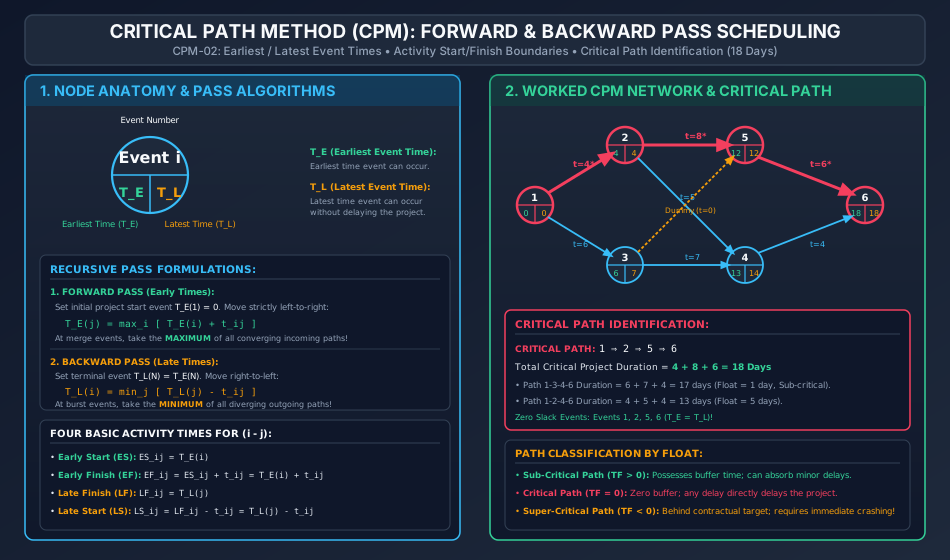
In an Activity-on-Arrow network, every event node represents an instantaneous accomplishment and is partitioned into geometric sectors to store temporal progress:
- Upper Sector: Event Number / Identifier ().
- Lower-Left Sector: Earliest Event Time ().
- Lower-Right Sector: Latest Event Time ().
4. Forward Pass Computations: Early Times ()
The forward pass moves systematically forward through the network from the initial project start event to the final project terminal event, calculating the earliest possible times at which events and activities can occur.
4.1 Earliest Event Time ()
- Boundary Condition: The initial start event (Event ) is assigned a time datum of zero:
- Recursive Forward Propagation: For any subsequent event , its earliest occurrence time is governed by the completion of all preceding activities entering event : (where the maximization is conducted across all incoming arrows converging into merge event ).
4.2 Early Activity Times ()
For any activity having duration :
- Early Start Time (): The earliest possible instant the activity can begin. An activity cannot start until its tail event has occurred:
- Early Finish Time (): The earliest possible instant the activity can be completed:
5. Backward Pass Computations: Late Times ()
The backward pass moves systematically backward from the final project terminal event to the initial start event, calculating the latest allowable times at which events and activities can occur without postponing the scheduled project completion date.
5.1 Latest Event Time ()
- Boundary Condition: For the final terminal event , unless an external contractual completion date is imposed, the latest allowable time is set equal to its earliest event time:
- Recursive Backward Propagation: For any preceding event , its latest allowable occurrence time is governed by the latest start times of all succeeding activities emerging from event : (where the minimization is conducted across all outgoing arrows diverging from burst event ).
5.2 Late Activity Times ()
For any activity having duration :
- Late Finish Time (): The latest possible instant the activity can finish without delaying the overall project completion:
- Late Start Time (): The latest possible instant the activity can begin without delaying project completion:
6. Event Slack Mechanics: Zero, Positive & Negative States
Event Slack () is a property of an event node that quantifies the buffer time available:
+---------------------------------------------------------------------------------------------------+
| EVENT SLACK STATE   | MATHEMATICAL CONDITION | OPERATIONAL INTERPRETATION                         |
+---------------------+------------------------+----------------------------------------------------+
| Zero Slack          | S_i = T_L,i - T_E,i = 0 | Critical Event: Zero buffer; strictly on schedule. |
+---------------------+------------------------+----------------------------------------------------+
| Positive Slack      | S_i = T_L,i - T_E,i > 0 | Sub-Critical Event: Surplus time; ahead of schedule.|
+---------------------+------------------------+----------------------------------------------------+
| Negative Slack      | S_i = T_L,i - T_E,i < 0 | Super-Critical Event: Deficit time; behind target. |
+---------------------+------------------------+----------------------------------------------------+
7. Rigorous Mathematical Formulations of the Four Floats
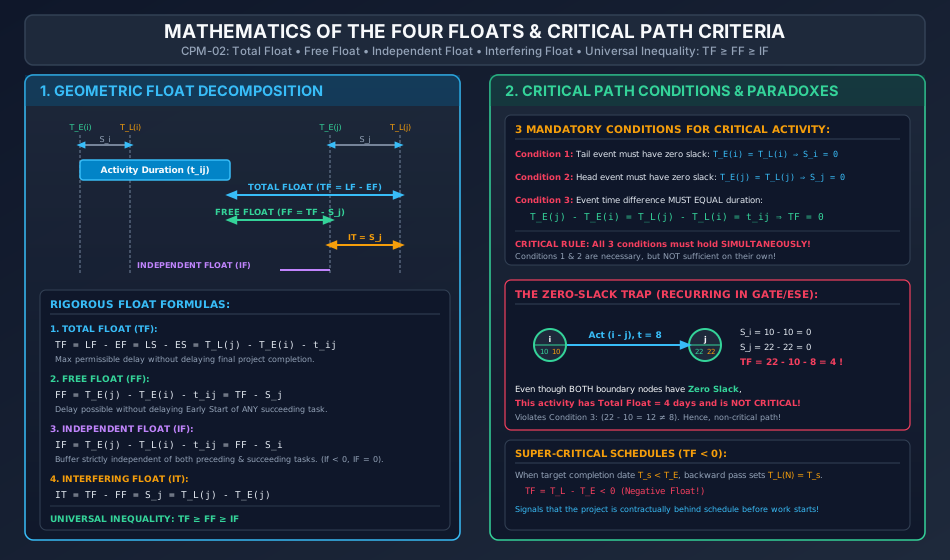
While Slack is strictly a property of an Event (Node), Float is strictly a property of an Activity. Float represents the temporal flexibility or scheduling buffer associated with a task.
7.1 Total Float ()
Definition: The maximum duration of time by which an activity can be delayed beyond its early start without delaying the overall project completion date.
Substituting event times ( and ):
- Total float is a shared property of an entire path sequence. Consuming total float on an upstream task reduces the total float available to downstream tasks on that path.
7.2 Free Float ()
Definition: The duration of time by which an activity can be delayed without delaying the early start time of any immediately succeeding activity.
Relationship between Total Float and Free Float:
Recall that head event slack is . Substituting into the Free Float equation:
(Free Float equals Total Float minus Head Event Slack).
7.3 Independent Float ()
Definition: The duration of time by which an activity can be delayed when its preceding activities finish as late as possible () and all succeeding activities are scheduled to start as early as possible ():
Relationship between Free Float and Independent Float:
Recall that tail event slack is . Substituting into the Independent Float equation:
(Independent Float equals Free Float minus Tail Event Slack).
[!NOTE] Independent Float is an autonomous buffer owned solely by that specific activity; consuming it has zero impact on either predecessor or successor tasks. If mathematical calculation yields , it is reported as in construction practice.
7.4 Interfering Float ()
Definition: That portion of the Total Float which, if utilized, delays the early start of subsequent activities without delaying project completion:
From :
(Interfering Float is identically equal to the Slack of the Head Event).
8. The Universal Float Hierarchy Inequality ()
8.1 Mathematical Proof of Hierarchy
For any real activity in a feasible network, event slacks are non-negative ( and ):
- Comparing Total Float and Free Float: Since :
- Comparing Free Float and Independent Float: Since :
Combining both expressions yields the Universal Float Hierarchy Inequality:
+---------------------------------------------------------------------------------------------------+
| FLOAT HIERARCHY SUMMARY:                                                                          |
|   1. Total Float (TF)       : Broadest buffer, shared along entire path.                          |
|   2. Free Float (FF)        : Buffer localized to head event; protects succeeding tasks.          |
|   3. Independent Float (IF) : Most restrictive buffer; completely autonomous (never < 0).         |
|   4. Interfering Float (IT) : Equal to Head Event Slack (S_j = TF - FF).                          |
+---------------------------------------------------------------------------------------------------+
9. The Three Inviolable Conditions for Critical Activities
The Critical Path is the longest path from the initial event to the terminal event in terms of total duration. Every activity lying along the critical path is a Critical Activity.
9.1 Three Simultaneous Conditions
For an activity with duration to lie on the critical path, all three of the following mathematical conditions must be satisfied simultaneously:
- Condition 1 (Tail Event Zero Slack):
- Condition 2 (Head Event Zero Slack):
- Condition 3 (Zero Activity Floats):
9.2 The Classic Zero-Slack Trap (Vital GATE & ESE Trap)
[!CAUTION] It is a common misconception that any activity connecting two zero-slack events is automatically critical. This is completely false!
Conditions 1 and 2 are necessary, but NOT sufficient. If Condition 3 is violated, an activity bridging two zero-slack nodes will have positive float and is strictly non-critical.
Mathematical Proof:
Let activity connect event (, ) and event (, ).
Let the duration of activity be .
- Total Float:
- Free Float:
- Independent Float:
Because , this activity has 4 days of buffer and does not lie on the critical path, even though both of its boundary events are critical nodes!
10. Sub-Critical, Critical, and Super-Critical Network Paths
When a project is constrained by an external contractual completion deadline :
- Backward pass sets: .
- If : The project has positive buffer across all paths. The path with minimum float is the critical path, but its float is positive ().
- If : Standard CPM baseline ().
- If : The contractual target is shorter than the minimum physical network duration.
- The critical path exhibits Negative Float ().
- A path with negative float is termed a Super-Critical Path.
- Management must immediately crash or fast-track activities along the super-critical path to eliminate negative float and avoid contractual liquidated damages.
11. Step-by-Step Rigorous Worked Numerical Examples
Problem 1: Complete CPM Network Forward & Backward Pass with Floats
Problem Statement:
A project network consists of 6 events and 8 activities (including 1 dummy). The activities and their estimated durations are:
- Activity :
- Activity :
- Activity :
- Activity :
- Activity :
- Activity : Dummy activity ,
- Activity :
- Activity :
Calculate:
- Earliest Event Times () and Latest Event Times () for all events to .
- The Critical Path and total project completion time.
- Construct a complete scheduling table tabulating , and for every activity.
Step 1: Forward Pass Computations ()
- Event : Initial start node:
- Event : Single incoming activity :
- Event : Single incoming activity :
- Event : Merge event with incoming activities and :
- Event : Merge event with incoming activities and dummy :
- Event : Terminal merge event with incoming activities and :
Step 2: Backward Pass Computations ()
- Event : Terminal boundary condition:
- Event : Outgoing activity :
- Event : Outgoing activity :
- Event : Burst event with outgoing activity and dummy :
- Event : Burst event with outgoing activities and :
- Event : Burst event with outgoing activities and :
Step 3: Event Slack Analysis
- Event : [Critical]
- Event : [Critical]
- Event : [Slack = 1]
- Event : [Slack = 1]
- Event : [Critical]
- Event : [Critical]
Step 4: Complete Activity Scheduling & Float Table
| Activity | Duration | Critical? | ||||||||
|---|---|---|---|---|---|---|---|---|---|---|
| CRITICAL | ||||||||||
| No | ||||||||||
| No | ||||||||||
| No | ||||||||||
| CRITICAL | ||||||||||
| No | ||||||||||
| No | ||||||||||
| CRITICAL |
Problem 2: Demonstration of Non-Critical Activity Between Critical Events
Problem Statement:
In a refinery maintenance project, an engineering pipeline inspection activity has an estimated duration of .
Network analysis yields the following event times:
- Event :
- Event :
- Compute the slack of events and .
- Compute Total Float, Free Float, and Independent Float of activity .
- Determine whether activity is critical, and justify why it does or does not lie on the critical path.
Step 1: Event Slacks
Both boundary events satisfy Critical Conditions 1 and 2!
Step 2: Compute Activity Floats
- Total Float ():
- Free Float ():
- Independent Float ():
- Interfering Float ():
Step 3: Criticality Determination
Even though both tail event and head event have Zero Slack, activity has:
Engineering Rationale: The time window between event 8 and event 14 is . Because the activity requires only , it has of float. Condition 3 () is violated (). It does not lie on the critical path.
Problem 3: Contractual Target Constraint and Super-Critical Network Analysis
Problem Statement:
A bridge reconstruction project has a critical path duration computed from forward pass as .
The client imposes a strict contractual completion deadline with liquidated damages after .
- Perform the backward pass termination and compute the project terminal slack.
- Determine the Total Float of activities along the critical path.
- Classify the resulting network and explain the engineering interventions required to return to feasibility.
Step 1: Backward Pass Boundary Condition & Slack
Because target date is mandatory:
The terminal event slack is:
Step 2: Total Float Along Critical Path
For any activity on the primary path:
The total float is negative!
Step 3: Path Classification & Interventions
- Classification: The path is a Super-Critical Path ().
- Implication: The project is already projected to breach the contract by 21 days before physical ground is broken!
- Engineering Remedial Interventions:
- Activity Crashing: Identify critical activities with the lowest cost slope () and compress their durations by 3 weeks through overtime, additional crews, or high-capacity equipment.
- Fast-Tracking (Pipelining): Convert rigid Finish-to-Start () dependencies into overlapping Start-to-Start () relationships with leads and lags.
- Scope De-scoping: Re-negotiate non-essential deliverables or seek an authorized extension of time (EOT).
12. Comprehensive Exam Question Bank
Section A: GATE CE Previous Years & Anticipated Styles
-
[GATE CE] For an activity in a network, the earliest start time is Day 5, latest start time is Day 12, earliest finish time is Day 15, and latest finish time is Day 22. If the head event slack is 3 days, the free float of the activity is:
- (A) 0 days
- (B) 3 days
- (C) 4 days
- (D) 7 days
Answer: (C). Total Float (or ). Free Float .
-
[GATE CE] Consider the following statements regarding the Critical Path Method:
- I. The critical path is the shortest path in terms of time through the network.
- II. An activity connecting two critical events is always a critical activity.
- III. Free float can never exceed Total float.
- IV. Independent float can be negative in mathematical calculations.
Which of the above statements are CORRECT? - (A) I and II
- (B) III and IV
- (C) II and III
- (D) I, III and IV
Answer: (B). Statement I is false (longest path); Statement II is false (zero-slack trap); Statement III is true (); Statement IV is true ( can be negative algebraically).
Section B: UPSC ESE Conventional Practice
- [ESE Mains] Define Total Float, Free Float, and Independent Float. Prove mathematically that Total Float Free Float Independent Float. In a network, can Free Float be zero while Total Float is non-zero? Explain with a neat sketch.
Section C: SSC JE & State AE/JE Quick Fire
- The difference between the latest start time and the earliest start time of an activity is known as:
- (A) Free float
- (B) Independent float
- (C) Total float
- (D) Interfering float
Answer: (C) Total float ().
- Interfering float is mathematically equal to:
- (A) Tail event slack
- (B) Head event slack
- (C) Total float plus Free float
- (D) Zero
Answer: (B) Head event slack ().
- If the earliest finish time of a project is 30 days and the contractual completion time is 26 days, the critical path float is:
- (A)
- (B)
- (C)
- (D)
Answer: (B) (Super-critical path).
13. Common Conceptual Pitfalls & Field Traps
- The Zero-Slack Activity Fallacy:
Assuming an activity is critical solely because its start node has and its end node has . Always verify Condition 3: . - Negative Independent Float Reporting Trap:
Reporting negative independent float in engineering schedules. While algebraically can be negative when , by definition an activity cannot have "negative flexibility"; it is officially recorded as . - Float Ownership Misunderstanding:
Assuming Total Float belongs exclusively to one activity. Total float is shared along the entire path. If upstream activity consumes 4 days of total float, downstream activities on that chain lose those 4 days of buffer! - Backward Pass Subtraction Order Trap:
Computing Late Finish as . Late Finish is strictly the head event time , and Late Start is . - Merge Event Forward Pass Trap:
Taking the minimum time at a merge node during the forward pass. Early event time must await the slowest converging activity; hence .
14. Quick Reference Formulas & Multi-Code Summary Table
| Category | Parameter | Exact Analytical Formulation |
|---|---|---|
| Event Times | Earliest Event Time () | |
| Latest Event Time () | ||
| Event Slack () | ||
| Activity Times | Early Start () | |
| Early Finish () | ||
| Late Finish () | ||
| Late Start () | ||
| Four Floats | Total Float () | |
| Free Float () | ||
| Independent Float () | ||
| Interfering Float () | ||
| Float Hierarchy | Universal Inequality | |
| Critical Conditions | Three Simultaneous Rules | |
| Path Types | Sub-Critical | (Possesses positive buffer) |
| Critical | (Zero buffer; governs duration) | |
| Super-Critical | (Project behind contractual deadline) |