Chemical & Mineral Admixtures, Special Concretes (SCC, RMC, FRC)
In this chapter (1 topics)
On this page
- 1. Topic Title & Authoritative References
- 2. Prerequisites & Learning Objectives
- Prerequisites
- Learning Objectives
- 3. Chemical Admixtures: Types, Mechanisms & Codal Requirements (IS 9103)
- 3.1 Water-Reducing Admixtures (Plasticizers & Superplasticizers)
- 3.2 Setting Regulators: Accelerators & Retarders
- 3.3 Air-Entraining Agents (AEA) (IS 9103)
- 3.4 Viscosity Modifying Agents (VMA)
- 4. Mineral Admixtures / Supplementary Cementitious Materials (SCMs)
- 4.1 The Fundamental Pozzolanic Reaction
- 4.2 Supplementary Cementitious Materials (SCMs) Matrix
- 5. Self-Compacting Concrete (SCC) Technology & EFNARC Testing
- 5.1 Rheological Formulation Principles
- 5.2 EFNARC Standard Testing Methods & Acceptance Limits
- 6. Other Advanced & Specialized Concretes
- 6.1 Ready-Mixed Concrete (RMC) (IS 4926:2003)
- 6.2 Fiber-Reinforced Concrete (FRC)
- 6.3 Shotcrete (Gunite / Sprayed Concrete)
- 7. Solved Numerical Problem 1: Pozzolanic Efficiency & Mix Proportioning
- Problem Statement
- Step-by-Step Analytical Solution
- 8. Solved Numerical Problem 2: EFNARC Self-Compacting Concrete Evaluation
- Problem Statement
- Step-by-Step Analytical Solution
- 9. Solved Numerical Problem 3: Air Entrainment & Strength Trade-Off Analysis
- Problem Statement
- Step-by-Step Analytical Solution
- 10. Common Misconceptions, Pitfalls & Field Traps
- 11. Multi-Exam Comparative Summary & High-Yield Facts Table
- 12. Comprehensive Glossary of Technical Terms
- 13. References & Standard Codes
1. Topic Title & Authoritative References
Title: Science of Concrete Admixtures: Chemical Plasticizers, Retarders, Accelerators & Air-Entraining Agents, Mineral Supplementary Cementitious Materials (Fly Ash, Silica Fume, GGBS, Metakaolin), Self-Compacting Concrete (EFNARC Rheology), Ready-Mixed Concrete (RMC), and Fiber-Reinforced Concrete (FRC).
Primary Standards & Authoritative Specifications:
- IS 9103:1999: Concrete Admixtures — Specification (First Revision).
- IS 456:2000: Plain and Reinforced Concrete — Code of Practice (Cl. 5.5, Cl. 10.3.3).
- IS 3812 (Part 1):2013: Pulverized Fuel Ash — Specification for Use as Pozzolana in Cement Mortar and Concrete.
- IS 15388:2003: Silica Fume — Specification.
- IS 12089:1987: Specification for Granulated Slag for the Manufacture of Portland Slag Cement.
- IS 16714:2018: Ground Granulated Blast Furnace Slag for Use in Concrete, Mortar and Grout.
- IS 4926:2003: Ready-Mixed Concrete — Code of Practice (Second Revision).
- EFNARC (2002/2005): Specification and Guidelines for Self-Compacting Concrete.
- ASTM C494 / C494M: Standard Specification for Chemical Admixtures for Concrete.
2. Prerequisites & Learning Objectives
Prerequisites
- Surface chemistry: adsorption, zeta potential, electrostatic repulsion, and polymer steric hindrance.
- Hydration kinetics: silicate and aluminate hydration reactions, crystallization of C-S-H gel and Portlandite.
- Rheological fluid mechanics: Bingham plastics, yield stress, plastic viscosity, and shear-thinning thixotropy.
Learning Objectives
- Formulate the molecular dispersion mechanics of chemical admixtures: electrostatic repulsion in sulfonated condensates (SNF/SMF) versus steric hindrance in polycarboxylate ether (PCE) superplasticizers.
- Quantify the chemical action of setting regulators: calcium chloride () accelerators (and strict prohibition in prestressed concrete) versus sugar and hydroxycarboxylic acid retarders.
- Evaluate the physics of air entrainment: microscopic bubble sizing, surfactant orientation, Powers' spacing factor (), and the compressive strength penalty.
- Model secondary pozzolanic reactions of mineral admixtures (Fly Ash Class F/C, Silica Fume, GGBS), calculating micro-filler densification and equivalent binder efficiency factors ().
- Master Self-Compacting Concrete (SCC) rheological characterization per EFNARC guidelines: Slump Flow (), time, V-Funnel flow time, and L-Box passing ratio ().
- Specify production, delivery, and testing protocols for Ready-Mixed Concrete (IS 4926) and Fiber-Reinforced Concrete (FRC toughness).
3. Chemical Admixtures: Types, Mechanisms & Codal Requirements (IS 9103)
Chemical admixtures are water-soluble organic or inorganic compounds added in small dosages ( by mass of cement) during mixing to modify the fresh rheological properties or hardened performance of concrete.
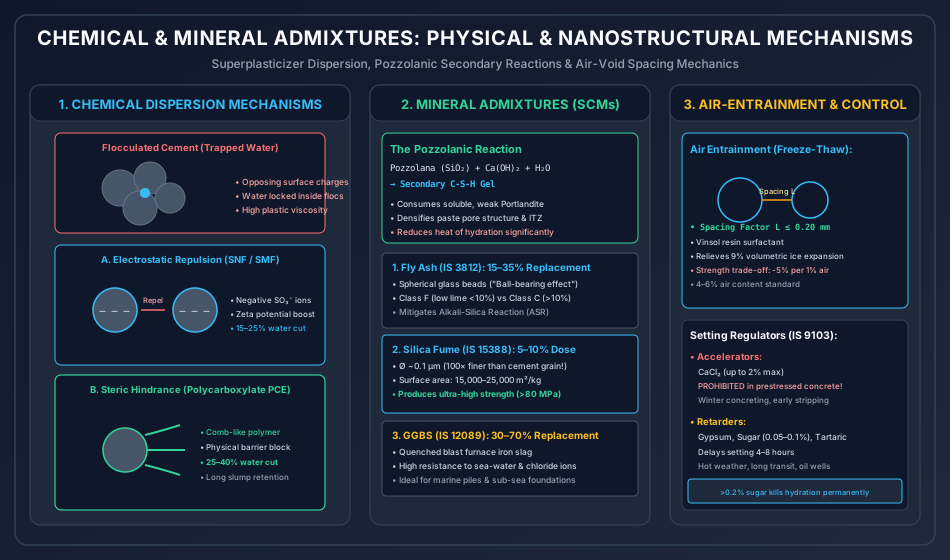
3.1 Water-Reducing Admixtures (Plasticizers & Superplasticizers)
1. Normal Plasticizers (Water Reducers per IS 9103)
- Active Formulations: Salts of lignosulfonic acids (calcium, sodium, or ammonium lignosulfonates), polyhydroxycarboxylic acids.
- Dosage: by mass of cement.
- Water Reduction: Achieves water reduction at equal slump, or increases slump by at constant .
- Mechanism (Electrostatic Repulsion):
- Anhydrous cement grains in water carry mixed electrostatic surface charges (positive on aluminate phases, negative on silicates), causing them to attract each other into loose, porous clusters called flocs.
- These flocs physically trap significant quantities of mixing water (), preventing it from lubricating the paste.
- Lignosulfonate polymer molecules adsorb onto cement grain surfaces with their hydrophilic polar groups oriented outward into the aqueous phase.
- This imparts a uniform, high negative electrostatic surface potential (Zeta Potential), causing individual cement particles to mutually repel each other.
- Flocs break apart (deflocculation), releasing trapped water to fluidize the mix.
2. Superplasticizers (High-Range Water Reducers, HRWR)
- Generations of Superplasticizers:
- First Generation: Sulfonated Melamine Formaldehyde (SMF) condensates. Rapid action, low retardation, ideal for precast plants; rapid slump loss.
- Second Generation: Sulfonated Naphthalene Formaldehyde (SNF) condensates. Powerful electrostatic dispersion; moderate slump retention (). Water reduction: .
- Third Generation: Polycarboxylate Ethers (PCE). Advanced comb-type synthetic graft co-polymers comprising a charged main backbone and long non-ionic polyether side chains.
- PCE Mechanism (Steric Hindrance):
- The carboxylic backbone anchors firmly onto the hydrating cement grain surface.
- The long, flexible polyethylene oxide (PEO) graft side chains extend outward like bristles into the pore water.
- When two cement grains approach, their protruding polymer side chains physically collide and compress.
- This compression restricts thermodynamic conformational entropy and generates powerful physical osmotic repulsion (Steric Hindrance), completely independent of electric charge!
- Performance: Achieves water reduction at dosages of ; maintains workable slump for (crucial for long-distance ready-mix transit).
3.2 Setting Regulators: Accelerators & Retarders
| Admixture Class | Primary Chemical Formulations | Dosage Range (% Cement) | Mechanism of Action | Applications & Critical Field Traps |
|---|---|---|---|---|
| Accelerators | Calcium Chloride (), Calcium Formate, Triethanolamine, Sodium Aluminate. | (Max for ) | Catalyzes the hydration of and ; increases rate of heat dissipation and early crystalline precipitation. | Emergency runway repairs, winter concreting (), rapid formwork cycling. STRICT WARNING: causes catastrophic pitting corrosion; ABSOLUTELY PROHIBITED in Prestressed Concrete (IS 456 Cl. 5.5.1) and steam-cured concrete! |
| Retarders | Calcium Sulfate (Gypsum), Sugar (Sucrose), Tartaric Acid, Citric Acid, Sodium Gluconate, Lignosulfonates. | Sugar: | Adsorbs onto nuclei and forms protective insoluble calcium tartrate/saccharate films, delaying nucleation of C-S-H gel. | Hot weather concreting (), long-haul transit mixers, mass gravity dams to avoid cold joints, oil-well drilling grouts. TRAP: Sugar permanently destroys hydration ("kills" concrete). |
3.3 Air-Entraining Agents (AEA) (IS 9103)
Air-entraining admixtures are natural or synthetic surfactants designed to stabilize microscopic air bubbles in fresh concrete during mixing.
- Active Ingredients: Wood resins (Vinsol Resin, neutralized with sodium hydroxide), animal and vegetable fats, sulfonated hydrocarbons.
- Physical Action:
- Surfactant molecules contain a hydrophilic head (attracted to water) and a hydrophobic hydrocarbon tail (repelled by water).
- At the air-water interface of mixing bubbles, molecules align with hydrophobic tails pointing into the air bubble and hydrophilic heads in the water, lowering surface tension by .
- This prevents bubble coalescence, creating billions of discrete, spherical micro-bubbles ( diameter) uniformly distributed throughout the cement paste.
- Freeze-Thaw Resistance (Powers' Spacing Factor):
- When water freezes in concrete capillaries, it expands by in volume.
- In non-air-entrained concrete, this expansion forces unfrozen water through narrow gel pores, generating hydraulic pressures exceeding the tensile strength of the paste (), causing spalling and disintegration.
- Entrained air voids act as empty expansion reservoirs where excess water freezes safely without pressure build-up.
- Statutory Requirement: The average distance between any point in the paste and the edge of the nearest air void—Powers' Spacing Factor ()—must be:
- Impact on Workability & Strength:
- Workability Benefit: The billions of microscopic bubbles act like frictionless elastic ball-bearings, increasing slump and dramatically reducing segregation and bleeding.
- Strength Penalty: Entrained air voids represent structural porosity: (However, because air improves workability, the ratio can be reduced by , offsetting much of the strength loss).
3.4 Viscosity Modifying Agents (VMA)
- Water-soluble polymers (welan gum, hydroxypropyl methylcellulose).
- Increase the plastic viscosity and cohesion of pore water without increasing yield stress.
- Essential in Self-Compacting Concrete (SCC) and underwater concrete to prevent segregation of coarse aggregates and wash-out of cement fines.
4. Mineral Admixtures / Supplementary Cementitious Materials (SCMs)
Mineral admixtures are finely divided siliceous or aluminosiliceous materials blended with Portland cement to enhance durability, lower heat of hydration, and refine pore structures.
4.1 The Fundamental Pozzolanic Reaction
A pozzolana is a siliceous or siliceous-and-aluminous material that possesses little or no cementitious value of its own, but in finely divided form and in the presence of moisture, chemically reacts with calcium hydroxide at ordinary temperatures to form compounds possessing cementitious properties:
Triple Engineering Benefits of the Pozzolanic Reaction:
1. Consumes Portlandite (Ca(OH)2): Converts weak, water-soluble, sulfate-susceptible CH crystals into strong, insoluble C-S-H binding gel.
2. Pore Refinement: Secondary gel precipitates inside wide capillary pores (10-100 nm), segmenting them into discontinuous microscopic gel pores (<2 nm), slashing permeability by 1 to 2 orders of magnitude!
3. Heat Mitigation: Pozzolanic reaction is slow and endothermic/low-exothermic, lowering peak core hydration temperatures by 15°C - 30°C in massive pours.
4.2 Supplementary Cementitious Materials (SCMs) Matrix
| Mineral Admixture | Source & Processing | Physical Morphology & Fineness | Replacement Level (%) | Salient Microstructural & Durability Benefits |
|---|---|---|---|---|
| Fly Ash (PFA) (IS 3812) | Electrostatic precipitators of pulverized coal thermal power plants. | Smooth, glassy spherical particles. Specific surface: (Blaine). | (Up to in HVFA mass dams) | "Ball-bearing" effect lowers water demand; lowers 7-day heat; binds alkalis, completely mitigating Alkali-Silica Reaction (ASR); increases sulfate resistance. Class F () vs Class C (). |
| Silica Fume (Micro-silica) (IS 15388) | Sub-micron vapor byproduct of electric arc furnaces producing silicon metal or ferrosilicon alloys. | Non-crystalline, amorphous (). Ultrafine spherical particles: ( finer than cement!). Specific surface: . | (Max ) | Micro-filler effect: packs into the interstitial spaces between cement grains, eliminating the porous bleeding zone at the Interfacial Transition Zone (ITZ) around aggregates. Produces ultra-high strength () and near-zero chloride permeability. High superplasticizer demand. |
| Ground Granulated Blast Furnace Slag (GGBS) (IS 12089) | Molten iron slag from blast furnaces rapidly water-quenched into glassy granules and pulverized. | Angular, glassy particles. Specific surface: . High hydraulic latent activity. | High resistance to seawater, chloride pitting, and chemical acid attack; low heat of hydration; high 56-day and 90-day compressive strength. Premier binder for marine and underground structures. | |
| Metakaolin (IS 16714) | Purified kaolinitic clay calcined at controlled temperatures (). | Dehydroxylated plate-like aluminosilicate particles. Highly reactive. Specific surface: . | Rapid pozzolanic strength gain (7-14 days); brilliant white color; resists chemical leaching and de-icing salts. |
5. Self-Compacting Concrete (SCC) Technology & EFNARC Testing
Self-Compacting Concrete (SCC) is an innovative, highly fluid concrete that is able to flow and consolidate under its own weight, completely filling the formwork and passing through congested reinforcement without any mechanical vibration, while maintaining perfect homogeneity without segregation or bleeding.
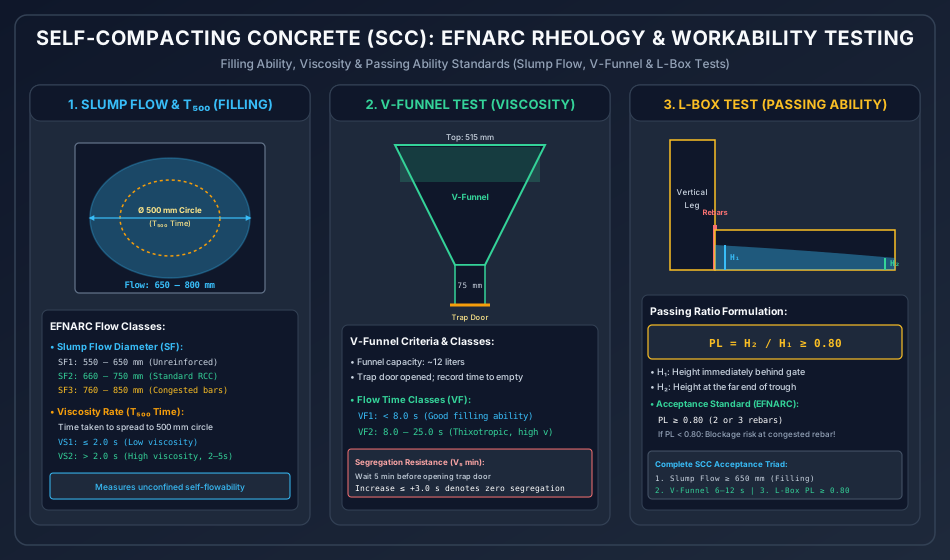
5.1 Rheological Formulation Principles
- Low Yield Stress (): Achieved via third-generation Polycarboxylate Ether (PCE) superplasticizers to initiate flow under gravity.
- Moderate Plastic Viscosity (): Achieved by incorporating high powder volumes (, including fly ash, limestone powder, or GGBS) and Viscosity Modifying Agents (VMA). High viscosity prevents aggregate segregation during flow.
- Limited Coarse Aggregate Volume: Coarse aggregate content limited to of total concrete volume (with maximum size restricted to ) to prevent aggregate interlocking across rebar gaps.
5.2 EFNARC Standard Testing Methods & Acceptance Limits
1. Slump Flow Test & Time (Filling Ability)
- Apparatus: Standard slump cone (inverted or upright) placed on a smooth, rigid base plate scribed with concentric circles at and .
- Procedure: Cone filled in a single pour without tamping or rodded compaction. Cone lifted vertically.
- Slump Flow Diameter (): The mean diameter of the resulting circular concrete cake measured along two perpendicular diameters ():
- Time: Stopwatch time in seconds from the moment the cone is lifted until the concrete spread first touches the circle.
- EFNARC Conformance Classes:
- SF1 (): Unreinforced or lightly reinforced slabs, deep housing footings.
- SF2 (): Standard reinforced concrete columns, beams, walls (Industry standard).
- SF3 (): Heavily congested reinforcement cages, complex architectural forms.
- VS1 (): Low viscosity; fast flow; superior surface finish.
- VS2 (): High viscosity; superior segregation resistance.
2. V-Funnel Test (Viscosity & Discharge Rate)
- Apparatus: V-shaped metal funnel with a rectangular cross-section ( top length, bottom discharge width, total height) fitted with a bottom trap door.
- Procedure: Funnel filled with of concrete without vibration. The trap door is opened, and the time () required for light to be visible through the discharge opening when looking from above is recorded.
- EFNARC Classes:
- VF1 (): Excellent filling ability even through narrow forms.
- VF2 (): High viscosity, thixotropic; used for heavy structural walls.
- Segregation Check (): The funnel is refilled and allowed to rest undisturbed for before opening the door. An increase in flow time indicates excellent segregation resistance.
3. L-Box Test (Passing Ability)
- Apparatus: Rigid L-shaped box consisting of a vertical leg ( cross-section, height) separated from a horizontal trough ( length, width, height) by a sliding gate. A rebar grill of 2 or 3 smooth steel bars () with clear spacings of (2 bars) or (3 bars) is installed immediately behind the gate.
- Procedure: Vertical leg filled with concrete and allowed to rest for 1 minute. The gate is raised smoothly, allowing concrete to flow through the rebar obstacle into the horizontal trough.
- Passing Ratio (): When flow ceases, the heights of concrete at the beginning (, immediately behind gate) and at the far end () are measured:
- Statutory EFNARC Standard: (If , aggregate blocking occurs at rebar openings).
6. Other Advanced & Specialized Concretes
6.1 Ready-Mixed Concrete (RMC) (IS 4926:2003)
- Concrete batched in a stationary computerized central batching plant and transported to site in truck mixers (transit mixers) equipped with revolving drums.
- Operational Speeds:
- Agitating Speed: during transit.
- Mixing Speed: on site for prior to discharge.
- Delivery Time Limit (IS 4926 Cl. 6.3): Concrete must be completely discharged on site within from the addition of water at the batching plant, or within , whichever is less. (Time can be extended up to using retarding superplasticizers).
6.2 Fiber-Reinforced Concrete (FRC)
- Concrete containing uniformly dispersed, randomly oriented short discrete fibers.
- Fiber Types: Crimped steel fibers, hooked-end steel fibers, polypropylene micro-fibers, alkali-resistant glass fibers (AR-glass), carbon fibers.
- Aspect Ratio: (Length typically , diameter ).
- Structural Role: Unreinforced concrete is brittle and cracks suddenly. Fibers do not increase compressive strength significantly, but they bridge across micro-cracks upon tensile cracking.
- Post-Cracking Toughness: Drastically increases energy absorption capacity, impact resistance, and shear toughness, controlling drying shrinkage cracking. Used in industrial warehouse flooring, tunnel linings, and blast-resistant structures.
6.3 Shotcrete (Gunite / Sprayed Concrete)
- Mortar or concrete conveyed pneumatically through a pressurized hose and projected at high velocity onto a surface.
- Gunite: Mortar mix (aggregate size ).
- Shotcrete: Concrete mix (coarse aggregate up to ).
- Two Processes:
- Dry-Mix: Cement and damp aggregate conveyed dry; water added at the discharge nozzle. Higher rebound loss ().
- Wet-Mix: Pre-mixed concrete pumped through hose; compressed air injected at nozzle. Lower rebound loss ().
- Accelerating Admixtures: Liquid sodium aluminate or alkali-free accelerators added at nozzle to induce flash setting within , preventing slumping overhead in tunnel roofs and rock stabilization.
7. Solved Numerical Problem 1: Pozzolanic Efficiency & Mix Proportioning
Problem Statement
A high-durability marine concrete mix for bridge foundation piles is proportioned with a replacement of Ordinary Portland Cement by Class F fly ash (IS 3812):
- The baseline control mix without fly ash requires an OPC content of at a water-cement ratio of .
- To compensate for the slower early-age pozzolanic activity of fly ash, the mix design protocol increases the total cementitious materials content () by over the control cement content.
- A third-generation PCE superplasticizer is added, allowing the water-to-binder ratio to be optimized to .
- Assuming a Bolomey-Smith pozzolanic efficiency factor of for the fly ash at 28 days, calculate:
- The individual masses of OPC, Fly Ash, and Mixing Water per of concrete.
- The effective cementitious binder mass ().
- The effective water-to-cementitious materials ratio ().
Step-by-Step Analytical Solution
Step 1: Total Cementitious Materials Content ()
Control cement mass .
Step 2: Component Binder & Water Masses
- Fly Ash Fraction: of total binder :
- OPC Fraction: of total binder :
- Mixing Water Mass: Proportioned at :
Step 3: Effective Cementitious Binder Mass ()
With a pozzolanic efficiency factor :
Step 4: Effective Water-Cementitious Ratio ()
Engineering Assessment: Even with fly ash substitution, the effective water-binder ratio of remains comfortably below the IS 456 Table 5 ceiling of for Severe marine exposure. The mix achieves superior long-term strength, pore refinement, and chloride resistance.
8. Solved Numerical Problem 2: EFNARC Self-Compacting Concrete Evaluation
Problem Statement
An experimental Self-Compacting Concrete (SCC) mix for a heavily congested nuclear containment diaphragm wall is subjected to standardized EFNARC rheological tests:
- Slump Flow Test: The fresh concrete spreads symmetrically over the base plate; perpendicular spread diameters measured are and . The time taken to reach the circle is recorded as .
- V-Funnel Test: The time taken for the fresh concrete to discharge fully from the standard V-funnel is .
- L-Box Test: The concrete flows through a three-rebar obstacle grill ( bars at clear gaps). The settled concrete heights are measured as immediately behind the gate and at the far end of the horizontal trough.
Determine:
- The mean slump flow diameter () and categorize the concrete into EFNARC Slump Flow and Viscosity classes.
- The V-funnel flow class.
- The L-box passing ratio () and verify compliance with EFNARC criteria ().
- Formulate an engineering certification statement regarding the suitability of this mix for heavily congested structural members.
Step-by-Step Analytical Solution
Step 1: Slump Flow & Evaluation
- Mean Slump Flow:
- Class Classification: Falls in Class SF2 (), which is the standard target class for normal to congested reinforced structures.
- Viscosity Rate ():
- Class Classification: Since , it falls into Class VS2 (), indicating moderate-to-high plastic viscosity that resists aggregate segregation during flow.
Step 2: V-Funnel Flow Evaluation
- Discharge flow time: .
- Class Classification: Since , the mix conforms to Class VF2, exhibiting substantial thixotropic stability and excellent cohesion.
Step 3: L-Box Passing Ratio ()
Compliance Verification:
- Statutory EFNARC requirement: .
- Conformance: Since across the strict 3-rebar test ( gap), the mix satisfies passing ability with zero aggregate blocking.
Step 4: Engineering Certification Statement
The mix satisfies all three fundamental EFNARC criteria:
- Filling Ability: Confirmed by (Class SF2).
- Segregation Resistance / Viscosity: Confirmed by (Class VS2) and (Class VF2).
- Passing Ability: Confirmed by .
Conclusion: The SCC mix is certified compliant for placing in heavily congested diaphragm walls without mechanical vibration.
9. Solved Numerical Problem 3: Air Entrainment & Strength Trade-Off Analysis
Problem Statement
A concrete mix for an airport runway pavement exposed to severe winter frost action is designed with an air-entraining admixture:
- The control non-air-entrained concrete achieves a 28-day compressive strength of at with an entrapped air content of .
- With the addition of a neutralized Vinsol resin admixture, the total air content is increased to (an increase of ).
- The fluid "ball-bearing" action of the entrained air bubbles improves fresh workability, permitting a mixing water reduction of , which lowers the water-cement ratio from to .
- Empirical testing indicates that each increase in air content reduces compressive strength by , while reducing the ratio by increases strength by .
Calculate:
- The gross percentage reduction in strength caused by the entrained air voids alone.
- The gross percentage gain in strength achieved from the lowered water-cement ratio.
- The net predicted 28-day compressive strength () of the air-entrained concrete.
Step-by-Step Analytical Solution
Step 1: Strength Reduction from Air Voids
- Net increase in air content:
- Strength penalty percentage:
- Retained strength factor ():
Step 2: Strength Gain from Water-Cement Ratio Reduction
- Reduction in : .
- Strength gain factor ():
Step 3: Net Compressive Strength
Combining the void reduction factor and the density gain factor:
Engineering Conclusion: Although the air voids alone would have slashed strength to ( loss), taking full advantage of the workability boost to reduce water recaptures strength up to (limiting the net sacrifice to only ), while granting total immunity to freeze-thaw scaling over a 50-year pavement life.
10. Common Misconceptions, Pitfalls & Field Traps
-
The Prestressed Concrete Disaster:
- The Trap: Adding calcium chloride to accelerate 1-day strength in prestressed concrete girders to release prestressing jacks early.
- The Reality: Free chloride ions () from aggressively attack the passive oxide film on high-tensile prestressing steel wires under high stress (), inducing catastrophic stress-corrosion cracking and hydrogen embrittlement. Entire bridge decks have collapsed without warning! IS 456 Cl. 5.5.1 legally and absolutely prohibits in prestressed concrete.
-
The Sugar Dosage Overdose Trap:
- The Trap: Assuming that adding a little more sugar will extend setting time safely by a few extra hours.
- The Reality: Sugar is extremely sensitive. A dosage of acts as a predictable retarder (extending set by 4-8 hours). However, exceeding permanently poisons and crystal nucleation sites; the concrete will never set or harden, remaining a liquid slurry forever!
-
Thinking Self-Compacting Concrete Needs No Curing:
- The Trap: Assuming that because SCC is ultra-dense and defect-free, water curing is optional.
- The Reality: SCC mixes contain high powder contents () and very low free water (). They bleed practically zero water. In sunny or windy conditions, the evaporation rate exceeds the bleeding rate, causing severe, deep plastic shrinkage cracking within hours. Immediate wet-curing or curing compound application is mandatory.
-
Silica Fume Superplasticizer Blindness:
- The Trap: Adding silica fume to a concrete mix without adding extra superplasticizer.
- The Reality: Silica fume has an astonishing surface area (, 100 times that of cement). It acts like a dry sponge, instantly soaking up free water and reducing a slump mix to a bone-dry crumble. Silica fume can never be used without a high-range PCE superplasticizer.
-
Fly Ash Formwork Stripping Trap:
- The Trap: Stripping beam soffit formwork at 7 days when using fly ash concrete.
- The Reality: Pozzolanic reaction is slow at early ages (). At 7 days, a fly ash concrete may possess only of its design strength. Stripping formwork early causes excessive creep deflections or structural cracking.
11. Multi-Exam Comparative Summary & High-Yield Facts Table
| Parameter / Topic | GATE CE Focus | UPSC ESE Focus | SSC JE / State AE Focus | RRB JE Focus |
|---|---|---|---|---|
| PCE Superplasticizer | Steric hindrance mechanism; comb polymer graft side chains. | Water reduction ; slump retention . | Mechanism: Steric hindrance (PCE) vs Electrostatic (SNF). | Water reduction achieved (). |
| Accelerators () | Pitting corrosion & stress-corrosion cracking in prestressed rebar. | Maximum permissible dose: by mass. | Prohibited in: Prestressed concrete (Most frequent question). | Chemical name of common accelerator: . |
| Retarders & Sugar | Nucleation poisoning; sugar permanently destroys setting. | Gypsum retarder in clinker; sugar () extends set 4-8 hrs. | Sugar acts as a: Retarder. Gypsum is added to prevent: Flash set. | Gypsum purpose in cement (Retard setting). |
| Air Entrainment & Spacing | Powers' spacing factor ; relieves 9% ice expansion. | Vinsol resin surfactant; strength penalty: per air. | Primary purpose: Freeze-thaw resistance. Chemical: Vinsol resin. | Purpose of air entraining (Frost resistance). |
| Fly Ash (IS 3812) | Secondary reaction: ; ASR mitigation. | Class F () vs Class C (); ball-bearing. | Reaction with: Calcium hydroxide (). | Source of fly ash: Thermal power plants. |
| Silica Fume (IS 15388) | Micro-filler ITZ densification; particle size . | Specific surface ; dosage . | Size relative to cement: finer. High strength concrete. | Particle size compared to cement ( finer). |
| SCC EFNARC Limits | Slump flow ; L-Box ratio ; V-funnel . | viscosity classes (VS1 , VS2 ); 3 rebars. | SCC requires NO vibration. Test for passing: L-Box. | Does SCC need vibrator? (No, self-compacts). |
| Ready-Mixed Concrete | Delivery time limit: or . | Transit drum speeds: Agitation (), Mixing (). | Maximum delivery time: (IS 4926). | Drum speed during transit (). |
12. Comprehensive Glossary of Technical Terms
- Plasticizer: A chemical admixture that increases the workability of fresh concrete at constant water content or allows water reduction at constant workability via electrostatic repulsion.
- Superplasticizer (HRWR): High-range water-reducing admixture (SNF/PCE) that achieves water reduction while retaining fluidity.
- Steric Hindrance: Physical repulsion caused by the spatial overlap of long, flexible polymer graft side chains projecting from adsorbed polycarboxylate molecules on cement grains.
- Pozzolana: A siliceous or aluminosiliceous material that chemically reacts with calcium hydroxide in the presence of water to precipitate secondary C-S-H gel.
- Micro-Filler Effect: The physical packing of ultrafine sub-micron particles (e.g., silica fume) into interstitial spaces between cement grains, densifying the interfacial transition zone.
- Spacing Factor (): The maximum distance from any point in the cement paste to the periphery of the nearest entrained air void, standardized at .
- Self-Compacting Concrete (SCC): Concrete that flows under its own weight and consolidates fully into congested formwork without mechanical vibration.
- Slump Flow: The mean diameter of the horizontal spread of a slumped cone of SCC measured on a base plate, indicating unconfined filling ability.
- Passing Ability (): The capacity of fresh SCC to flow through narrow openings between reinforcing bars without aggregate blockage, measured by the L-Box ratio .
- Fiber-Reinforced Concrete (FRC): Concrete containing dispersed short discrete fibers (steel, synthetic, glass) that enhance post-cracking tensile toughness and impact energy absorption.
- Shotcrete: Concrete pneumatically conveyed through a hose and projected at high velocity onto a surface, consolidating upon impact.
13. References & Standard Codes
- Bureau of Indian Standards (BIS):
- IS 9103:1999 — Concrete Admixtures — Specification (First Revision).
- IS 456:2000 — Plain and Reinforced Concrete — Code of Practice (Fourth Revision).
- IS 3812 (Part 1):2013 — Pulverized Fuel Ash — Specification.
- IS 15388:2003 — Silica Fume — Specification.
- IS 4926:2003 — Ready-Mixed Concrete — Code of Practice (Second Revision).
- EFNARC (2002/2005). Specification and Guidelines for Self-Compacting Concrete. European Federation of National Associations Representing for Concrete.
- Neville, A. M. (2011). Properties of Concrete (5th Edition). Pearson Education.
- Shetty, M. S., & Jain, A. K. (2019). Concrete Technology: Theory and Practice (8th Edition). S. Chand Publishing.
- Ramachandran, V. S. (1995). Concrete Admixtures Handbook (2nd Edition). Noyes Publications.