Concrete Mix Proportioning (IS 10262:2019) & Statistical Quality Control
In this chapter (1 topics)
On this page
- 1. Topic Title & Authoritative References
- 2. Prerequisites & Learning Objectives
- Prerequisites
- Learning Objectives
- 3. Fundamental Principles & Statistical Basis of Mix Proportioning
- 3.1 Characteristic Compressive Strength (fck)
- 3.2 Target Mean Compressive Strength (fm) Formulations
- 4. Step-by-Step Mix Proportioning Flowchart (IS 10262:2019)
- Step 1: Determine Target Mean Strength (fm)
- Step 2: Select Water-Cementitious Materials Ratio (w/cm)
- Step 3: Select Water Content per m3 of Concrete
- Step 4: Calculate Cementitious Materials Content
- Step 5: Determine Proportion of Coarse and Fine Aggregates
- Step 6: Absolute Volume Calculations per 1.0 m3 Fresh Concrete
- Step 7: Calculate Saturated Surface-Dry (SSD) Aggregate Masses
- Step 8: Trial Batches & Optimization
- 5. Aggregate Moisture Adjustments & Field Batch Corrections
- 5.1 Governing Equations for Field Batch Corrections
- 6. Statistical Quality Control & Acceptance Criteria (IS 456:2000)
- 6.1 Sampling Frequency Protocol (IS 456 Cl. 15.2.2)
- 6.2 The Three-Specimen Sample & The ± 15\% Variation Rule (Cl. 15.4)
- 6.3 Characteristic Acceptance Criteria Gates (IS 456 Cl. 16, Table 11)
- 6.4 Failure Investigation Protocol (IS 456 Cl. 17)
- 7. Solved Numerical Problem 1: Complete IS 10262:2019 Mix Proportioning
- Problem Statement
- Step-by-Step Analytical Solution
- 8. Solved Numerical Problem 2: Field Moisture & Water Absorption Corrections
- Problem Statement
- Step-by-Step Analytical Solution
- 9. Solved Numerical Problem 3: Acceptance Criteria & Compliance Gate Verification
- Problem Statement
- Step-by-Step Analytical Solution
- 10. Common Misconceptions, Pitfalls & Field Traps
- 11. Multi-Exam Comparative Summary & High-Yield Facts Table
- 12. Comprehensive Glossary of Technical Terms
- 13. References & Standard Codes
1. Topic Title & Authoritative References
Title: Principles of Concrete Mix Proportioning, IS 10262:2019 Absolute Volume Methodology, Target Mean Strength Formulations, Field Moisture & Absorption Corrections, and IS 456:2000 Statistical Acceptance Criteria.
Primary Standards & Authoritative Specifications:
- IS 10262:2019: Concrete Mix Proportioning — Guidelines (Second Revision).
- IS 456:2000: Plain and Reinforced Concrete — Code of Practice (Clauses 9, 15, 16, and 17 with Amendments 1 to 5).
- SP 23 (S&T): 1982: Handbook on Concrete Mixes.
- IS 383:2016: Coarse and Fine Aggregate for Concrete — Specification.
- IS 9103:1999: Specification for Concrete Admixtures.
- ACI 211.1: Standard Practice for Selecting Proportions for Normal, Heavyweight, and Mass Concrete.
2. Prerequisites & Learning Objectives
Prerequisites
- Probability and mathematical statistics: normal Gaussian distribution, standard deviation, confidence intervals, and cumulative defect probability.
- Fresh concrete rheology: workability, slump adjustments, and water-reducing superplasticizer mechanisms.
- Aggregate physics: specific gravity, saturated surface-dry (SSD) conditions, absorption capacity, and free moisture.
Learning Objectives
- Define characteristic compressive strength () at the lower defect exclusion limit, calculating target mean strength () incorporating the standard deviation () and IS 10262:2019 -factor.
- Execute the complete 8-step IS 10262:2019 mix design procedure: water-cementitious ratio selection, water content optimization, cement content limits, coarse-to-fine aggregate volume fractions, and absolute volume balance.
- Compute rigorous field batch adjustments for aggregate free moisture and absorption, correcting mixing water and batch weights to maintain target effective .
- Enforce IS 456:2000 sampling frequency protocols based on concrete placement volumes ( to ).
- Apply the three-specimen individual variation integrity rule and verify lot compliance against the dual acceptance gates of IS 456 Clause 16.
- Evaluate non-destructive testing and core drilling failure protocols for non-compliant concrete lots per IS 456 Clause 17.
3. Fundamental Principles & Statistical Basis of Mix Proportioning
Concrete is a heterogeneous composite whose compressive strength exhibits inherent statistical dispersion arising from batching tolerances, aggregate variability, ambient temperatures, and testing errors.
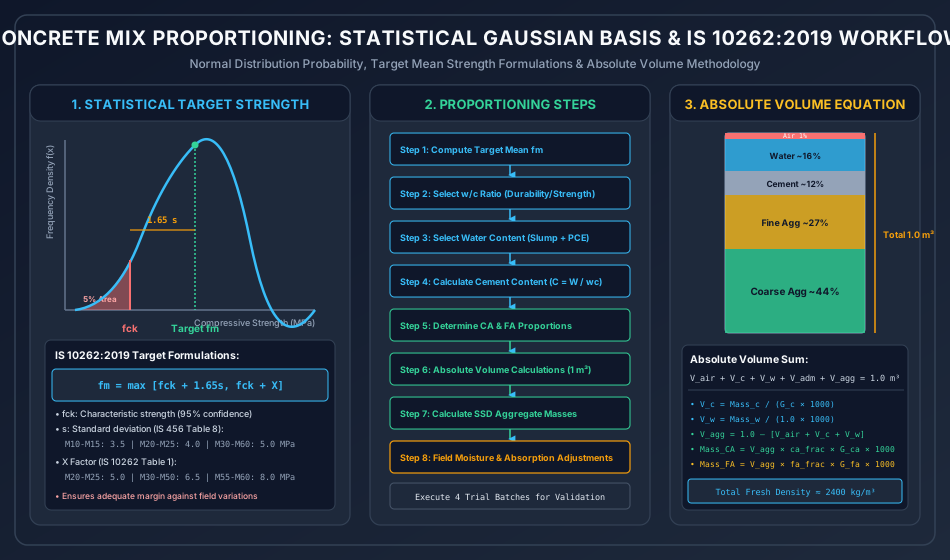
3.1 Characteristic Compressive Strength ()
According to IS 456:2000 Cl. 6.1.1, the Characteristic Compressive Strength is defined as:
Mathematically, assuming compressive test results follow a Gaussian Normal Distribution:
Where:
3.2 Target Mean Compressive Strength () Formulations
1. Classical Formulation (IS 456:2000 & Pre-2019):
2. Updated Statutory Formulation per IS 10262:2019 (Cl. 4.2):
To provide a fail-safe floor when site quality control data is limited or when standard deviation is abnormally low:
Where is a statutory margin factor defined in IS 10262:2019 Table 1, and is the assumed standard deviation from IS 456:2000 Table 8:
| Concrete Grade Range | Assumed Standard Deviation (MPa) (IS 456 Table 8) | IS 10262:2019 Factor (MPa) (Table 1) | Governing Target Formula Baseline |
|---|---|---|---|
| M 10, M 15 | |||
| M 20, M 25 | |||
| M 30 to M 50 | |||
| M 55, M 60 | |||
| M 65 and above | By actual site trials | Table 1 values | Derived from established plant standard deviation |
(Note: The assumed standard deviation values apply only when concrete production has very good to fair field control with weigh-batching. If volume-batching is used, must be increased by ).
4. Step-by-Step Mix Proportioning Flowchart (IS 10262:2019)
Step 1: Determine Target Mean Strength ()
Compute target strength using the dual criteria: .
Step 2: Select Water-Cementitious Materials Ratio ()
- Estimate initial from the generalized empirical curves of IS 10262:2019 (Figure 1 for OPC and Figure 2 for blended cements) corresponding to target strength .
- Check against the statutory Maximum Free Water-Cement Ratio dictated by durability considerations in IS 456:2000 Table 5 (e.g., for Mild, for Moderate, for Severe/Very Severe, for Extreme).
- The lower of the two values is selected.
Step 3: Select Water Content per of Concrete
IS 10262:2019 Table 4 provides baseline maximum water contents for angular crushed aggregates at a standard slump of without chemical admixtures:
| Nominal Maximum Size of Aggregate (MSA) | Baseline Water Content ( slump, no admixture) |
|---|---|
Mandatory Water Content Adjustments:
- Slump Adjustment: For slumps exceeding , increase water by for every additional slump.
- Aggregate Shape Adjustment: Reduce water by to for sub-angular or rounded gravels.
- Superplasticizer Reduction: High-range water-reducing admixtures (polycarboxylate ethers, PCE) reduce water demand by at identical slump.
Step 4: Calculate Cementitious Materials Content
Verification against IS 456 Constraints:
- Must exceed the statutory Minimum Cement Content from IS 456 Table 5 ( for Mild/Moderate, for Severe, for Very Severe, for Extreme).
- Must not exceed the statutory Maximum Permissible Cement Content of (IS 456 Cl. 8.2.4.2).
Step 5: Determine Proportion of Coarse and Fine Aggregates
IS 10262:2019 Table 5 specifies the volume fraction of coarse aggregate per unit volume of total aggregate for a baseline water-cement ratio of :
| Nominal Max Size of Aggregate (MSA) | Zone I Sand (Coarse) | Zone II Sand (Standard) | Zone III Sand (Medium-Fine) | Zone IV Sand (Fine) |
|---|---|---|---|---|
Adjustments to Coarse Aggregate Fraction:
- Correction: For every change in from , adjust coarse aggregate fraction by : (Lower allows higher coarse aggregate content).
- Pumpable Concrete Correction: For pumpable concrete, reduce coarse aggregate volume fraction by (or subtract ) to provide sufficient mortar lubrication.
Step 6: Absolute Volume Calculations per Fresh Concrete
The absolute volume method balances the solid volumes of all constituents to exactly equal ():
- Volume of Entrapped Air (): Obtained from IS 10262:2019 Table 6:
- For aggregate: ()
- For aggregate: ()
- For aggregate: ()
- Volume of Cement ():
- Volume of Water ():
- Volume of Chemical Admixture ():
- Net Volume of Total Aggregates ():
Step 7: Calculate Saturated Surface-Dry (SSD) Aggregate Masses
Step 8: Trial Batches & Optimization
Cast Trial Mix 1 using calculated SSD quantities. Evaluate slump, cohesion, bleeding, and density. If workability is off, adjust water or admixture dose, recalculate absolute volumes (Trial Mix 2), and test compressive cubes at 7 and 28 days.
5. Aggregate Moisture Adjustments & Field Batch Corrections
In laboratory design, aggregate masses are calculated assuming Saturated Surface-Dry (SSD) conditions. In the field, aggregates are rarely in SSD condition:
- If aggregate has free surface moisture (moisture content absorption), it releases water into the mix, artificially increasing the effective ratio and reducing strength.
- If aggregate is dry / unsaturated (moisture content absorption), it absorbs mixing water from the paste, decreasing workability.
5.1 Governing Equations for Field Batch Corrections
Let:
- (positive if wet, negative if absorptive)
-
Free Surface Water Contributed by Aggregates:
-
Corrected Mixing Water Added to Batch:
-
Corrected Moist Aggregate Batch Masses:
6. Statistical Quality Control & Acceptance Criteria (IS 456:2000)
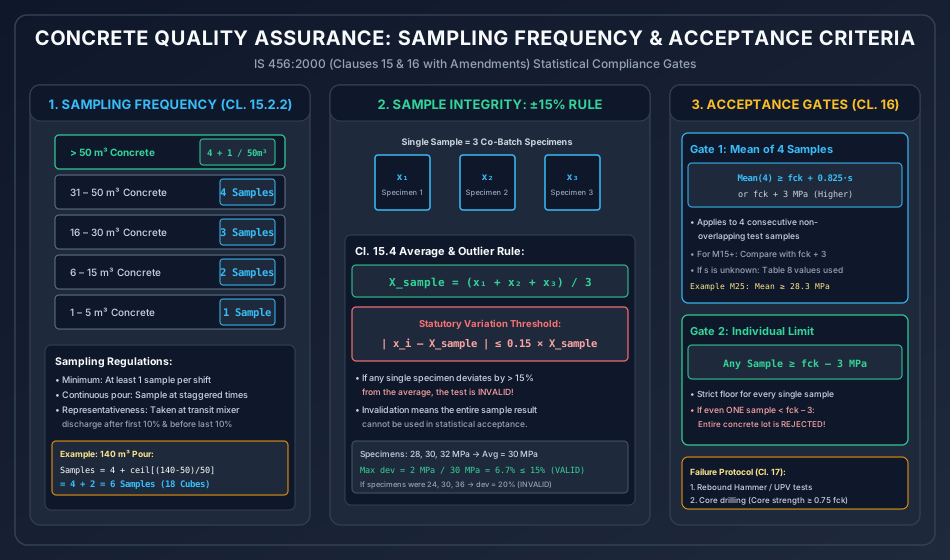
6.1 Sampling Frequency Protocol (IS 456 Cl. 15.2.2)
To ensure true statistical representation of continuous concrete pours, IS 456 establishes a stepped sampling frequency:
| Total Quantity of Concrete in the Work () | Number of Statutory Samples Required |
|---|---|
| Sample | |
| Samples | |
| Samples | |
| Samples | |
| and above | plus additional sample for each additional or part thereof |
Statutory Sampling Rule: At least one sample must be taken from each shift of concrete production.
6.2 The Three-Specimen Sample & The Variation Rule (Cl. 15.4)
- Sample Constitution: A single test "sample" consists of three specimen cubes () cast from a single batch of fresh concrete.
- Test Result: The 28-day compressive strength of the sample is the mathematical arithmetic average of the three specimens:
- The Outlier Rule: Critical Engineering Law: If the individual variation of even one cube exceeds of the average, the test result of the sample is invalid and must be completely rejected. It cannot be used in statistical compliance evaluation!
6.3 Characteristic Acceptance Criteria Gates (IS 456 Cl. 16, Table 11)
A concrete lot represented by a group of test samples is legally accepted if and only if it simultaneously satisfies both Gate 1 and Gate 2:
Gate 1: Mean Strength of Four Consecutive Samples
The arithmetic mean of the strengths of any group of four consecutive non-overlapping samples must satisfy:
(For M10 grade: or ).
Gate 2: Individual Sample Result Floor
Every individual test sample strength in the lot must satisfy:
(For M10 grade: ).
Compliance Decision Tree:
• Both Gate 1 AND Gate 2 PASSED → Concrete Lot ACCEPTED
• Gate 1 FAILED or ANY single sample FAILS Gate 2 → Concrete Lot DECLARED NON-COMPLIANT
6.4 Failure Investigation Protocol (IS 456 Cl. 17)
When concrete fails to satisfy the acceptance criteria:
- Structural Adequacy Check: Structural designer reviews member stresses; load reductions or secondary calculations may be performed.
- Non-Destructive Testing (NDT): Ultrasonic Pulse Velocity (UPV per IS 13311 Part 1) and Rebound Hammer (IS 13311 Part 2) tests are executed across the doubtful zone to delineate the extent of weak concrete.
- Core Drilling Test (IS 516 Part 4):
- Cylindrical cores ( dia, length-to-diameter ratio between and ) are drilled from the hardened structure.
- Tested in compression after moisture conditioning.
- Core Acceptance Standard (Cl. 17.4.3): Concrete in the area represented by core testing is deemed structurally acceptable if:
- Load Testing (Cl. 17.6): Full-scale flexural load test under for 24 hours. Member must recover of maximum deflection within 24 hours of unloading.
7. Solved Numerical Problem 1: Complete IS 10262:2019 Mix Proportioning
Problem Statement
Design an M30 grade reinforced concrete mix using Ordinary Portland Cement conforming to IS 269:2015 and following IS 10262:2019 guidelines:
- Design Stipulations:
- Characteristic compressive strength: at 28 days
- Maximum nominal size of aggregate: (angular crushed stone)
- Degree of workability: slump (Pumpable concrete)
- Environmental exposure condition: Severe (IS 456 Table 5)
- Standard deviation: (IS 10262:2019 Table 2 / IS 456 Table 8); IS 10262:2019 Table 1 factor
- Chemical admixture: Polycarboxylate ether (PCE) superplasticizer ( water reduction at dosage by mass of cement)
- Material Characteristics:
- Specific gravity of cement:
- Specific gravity of water:
- Specific gravity of coarse aggregate (SSD):
- Specific gravity of fine aggregate (SSD):
- Specific gravity of chemical admixture:
- Fine aggregate grading: Conforms to Grading Zone II of IS 383:2016
Calculate:
- Target mean compressive strength ().
- Effective water-cement ratio ().
- Adjusted water content and cement content per .
- Saturated surface-dry (SSD) masses of coarse aggregate, fine aggregate, and admixture.
- Final mix proportions expressed as .
Step-by-Step Analytical Solution
Step 1: Target Mean Compressive Strength ()
Per IS 10262:2019 Cl. 4.2 (using from Table 2 and from Table 1 for M30):
Step 2: Selection of Water-Cement Ratio ()
- From IS 10262:2019 Figure 1 (Curve for OPC 43/53 grade at ): Target .
- From IS 456:2000 Table 5 (Severe exposure for RCC): Maximum permissible .
- Adopting the lower, conservative value: .
Step 3: Selection of Water Content
- From IS 10262:2019 Table 4, maximum water content for aggregate at slump .
- Slump Adjustment (Cl. 5.3): Target slump is ( above baseline). Increase by per :
- Admixture Reduction: PCE superplasticizer achieves water reduction:
Step 4: Calculation of Cement Content ()
Statutory Verification (IS 456 Table 5):
- Minimum cement for Severe exposure . Since OK.
- Maximum cement limit . Since OK.
Admixture Mass:
Step 5: Proportion of Coarse and Fine Aggregates
- From IS 10262:2019 Table 5, for aggregate and Zone II fine aggregate at , baseline coarse aggregate volume fraction .
- Correction (Cl. 5.5.1): Here , which is below .
- Pumpability Adjustment (Cl. 5.5.2): IS 10262:2019 Clause 5.5.2 permits reducing coarse aggregate volume by up to for pumpable concrete; adopting a specified reduction of ( reduction):
- Fine Aggregate Fraction:
Step 6: Absolute Volume Calculations per
Per IS 10262:2019 Table 3 (Cl. 5.2), approximate entrapped air volume for nominal maximum size aggregate .
- Volume of cement:
- Volume of water:
- Volume of admixture:
- Total volume of aggregates:
Step 7: Saturated Surface-Dry (SSD) Aggregate Masses
-
Coarse Aggregate Mass:
-
Fine Aggregate Mass:
Step 8: Final Design Mix Proportions
- Cement: ()
- Fine Aggregate (SSD): ()
- Coarse Aggregate (SSD): ()
- Water: ()
- PCE Admixture: ( of cement)
8. Solved Numerical Problem 2: Field Moisture & Water Absorption Corrections
Problem Statement
Using the design mix developed in Problem 1 (, , , ), field tests on the stockpiled aggregates reveal the following conditions:
- Fine Aggregate (River Sand): Free surface moisture content by mass.
- Coarse Aggregate (Crushed Basalt): Completely dry with a water absorption capacity by mass (zero surface moisture).
Determine:
- The quantity of free water contributed by the fine aggregate.
- The quantity of mixing water absorbed by the dry coarse aggregate.
- The net water adjustment per and the corrected quantity of mixing water to be added at the batching plant.
- The adjusted batch weights of moist fine aggregate and dry coarse aggregate required per and for a standard bag of cement.
Step-by-Step Analytical Solution
Step 1: Water Balance from Aggregates
-
Free Water from Fine Aggregate:
-
Water Absorbed by Coarse Aggregate:
-
Net Water Adjustment ():
(The sand introduces more water than the coarse stone absorbs).
Step 2: Corrected Mixing Water to be Batched
Step 3: Adjusted Aggregate Batch Weights (per )
-
Moist Fine Aggregate:
-
Dry Coarse Aggregate: Because dry aggregate absorbs water to reach SSD state, the linear approximation commonly used in exam problems gives:
(Note: Per the exact divisor formula in IS 10262:2019 Annex A Clause A-8, since absorption is defined relative to oven-dry mass, and water absorbed ).
Step 4: Proportions per Single Bag of Cement
- Scale factor:
- Cement:
- Corrected Mixing Water: ()
- Moist Fine Aggregate:
- Dry Coarse Aggregate:
- PCE Admixture: ()
9. Solved Numerical Problem 3: Acceptance Criteria & Compliance Gate Verification
Problem Statement
A ready-mixed concrete supplier supplies of M25 grade reinforced concrete for a multi-story building slab:
- Determine the mandatory minimum number of test samples required per IS 456 Cl. 15.2.2.
- Four consecutive non-overlapping samples are tested at 28 days. Each sample's test result (representing the mean of three compliant cubes) is recorded:
- Sample 1:
- Sample 2:
- Sample 3:
- Sample 4:
- Verify compliance against IS 456:2000 Clause 16 (Table 11 with Amendments) assuming standard deviation .
- If a fifth individual sample tests at , evaluate whether the lot remains compliant.
Step-by-Step Analytical Solution
Step 1: Mandatory Sampling Frequency
Total pour volume . Using the stepped schedule of Cl. 15.2.2:
- First
- Additional volume:
- Additional samples:
- Total required: (comprising ).
Step 2: Evaluation of Gate 1 (Mean of Four Consecutive Samples)
- Group arithmetic mean:
- Statutory threshold for M25 ():
Gate 1 Verification:
Step 3: Evaluation of Gate 2 (Individual Sample Floor)
Statutory individual floor for :
- Sample 1: OK
- Sample 2: OK
- Sample 3: OK
- Sample 4: OK
Gate 2 Verification:
Lot Status: Both Gate 1 and Gate 2 are passed; the concrete lot represented by these 4 samples is STATUTORILY ACCEPTED.
Step 4: Impact of Fifth Sample Testing at
- Gate 2 Requirement: .
- Measured value: ().
- Legal Engineering Consequence: Even if the four-sample running mean continues to exceed , the failure of even ONE individual sample below constitutes an automatic rejection of the affected concrete lot. The contractor must immediately halt work and initiate non-destructive testing (UPV / Rebound) and core drilling per IS 456 Cl. 17.
10. Common Misconceptions, Pitfalls & Field Traps
-
The Nominal vs. Design Mix Confusion:
- The Trap: Specifying nominal recipe mixes ( for M20) on structural projects.
- The Reality: IS 456 Cl. 9.1 restricts nominal mixes strictly to concrete grades of M20 or lower, and only for small, non-critical works. For all structural RCC of M25 and higher, Design Mixes are mandatory.
-
The Specimen Invalidation vs. Concrete Rejection:
- The Trap: Confusing the invalidation of a single cube sample with the structural rejection of the entire concrete batch.
- The Reality: The rule applies within the three cubes of one sample. If vary by of their average, it signifies poor laboratory tamping or broken molds. The test data is discarded as technically invalid, but the concrete structure is not condemned yet—subsequent samples or non-destructive tests are evaluated.
-
Neglecting Coarse Aggregate Absorption:
- The Trap: Correcting only for wet sand moisture while ignoring the absorption of dry crushed coarse aggregate.
- The Reality: Dry, porous coarse aggregate (absorption ) absorbs of water per directly from the paste within the first 15 minutes of mixing, causing immediate severe slump loss, pump choking, and cold joints.
-
The Cement Limit Trap:
- The Trap: Attempting to design high-strength concrete by simply loading the mixer with of cement.
- The Reality: IS 456 Cl. 8.2.4.2 legally prohibits cement contents exceeding unless specialized pozzolanic replacements (fly ash, slag) are incorporated. Excess cement creates high hydration temperatures, thermal stress cracking, and severe long-term drying shrinkage.
-
Pumping Reduction Omission:
- The Trap: Batching a design mix calculated for crane buckets into a concrete boom pump.
- The Reality: Pumping concrete through pipes requires a richer lubricating mortar annulus. If the coarse aggregate fraction is not decreased by (or ) as mandated by IS 10262 Table 5, aggregate interlocking will lock the pipeline, causing catastrophic pump blockages.
11. Multi-Exam Comparative Summary & High-Yield Facts Table
| Parameter / Question Theme | GATE CE Focus | UPSC ESE Focus | SSC JE / State AE Focus | RRB JE Focus |
|---|---|---|---|---|
| Characteristic Strength () | Statistical definition: 5% lower exclusion limit (). | Gaussian distribution; . | Strength below which not more than 5% results fall. | Confidence level: 95% (5% fail). |
| Target Mean Strength () | (IS 10262:2019). | Values of ( for M20-M25; for M30-M50). | Formula: (Standard numericals). | Target strength formula. |
| Assumed Standard Deviation () | IS 456 Table 8: M10-M15 (), M20-M25 (), M30+ (). | increase if volume batching is used. | Value of for M25: ; M30: . | Standard deviation for M20/M25 (). |
| Water Content Adjustments | per slump above ; PCE to . | Base water for agg: ( slump). | Base water content for aggregate (). | Slump adjustment percentage (). |
| Absolute Volume Method | Equation: ; Entrapped air . | Calculation of aggregate volumes and SSD masses. | Concept: Sum of absolute volumes equals . | Unit volume used (). |
| Sampling Frequency | Formula for : or part thereof. | Stepped volume ranges: , , , . | Samples required for (); (). | Minimum samples for (). |
| Outlier Rule | Cube variation invalidates test sample. | Sample consists of 3 cubes tested at 28 days. | Maximum permissible variation of individual cube: . | Percentage variation allowed (). |
| Acceptance Gates (IS 456) | Gate 1: Mean(4) or ; Gate 2: . | Core test criteria: mean , no core . | Individual cube floor: . | Core test average limit (). |
12. Comprehensive Glossary of Technical Terms
- Characteristic Strength (): The compressive strength of concrete below which not more than of the test results are expected to fall.
- Target Mean Strength (): The statistical average strength for which a concrete mix is proportioned to guarantee that the characteristic strength requirement is satisfied.
- Standard Deviation (): A measure of the statistical dispersion of concrete compressive test results, reflecting the degree of quality control.
- Absolute Volume: The solid volume occupied by the particles of a material, calculated by dividing its mass by the product of its specific gravity and water density.
- Saturated Surface-Dry (SSD): The ideal moisture condition of an aggregate particle where all permeable internal pores are saturated with water, but the external surface is completely dry.
- Entrapped Air: Microscopic air voids involuntarily trapped in fresh concrete during mixing and placing, typically assumed as for aggregate.
- Entrained Air: Microscopic, spheroidal air bubbles deliberately introduced via surfactants () to enhance freeze-thaw durability and workability.
- Acceptance Gate 1: The statutory requirement that the mean compressive strength of four consecutive non-overlapping test samples must exceed or .
- Acceptance Gate 2: The statutory floor requirement that no individual test sample strength in a lot may fall below .
- Core Test: A destructive quality audit where cylindrical cores are drilled from hardened concrete elements and crushed in compression to verify in-situ structural integrity.
13. References & Standard Codes
- Bureau of Indian Standards (BIS):
- IS 10262:2019 — Concrete Mix Proportioning — Guidelines (Second Revision).
- IS 456:2000 — Plain and Reinforced Concrete — Code of Practice (Fourth Revision).
- SP 23 (S&T): 1982 — Handbook on Concrete Mixes.
- IS 516 (Parts 1 to 4) — Hardened Concrete — Methods of Test.
- IS 383:2016 — Coarse and Fine Aggregate for Concrete — Specification.
- Neville, A. M. (2011). Properties of Concrete (5th Edition). Pearson Education.
- Shetty, M. S., & Jain, A. K. (2019). Concrete Technology: Theory and Practice (8th Edition). S. Chand Publishing.
- Day, K. W., Aldred, J., & Hudson, B. (2013). Concrete Mix Design, Quality Control and Specification (4th Edition). CRC Press.