Cement, Hydration Kinetics, Testing Methodologies & Building Lime
In this chapter (1 topics)
On this page
- 1. Topic Title & Authoritative References
- 2. Prerequisites & Learning Objectives
- Prerequisites
- Learning Objectives
- 3. Raw Materials & Manufacturing of Portland Cement
- 3.1 Raw Feed Classifications
- 3.2 Chemical Composition of Ordinary Portland Cement (OPC)
- 3.3 Chemical Moduli & Statutory Ratios (IS 269:2015)
- 3.4 Manufacturing Process: Modern Dry Process
- 4. Bogue's Compounds, Hydration Kinetics & Microstructure
- 4.1 Bogue's Empirical Equations
- 4.2 Hydration Reactions of Silicates
- 4.3 Structural Composition of Hydrated Cement Paste (hcp)
- 4.4 Hydration of Aluminates & Gypsum Action (Flash Set Prevention)
- 4.5 Kinetic & Heat Comparison
- 5. Physical & Mechanical Testing of Cement (IS 4031 & IS 269)
- 5.1 Field Tests (Rapid Qualitative Verification)
- 5.2 Laboratory Test 1: Fineness (IS 4031 Part 1 & Part 2)
- 5.3 Laboratory Test 2: Standard Consistency (P) (IS 4031 Part 4)
- 5.4 Laboratory Test 3: Setting Times (IS 4031 Part 5)
- 5.5 Laboratory Test 4: Soundness (IS 4031 Part 3)
- 5.6 Laboratory Test 5: Compressive Strength (IS 4031 Part 6)
- 5.7 Other Diagnostic Tests
- 6. Special Cements & Industrial Classifications
- 7. Building Lime & Gypsum Materials
- 7.1 Chemistry of Lime (The Lime Cycle)
- 7.2 Classification of Building Lime (IS 712:1984)
- 7.3 Gypsum Products in Construction
- 8. Solved Numerical Problem 1: Bogue Compound & Heat Calculation
- Problem Statement
- Step-by-Step Analytical Solution
- 9. Solved Numerical Problem 2: Consistency & Strength Water Allocation
- Problem Statement
- Step-by-Step Analytical Solution
- 10. Solved Numerical Problem 3: Blaine Specific Surface & Permeability Kinetics
- Problem Statement
- Step-by-Step Analytical Solution
- 11. Common Misconceptions, Pitfalls & Field Traps
- 12. Multi-Exam Comparative Summary & High-Yield Facts Table
- 13. Comprehensive Glossary of Technical Terms
- 14. References & Standard Codes
1. Topic Title & Authoritative References
Title: Comprehensive Chemistry of Cement, Bogue's Compounds, Hydration Kinetics, Standard Physical & Mechanical Testing, Industrial Cement Variants, and Building Lime Technology.
Primary Standards & Authoritative Specifications:
- IS 269:2015: Ordinary Portland Cement — Specification (33, 43, and 53 Grades) (Amalgamating erstwhile IS 269, IS 8112, and IS 12269).
- IS 4031 (Parts 1 to 15): Methods of Physical Tests for Hydraulic Cement (Fineness, Consistency, Setting Times, Soundness, Compressive Strength).
- IS 712:1984: Specification for Building Lime (Third Revision).
- IS 1489 (Part 1 & 2): Portland Pozzolana Cement Specification (Fly Ash and Calcined Clay based).
- IS 455:2015: Portland Slag Cement Specification.
- ASTM C150 / C150M: Standard Specification for Portland Cement.
2. Prerequisites & Learning Objectives
Prerequisites
- Basic inorganic chemistry: stoichiometry of calcium oxides, silicates, and aluminates.
- Mechanics of materials: compressive strength, shear, and brittle fracture modes.
- Thermodynamics of exothermic reactions (enthalpy of hydration, thermal dissipation).
Learning Objectives
- Quantify the oxide composition of raw feed and compute Bogue's compound fractions () from chemical analysis.
- Formulate the chemical reactions governing hydration, C-S-H gel formation, Portlandite precipitation, and the role of gypsum in suppressing flash setting.
- Master standard laboratory testing procedures per IS 4031: Vicat consistency (), initial and final setting times, Le Chatelier and Autoclave soundness, Blaine air permeability fineness, and mortar cube compressive strength.
- Distinguish between specialized cement formulations (RHC, LHC, SRPC, PPC, PSC, High Alumina) based on clinker composition and performance demands.
- Classify building limes (Classes A through F per IS 712), distinguishing hydraulic setting from carbonation-driven hardening.
3. Raw Materials & Manufacturing of Portland Cement
3.1 Raw Feed Classifications
Portland cement is manufactured by pyroprocessing intimate mixtures of calcareous materials (calcium carbonate sources: limestone, chalk, marl) and argillaceous materials (silica and alumina sources: clay, shale, slate, blast furnace slag).
Raw Materials → Calcareous (CaO ~ 60-67%) + Argillaceous (SiO2 ~ 17-25%, Al2O3 ~ 3-8%, Fe2O3 ~ 0.5-6.0%)
3.2 Chemical Composition of Ordinary Portland Cement (OPC)
The standard oxide percentages for high-quality clinker conform to the following limits:
| Oxide Constituent | Chemical Formula | Typical Range (%) | Average (%) | Primary Functional Role & Thresholds |
|---|---|---|---|---|
| Lime | Imparts strength and soundness. Excess causes unsoundness (expansion); deficiency causes rapid setting and reduced strength. | |||
| Silica | Imparts strength via formation of calcium silicates. Excess increases setting time. | |||
| Alumina | Imparts quick-setting properties; acts as flux. Excess weakens cement. | |||
| Iron Oxide | Imparts color, hardness, and strength; acts as flux in kiln. | |||
| Magnesia | Imparts hardness and color. Must be (IS 269) to prevent unsoundness. | |||
| Sulfur Trioxide | Regulates setting time (from added gypsum). Excess causes unsoundness (). | |||
| Alkalis | Excess () causes alkali-aggregate reaction (AAR) and efflorescence. |
3.3 Chemical Moduli & Statutory Ratios (IS 269:2015)
To ensure dimensional stability and adequate phase formation, IS 269 enforces strict chemical ratios:
-
Lime Saturation Factor (LSF): Governs the maximum amount of lime that can combine with acidic oxides under kiln conditions:
IS 269 Statutory Requirement: . If , free lime will remain uncombined, causing severe expansive cracking.
-
Alumina-to-Iron Ratio:
Ensures sufficient liquid phase formation at lower clinkering temperatures.
-
Insoluble Residue (IR): by mass. Indicates unreacted siliceous contaminants.
-
Loss on Ignition (LOI): by mass. Measures pre-hydration and carbonation during storage.
3.4 Manufacturing Process: Modern Dry Process
Modern plants exclusively employ the Dry Process with Precalciner Rotatory Kilns:
- Raw Meal Grinding & Blending: Limestone and clay are crushed, dried, and pulverized in a ball mill/vertical roller mill to .
- Preheater & Precalciner (Multi-Stage Cyclone): Raw meal is preheated from to in counter-current kiln exhaust gases. Up to of limestone decarbonation () occurs within seconds in the precalciner.
- Rotary Kiln Thermal Zones:
- Dehydration / Pre-calcining Zone (): Complete removal of combined water and finish calcination.
- Transition Zone (): Solid-state reactions begin; formation of and .
- Clinkering / Burning Zone (): Incipient fusion (liquid phase ). Belite () reacts with free to form Alite (). Nodular clinker balls () form.
- Cooling Zone (): Rapid quenching prevents inversion of into non-hydraulic ("dusting" of clinker).
- Finish Grinding: Clinker is ground with high-purity gypsum () in closed-circuit ball mills to achieve the target specific surface area ().
4. Bogue's Compounds, Hydration Kinetics & Microstructure
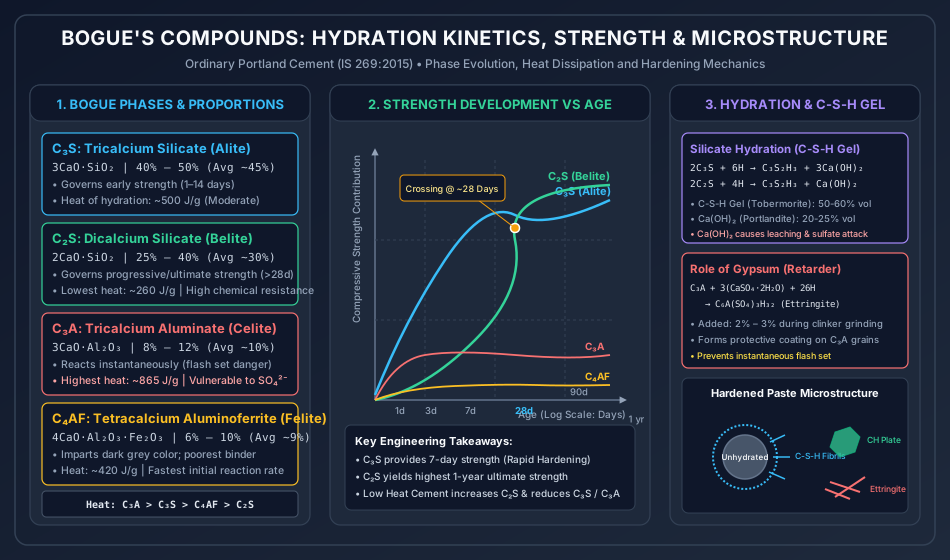
During clinkering, the four basic oxides combine into four primary crystalline mineral phases, designated as Bogue's Compounds (after R. H. Bogue, 1929).
4.1 Bogue's Empirical Equations
Assuming chemical equilibrium and stoichiometric crystallization:
Phase Summary:
• C3S (Alite): 40 - 50% (Governs 1-14 day early strength; moderate heat ~500 J/g)
• C2S (Belite): 25 - 40% (Governs ultimate strength >28 days; low heat ~260 J/g)
• C3A (Celite): 8 - 12% (Flash set danger; highest heat ~865 J/g; sulfate susceptible)
• C4AF (Felite): 6 - 10% (Fastest initial reaction; imparts dark color; lowest strength contribution)
4.2 Hydration Reactions of Silicates
The hydraulic hardening of concrete is governed primarily by the hydration of and :
-
Hydration of Tricalcium Silicate ():
-
Hydration of Dicalcium Silicate ():
4.3 Structural Composition of Hydrated Cement Paste (hcp)
- Calcium Silicate Hydrate (C-S-H Gel / Tobermorite Gel):
- Comprises of the solid volume of hydrated cement paste.
- Amorphous to poorly crystalline colloidal gel with an extremely high specific surface area ().
- Possesses rigid van der Waals bonds across interlayer spaces ( gel pores), acting as the primary glue giving concrete its compressive strength.
- Calcium Hydroxide (, Portlandite / CH):
- Comprises of paste volume.
- Forms large, hexagonal prism/platelet crystals.
- Maintains a highly alkaline pore water (passivating embedded steel reinforcement against corrosion).
- Engineering Vulnerability: Easily soluble in water and acidic media; reacts with sulfates to cause destructive expansion (gypsum and secondary ettringite formation).
- Calcium Aluminate / Sulfoaluminate Hydrates:
- Comprises of paste volume (Ettringite and Monosulfate).
4.4 Hydration of Aluminates & Gypsum Action (Flash Set Prevention)
In the absence of gypsum, reacts violently with water within minutes, releasing intense heat and precipitating crystalline calcium aluminate hydrates that lock the paste permanently into an unworkable, low-strength mass:
To control this, Gypsum () is interground with clinker. Gypsum dissolves, reacting with and hydroxyl ions to precipitate insoluble, needle-shaped crystals of Ettringite on the surfaces of grains:
This impermeable ettringite barrier retards further hydration of , granting of workable plasticity. Once sulfate ions in pore water are depleted, remaining reacts with ettringite to form stable Monosulfate Hydrate:
4.5 Kinetic & Heat Comparison
- Rate of Hydration (First 24 Hours):
- Total Heat of Hydration (Enthalpy):
- Compressive Strength Contribution:
- Early (1 to 7 days): Dominated by .
- 28 Days: and contribute roughly equally.
- Long Term ( days to 1 year): surpasses in ultimate density and strength.
5. Physical & Mechanical Testing of Cement (IS 4031 & IS 269)
5.1 Field Tests (Rapid Qualitative Verification)
- Color Check: Uniform greenish-grey color. Brownish shades indicate excess clay or under-burning.
- Physical Feel: Smooth and velvety when rubbed between fingers; zero gritty sensation.
- Presence of Lumps: Free of visible air-set lumps. Lumps indicate atmospheric moisture absorption.
- Temperature (Sink Test): Thrusting hand deep into a cement sack must feel distinctly cool.
- Floatation / Setting Test: A small handful tossed on water should float momentarily before sinking, not plunge instantly. A stiff cake ( dia, thick) immersed under water for 24 hours must set hard without distortion or cracking.
5.2 Laboratory Test 1: Fineness (IS 4031 Part 1 & Part 2)
Fineness dictates the specific surface area available for hydration, accelerating dissolution kinetics, early strength gain, and workability demand.
-
Dry Sieve Method (IS 4031 Part 1):
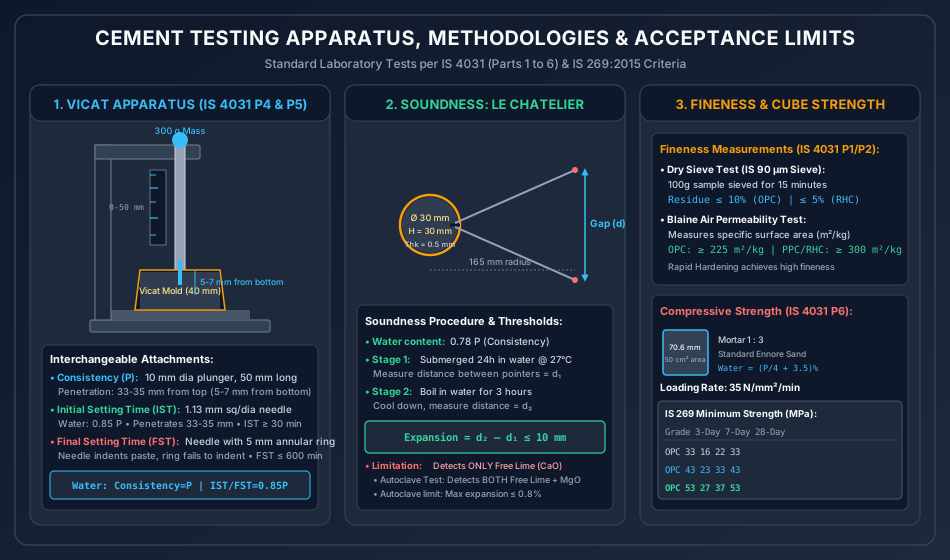
- of aerated cement is sieved through a standard (IS Sieve No. 9) continuously for .
- Permissible Residue on Sieve by Mass:
- OPC (33, 43, 53 Grades):
- Rapid Hardening Cement (RHC):
- Portland Pozzolana Cement (PPC):
-
Blaine Air Permeability Method (IS 4031 Part 2):
- Measures specific surface area () based on the resistance offered to air laminar flow through a compacted cement bed of known porosity () via the Kozeny-Carman Equation: Where is apparatus constant, is cement density (), is manometer drop time, and is air dynamic viscosity.
- Comparative calibration against reference standard cement ():
- IS 269:2015 Minimum Specific Surface Thresholds:
- OPC (all grades): ()
- PPC and PSC:
- Rapid Hardening Cement:
- Super Fine Cement:
5.3 Laboratory Test 2: Standard Consistency () (IS 4031 Part 4)
Standard consistency is the water percentage () by mass of dry cement required to prepare a paste that permits the standard Vicat plunger to penetrate to a specified depth.
- Apparatus: Vicat Apparatus with frame, movable rod, and non-porous plate.
- Attachment: Smooth cylindrical brass plunger of diameter and length.
- Vicat Mold: Truncated cone / split ring of diameter and height.
- Standard Endpoint: Plunger penetrates to a depth of from the top of the mold (i.e., from the bottom).
- Typical Range: for standard OPC.
- Reference Baseline: All subsequent setting, soundness, and strength test water quantities are expressed as linear functions of .
5.4 Laboratory Test 3: Setting Times (IS 4031 Part 5)
Conducted on neat cement paste at standard laboratory temperature () and relative humidity ().
- Water Quantity: Paste mixed with water by mass.
- Initial Setting Time (IST):
- Time elapsed from adding water until the square / circular needle penetrates to from top ( from bottom).
- Identifies the window available for mixing, transporting, placing, and compacting concrete without loss of plasticity.
- IS 269 Requirement: (for OPC, PPC, PSC, RHC); for Quick Setting Cement.
- Final Setting Time (FST):
- Attachment changed to needle fitted with a annular metal collar.
- Final set is reached when the central needle makes an impression on the paste surface, but the annular collar fails to leave an impression.
- Marks transition to rigid structural hardness.
- IS 269 Requirement: () for OPC, PPC, PSC; for Quick Setting Cement.
5.5 Laboratory Test 4: Soundness (IS 4031 Part 3)
Soundness measures the ability of hardened cement paste to retain its dimensional volume without destructive post-hardening expansion caused by slow hydration of uncombined free lime () or periclase magnesia ().
-
Le Chatelier Test (Free Lime Soundness):
- Mold: Split brass cylinder of internal diameter, height, and wall thickness, with two indicator needles long from the cylinder center.
- Water Content: Paste prepared with water.
- Procedure: Mold filled, covered with glass plates, submerged in water at for 24 hours. Distance between pointer tips measured (). Mold submerged in water, brought to boiling in , and boiled continuously for . Mold removed, cooled to , pointer distance measured ().
- Expansion: .
- IS 269 Statutory Limit: for OPC, PPC, PSC, RHC; for High Alumina / Super Sulphated.
- Critical Blind Spot: Le Chatelier test detects only Free Lime expansion; it does not detect Magnesia expansion because hydrates extremely slowly at boiling temperature.
-
Autoclave Test (Free Lime + Magnesia Soundness):
- neat cement prisms cured for 24 hours.
- Prisms heated in high-pressure steam autoclave at () and for .
- Rapidly accelerates hydration of both crystalline and into and .
- IS 269 Statutory Limit: of original gauge length. Mandatory when .
5.6 Laboratory Test 5: Compressive Strength (IS 4031 Part 6)
Neat cement shrinks excessively and exhibits high variability; compressive strength is therefore determined on standard mortar cubes.
- Cube Dimensions: (giving a standard face contact area of ).
- Mortar Proportions: by mass ( cement standard sand per single cube; cement sand for batch of 3 cubes).
- Standard Sand: High-purity silica sand conforming to IS 650 (Ennore Sand, Tamil Nadu), blended in equal 1:1:1 mass parts of Grade I (), Grade II (), and Grade III ().
- Water Quantity: Calculated strictly as:
- Compaction: Compacted on standard vibrating machine at for .
- Curing & Testing: Cured in water at until testing. Tested under uniform compression at a standard loading rate of until crushing.
| Cement Grade (IS 269:2015) | 3-Day Strength (MPa) | 7-Day Strength (MPa) | 28-Day Strength (MPa) | Max 28-Day Strength (MPa) |
|---|---|---|---|---|
| OPC 33 | ||||
| OPC 43 | ||||
| OPC 53 | — |
5.7 Other Diagnostic Tests
- Tensile Strength Test (IS 4031 Part 8): Standard briquette specimens ( waist area) with mortar; water content . Minimum 3-day tensile strength , 7-day .
- Specific Gravity (IS 4031 Part 11): Determined using Le Chatelier Specific Gravity Flask with kerosene (density ) to prevent hydration. Standard OPC specific gravity (PPC , PSC ).
6. Special Cements & Industrial Classifications
Special Cements Matrix:
• Rapid Hardening (RHC): High C3S (~55-60%), very fine (≥325 m²/kg), 1-day strength = 3-day OPC
• Extra Rapid Hardening: RHC + 2% CaCl2 accelerator (place within 20 mins, high cold-weather utility)
• Low Heat Cement (LHC): High C2S, low C3S (<35%), low C3A (<6%), massive gravity dams
• Sulfate Resisting (SRPC): C3A ≤ 5%, 2C3A + C4AF ≤ 25%, marine structures & foundation soils
• Portland Pozzolana (PPC): OPC clinker + 15-35% pozzolanic fly ash, consumes leachable Ca(OH)2
• High Alumina Cement (HAC): Bauxite + limestone, CA primary phase, refractory up to 1600°C
| Cement Type | Relevant IS Code | Chemical / Phase Modification | Salient Performance Characteristics | Primary Applications |
|---|---|---|---|---|
| Rapid Hardening Cement (RHC) | IS 8041 | Increased (), reduced , ground to Blaine . | Develops 1-day strength equal to 3-day strength of OPC 33. Total heat higher. | Pre-cast elements, early formwork stripping, highway repair. |
| Extra Rapid Hardening Cement | — | RHC interground with (accelerator). | Rapid setting; must be placed within 20 min. High early heat prevents freezing. | Cold weather concreting, urgent runway repairs. Prohibited in prestressed concrete. |
| Low Heat Portland Cement (LHC) | IS 12600 | Low (), low (), high (). | 7-day heat (); 28-day heat (). | Mass concrete gravity dams, thick bridge piers, retaining walls. |
| Sulfate Resisting Cement (SRPC) | IS 12330 | , and . | Eliminates reactive aluminate phases that form expansive ettringite under attack. | Foundations in sulfate soils, coastal marine piers, sewage plants. |
| Portland Pozzolana Cement (PPC) | IS 1489 | OPC clinker siliceous/aluminous pozzolana (fly ash). | Secondary pozzolanic reaction: . Highly durable, pore-refined. | Marine structures, hydraulic dams, mass concrete, plastered masonry. |
| Portland Slag Cement (PSC) | IS 455 | OPC clinker granulated blast furnace slag (GGBS). | High chemical and chloride resistance, low heat of hydration, reduced permeability. | Marine works, water retaining structures, underground piles. |
| Quick Setting Cement | — | Aluminum sulfate added; gypsum reduced. | , . Hardens rapidly without high early strength. | Underwater grouting, repairing running water leaks in tunnels. |
| Hydrophobic Cement | IS 8043 | Clinker ground with oleic acid or stearic acid. | Forms water-repellent monomolecular film preventing deterioration during humid storage. | Humid coastal monsoon transport, remote storage sites. |
| High Alumina Cement (HAC) | IS 6452 | Ground from bauxite and limestone. Primary compound: (Monocalcium Aluminate). | Ultra-rapid strength ( at 1 day); withstands temperatures up to . | Refractory furnace linings, chemical plants. Susceptible to strength conversion loss in hot-humid air. |
| Super Sulphated Cement | IS 6909 | granulated blast furnace slag hard-burnt gypsum clinker. | Highly resistant to chemical attacks, acids, and high concentration of sulfates. | Chemical factories, sewer pipes, marine sub-structures. |
7. Building Lime & Gypsum Materials
7.1 Chemistry of Lime (The Lime Cycle)
Lime is manufactured by calcining natural calcium carbonate rocks:
-
Calcination (Burning in Kiln @ ):
Quicklime is highly caustic, unstable, and possesses high affinity for water.
-
Slaking (Hydration with Water):
Exothermic reaction produces hissing sound, boiling steam, and a volume expansion of times the quicklime volume.
-
Setting & Hardening (Carbonation via Atmospheric ):
Crucial Engineering Distinction: Fat lime hardens only in the presence of atmospheric carbon dioxide, meaning it cannot set under water or in thick unventilated walls!
7.2 Classification of Building Lime (IS 712:1984)
IS 712 categorizes building lime into six distinct statutory classes:
- Class A (Eminently Hydraulic Lime):
- Contains clay (silica and alumina).
- Sets and hardens under water or damp environments through hydraulic silicate reactions (similar to cement).
- Slakes very slowly with negligible cracking or volume increase.
- Used for structural masonry, foundation works, and marine engineering structures.
- Class B (Semi-Hydraulic Lime):
- Contains clay.
- Hardens partly by hydraulic reactions and partly by carbonation.
- Slakes within .
- Used for load-bearing brick and stone masonry mortars.
- Class C (Fat Lime / Rich Lime / White Lime / Pure Lime):
- Contains pure .
- Slakes violently within minutes, producing voluminous, velvety white paste.
- Hardens very slowly strictly via carbonation. Shrinks excessively during drying.
- Used for white-washing, plaster finishing coats, and lime-surkhi mortars.
- Class D (Magnesium / Dolomitic Lime):
- Contains .
- Slakes slowly without high heat generation.
- Used for plastering, white-washing, and soil stabilization.
- Class E (Kankar Lime):
- Manufactured by burning impure calcareous nodules (kankar) quarried from soils.
- Possesses hydraulic properties; used for rural masonry mortar.
- Class F (Siliceous Dolomitic Lime):
- Contains significant reactive silica and magnesia; used for finishing undercoats.
7.3 Gypsum Products in Construction
- Raw Gypsum: (Calcium Sulfate Dihydrate). Retarder in cement manufacturing.
- Plaster of Paris (POP): Produced by calcining gypsum at : Sets within with a slight volume expansion (), making it ideal for sharp ornamental architectural moldings and false ceilings.
- Keene's Cement: Anhydrous gypsum () calcined at with alum; produces an extremely hard, smooth, marble-like finish.
8. Solved Numerical Problem 1: Bogue Compound & Heat Calculation
Problem Statement
A certified chemical assay of an industrial Ordinary Portland Cement clinker yields the following mass percentages of oxides:
Determine:
- The percentage composition of the four major Bogue compounds ().
- The Lime Saturation Factor (LSF) and verify compliance with IS 269:2015 limits ().
- The estimated cumulative heat of hydration dissipated at 7 days and 28 days given unit compound enthalpies:
- 7 Days: , , , .
- 28 Days: , , , .
Step-by-Step Analytical Solution
Step 1: Calculation of Bogue's Compound Percentages
Using the standard Bogue equations:
-
Tetracalcium Aluminoferrite ():
-
Tricalcium Aluminate ():
-
Tricalcium Silicate ():
-
Dicalcium Silicate ():
Total Bogue Compounds:
(The remaining consists of uncombined , free , alkali sulfates, and minor impurities).
Step 2: Verification of Lime Saturation Factor (LSF)
- Numerator:
- Denominator:
- LSF Ratio:
Compliance Check: Since , the cement satisfies the statutory Lime Saturation Factor requirement of IS 269:2015.
Step 3: Cumulative Heat of Hydration Estimation
-
At 7 Days:
-
At 28 Days:
9. Solved Numerical Problem 2: Consistency & Strength Water Allocation
Problem Statement
In a quality control laboratory, a sample of 43 Grade Ordinary Portland Cement is evaluated:
- The standard consistency test conducted with a Vicat plunger yields a penetration depth of from the top with an added water content of on a dry cement sample.
- Calculate the standard consistency percentage ().
- Determine the exact volume of distilled water (in , assuming water density ) required to prepare:
- Paste for Initial and Final Setting Time tests ( dry cement).
- Paste for Le Chatelier Soundness test ( dry cement).
- Mortar mix for casting a standard batch of three compressive strength cubes as per IS 4031 Part 6.
Step-by-Step Analytical Solution
Step 1: Standard Consistency ()
The penetration depth of falls within the standard specification of from the top of the Vicat mold.
Step 2: Water Required for Setting Time Tests
Per IS 4031 Part 5, the water proportion required is :
For of dry cement:
Step 3: Water Required for Le Chatelier Soundness Test
Per IS 4031 Part 3, the water proportion required is :
For of dry cement:
Step 4: Water Required for Compressive Strength Mortar Cubes
Per IS 4031 (Part 6):1988 (Reaffirmed 2019) Clause 5.1, each standard mortar cube ( face area) is gauged individually using cement and standard Ennore sand ( dry mix per cube, or cement sand for 3 cubes) with water content of combined dry mass for standard Ennore sand compacted on a vibration machine ( or for 3 cubes).
In legacy multi-cube laboratory batching (and older examination keys using ordinary sand factor and cement per cube):
- Mass of Cement (3-cube batch):
- Mass of Standard Sand (1:3 mix): (comprising each of Grade I, II, and III).
- Total Combined Mass of Dry Material:
- Water Content with Factor:
(Note: In GATE / ESE / AE examinations, use with cement standard Ennore sand per cube per IS 4031 (Part 6):1988 unless the question explicitly specifies or a batch).
10. Solved Numerical Problem 3: Blaine Specific Surface & Permeability Kinetics
Problem Statement
An air permeability test using a standardized Blaine apparatus is conducted to evaluate the fineness of a Rapid Hardening Portland Cement sample per IS 4031 Part 2.
- The apparatus was calibrated using a certified standard reference cement having:
- Specific surface area:
- Grain density:
- Bed porosity:
- Measured manometer time interval: at
- The test cement is packed into the permeability cell at the same bed volume and identical porosity () and tested at the same ambient temperature ():
- Grain density of test cement:
- Measured manometer time interval:
Calculate:
- The specific surface area () of the test cement in .
- Check whether the cement conforms to the statutory fineness criterion for Rapid Hardening Cement per IS 8041 ().
- If the test cement had been tested at a slightly higher porosity with an observed flow time , compute the adjusted specific surface area.
Step-by-Step Analytical Solution
Step 1: General Blaine Calibration Formula
The general Kozeny-Carman relationship relating specific surface to flow time , bed porosity , and density is:
When the test cement and reference standard cement are tested at the same porosity () and same ambient temperature (), the porosity and viscosity terms cancel:
Step 2: Computation of Specific Surface Area
Substituting the given experimental parameters:
- Density ratio:
- Square root of time ratio:
- Specific Surface:
Step 3: Statutory Conformance Check
- Standard requirement for Rapid Hardening Cement (IS 8041): .
- Conformance: The measured fineness of substantially exceeds , successfully passing the statutory specification.
Step 4: Calculation at Varying Porosity ()
When porosity differs between sample and standard, the full porosity function must be evaluated:
- For standard reference cement ():
- For sample at :
The adjusted specific surface formula is:
11. Common Misconceptions, Pitfalls & Field Traps
-
Flash Set vs. False Set:
- Flash Set: Caused by insufficient gypsum. reacts violently with water, generating high heat of hydration. Plasticity cannot be regained by remixing or adding water; the mix is ruined.
- False Set (Early Stiffening): Caused by excessive clinker grinding temperatures (), which dehydrates gypsum into hemihydrate (plaster of Paris, ). Upon mixing with water, the hemihydrate rapidly precipitates needle-like secondary gypsum crystals, stiffening the paste within 1-5 minutes with no significant heat generation. Plasticity can be completely restored by vigorous remixing without adding extra water.
-
Soundness Test Limitation Trap:
- The Trap: Assuming that passing the Le Chatelier test guarantees complete dimensional stability against all expansion.
- The Reality: Le Chatelier test detects only Free Lime (). Free Magnesia () takes months to years to hydrate into with massive expansion, and will not register in a 3-hour boil test. Only the Autoclave Test (, ) detects magnesia unsoundness.
-
Fineness vs. Ultimate Strength:
- The Trap: Assuming that grinding cement finer increases its 1-year ultimate compressive strength.
- The Reality: Finer grinding accelerates early hydration rates (), but has virtually zero impact on the 1-year ultimate strength (which is governed by the total percentage of and water-cement ratio). In fact, excessively fine cement exhibits higher drying shrinkage, greater cracking tendency, and higher vulnerability to pre-hydration during storage.
-
Contribution to Strength:
- The Trap: Conflating rapid reaction rate with high structural strength.
- The Reality: reacts fastest and produces the most heat, but its hydration products contribute virtually negligible compressive strength beyond the first 24 hours.
-
Storage Aeration & Loss on Ignition (LOI):
- Cement stored in damp warehouses absorbs moisture and atmospheric . Pre-hydrated clinker grains form inert surface coatings, delaying setting and cutting 28-day strength by after 3 months and up to after 12 months. Any cement exhibiting must be rejected per IS 269.
12. Multi-Exam Comparative Summary & High-Yield Facts Table
| Parameter / Question Theme | GATE CE Focus | UPSC ESE Focus | SSC JE / State AE Focus | RRB JE Focus |
|---|---|---|---|---|
| Bogue Formula & Calculations | Numerical calculation of from raw oxides; LSF limits. | Oxide ranges; role of fluxes; mineralogical phase balance. | Direct percentages of phases; phase responsible for early/late strength. | Sequence of phases: early, ultimate strength. |
| Rate of Reaction vs Heat | Derivation of heat kinetics; activation energy of hydration. | Enthalpy values (). | Direct ordering: Heat (). | Fastest hydrating compound ( rate, heat). |
| Vicat Apparatus Dimensions | Plunger , mold height , needle . | Penetration depths: from top ( from bottom). | Mass of movable rod (); IST , FST . | Needle shape; FST needle with annular ring (). |
| Water Content Formulas | Derivations linked to standard consistency . | Mortar cube: ; Briquette: . | IST/FST: ; Soundness: ; Consistency: . | Numeric direct formula matching. |
| Soundness Specifications | Physical chemistry of delayed expansion. | Difference between Le Chatelier ( only) and Autoclave (). | Le Chatelier pointer length: ; max expansion ; Autoclave . | Indicator arm length (); allowable limit (). |
| Fineness Limits | Blaine air permeability calibration via Kozeny-Carman. | Specific surface thresholds (OPC , PPC/RHC ). | Sieve residue on sieve: OPC , RHC/PPC . | Sieve number: IS No. 9 (). |
| Special Cements | SRPC limit; LHC for mass concrete dams. | High Alumina refractory phase (); Extra Rapid hardening (). | Quick Setting Cement (, ). | Cement used for underwater works (Quick setting). |
| Building Lime (IS 712) | Hydraulic reaction of Class A lime under water. | Classes A through F; clay contents ( vs ). | Fat lime cannot set under water (hardens by carbonation). | Lime used for white-washing (Class C / Fat lime). |
13. Comprehensive Glossary of Technical Terms
- Alite (): Tricalcium silicate phase in clinker; crystal form that provides rapid hardening and 1-to-14 day compressive strength.
- Belite (): Dicalcium silicate phase in clinker; slow-hydrating compound that generates minimal heat and contributes ultimate long-term strength.
- C-S-H Gel (Tobermorite Gel): Amorphous calcium silicate hydrate (); the principal nanostructural binding phase of hardened Portland cement paste.
- Portlandite (): Crystalline calcium hydroxide () byproduct of silicate hydration; maintains high pH () for steel passivation but is vulnerable to leaching and sulfate attack.
- Ettringite (): Calcium trisulfoaluminate hydrate; prismatic needle-like crystal formed by reaction of with gypsum to prevent flash setting.
- Flash Set: Instantaneous, irreversible stiffening of cement paste accompanied by intense heat dissipation, caused by hydration of unhindered .
- False Set: Premature temporary stiffening of paste within minutes without high heat release, caused by hydration of dehydrated gypsum (hemihydrate); plastic state fully restored by remixing.
- Standard Consistency (): Water content (percentage of dry cement mass) yielding a standard paste penetration of from the top in a Vicat mold using a plunger.
- Lime Saturation Factor (LSF): Molar ratio of available to combined acidic oxides (); must fall between and .
- Soundness: The ability of hardened cement paste to retain its original volume without destructive expansion caused by free lime or magnesia.
- Specific Surface Area: Total surface area per unit mass ( or ), typically measured by the Blaine air permeability apparatus.
- Fat Lime (Rich / Pure Lime): Highly pure lime (Class C, ) that slakes vigorously and hardens exclusively through atmospheric carbonation.
- Hydraulic Lime (Class A): Lime containing clay that sets and hardens under water through hydraulic silicate crystallization.
14. References & Standard Codes
- Bureau of Indian Standards (BIS):
- IS 269:2015 — Ordinary Portland Cement — Specification (Sixth Revision).
- IS 4031 (Parts 1 to 15) — Methods of Physical Tests for Hydraulic Cement.
- IS 712:1984 — Specification for Building Lime (Third Revision).
- IS 8041:1990 — Specification for Rapid Hardening Portland Cement.
- IS 12330:1988 — Specification for Sulphate Resisting Portland Cement.
- IS 1489 (Part 1):2015 — Portland Pozzolana Cement Specification.
- Neville, A. M. (2011). Properties of Concrete (5th Edition). Pearson Education.
- Shetty, M. S., & Jain, A. K. (2019). Concrete Technology: Theory and Practice (8th Edition). S. Chand Publishing.
- Mehta, P. K., & Monteiro, P. J. M. (2014). Concrete: Microstructure, Properties, and Materials (4th Edition). McGraw-Hill Education.